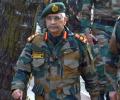
On the first day of his two-day visit to Ladakh, Gen Naravane held a series of meetings with top commanders about the evolving situation in the region as well as on India's overall combat readiness to deal with any eventualities, military sources said.
Pakistan's western front continues to remain unstable and it fishing in troubled waters of Afghanistan is going to come and bite it in the future, Army Chief General M M Naravane said on Thursday.
....a long-term boundary agreement is reached between the two countries.
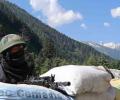
The Army Chief was in Ladakh on a two-day visit from June 23 to take stock of the situation.

Gen K M Cariappa was the first Indian Army chief to be decorated with the title in 1950.
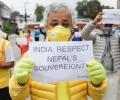
His visit comes ahead of the upcoming official trip of Indian Army chief Gen M M Naravane to Nepal in the first week of November. Goel called on Prime Minister Oli at his official residence at Baluwatar on Wednesday evening, the premier's press advisor Surya Thapa told PTI.

Indian Army has taken the initiative to induct women in rank and file, and the first batch of 100 women soldiers is undergoing training at Corps of Military Police Centre and School, he said.
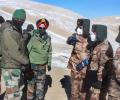
Indian Army Chief General M M Naravane had said on Wednesday that India was hopeful of resolving issues related to disengagement at Patrolling Point 15 (Hot Springs) in eastern Ladakh in the 14th round of talks.
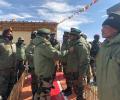
Gen Naravane awarded Commendation Cards to a number of soldiers who fought valiantly during the recent face-offs with Chinese Army.

After a gap of over two-and-half months, India and China on Sunday held the ninth round of military talks specifically focusing on ways to move forward on the long-negotiated disengagement process in eastern Ladakh as thousands of their troops remained deployed at friction points under freezing conditions.
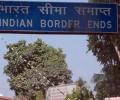
"This unilateral act is not based on historical facts and evidence. It is contrary to the bilateral understanding to resolve the outstanding boundary issues through diplomatic dialogue," External Affairs Ministry Spokesperson Anurag Srivastava said.
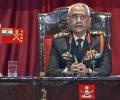
Army chief General M M Naravane on Tuesday hoped for an amicable resolution of the military standoff with China in Ladakh through talks based on 'mutual and equal security' even as he said India will have to be prepared to deal with a 'two-front' threat scenario due to the potent and collusive threat from China and Pakistan.

Lt Gen PGK Menon, the commander of the Leh-based 14 Corps, popularly known as 'Fire and Fury' Corps, briefed the army chief on various aspects of the situation in eastern Ladakh.

He said if the Chinese military maintains the deployment through the second winter, it may lead to an LoC-like situation (Line of Control) though not an active LoC as is there on the western front with Pakistan.

"When we have something to share, we will share. Discussions are ongoing," External Affairs Ministry Spokesperson Anurag Srivastava said replying to a volley of questions on whether India and China are working on specific proposals to resolve the over six-month-long row in eastern Ladakh.

They said the Indian Army has further bolstered its presence around the Southern Bank area of Pangong lake by deploying additional troops and bringing in more weaponry including tanks and anti tank guided missiles.
Gen Naravane reviewed the overall security situation in the region with Northern Army Commander Lt Gen Yogesh Kumar Joshi, commander of the 14 Corps Lt Gen Harinder Singh and other senior Army officials.

The PM will pay homage to fallen soldiers at the newly-built National War Memorial in New Delhi on the Republic Day instead of Amar Jawan Jyoti beneath the India Gate arch.

In a statement, the Indian Army said the face-off was resolved by local commanders as per established protocols. The incident at Naku La became public on Monday hours after senior commanders of both the armies concluded a nearly 16-hour-long meeting in an attempt to defuse tension in eastern Ladakh.
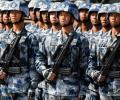
Chinese military has also deployed a sizeable number of its troops in Galwan Valley, the site of the violent clashes on June 15 that left 20 Indian soldiers dead.

The Chief of the Army Staff interacted with almost all the injured soldiers and complimented them for their bravery.

The Army chief said the nation is passing through a challenging period.
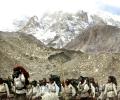
The Indian Army will continue to maintain its aggressive posturing in all disputed areas in eastern Ladakh and will not back off till status quo is maintained, sources said.
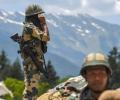
Gen Naravane said India is dealing with China in a "firm" and "non-escalatory" manner to ensure the sanctity of its claims in eastern Ladakh, and that it was even open to initiating confidence-building measures.
The commanders will also deliberate on the overall situation in Jammu and Kashmir besides delving into issues having national security implications, they said. However, the main focus will be on the situation in eastern Ladakh where Indian and Chinese troops are locked in an eyeball-to-eyeball face-off in Pangong Tso, Galwan Valley, Demchok and Daulat Beg Oldie, the sources said.

In an address to the air warriors on the occasion of the 89th Air Force Day, the Chief of Air Staff also said that the IAF must demonstrate to the nation that external forces will not be allowed to violate its territory.
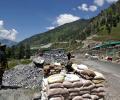
The meeting was attended by National Security Advisor Ajit Doval, Chief of Defence Staff General Bipin Rawat, Army Chief General M M Naravane, Navy Chief Admiral Karambir Singh and Indian Air Force Chief Air Chief Marshal R K S Bhadauria.

The Chief of Army Staff is scheduled to hold extensive talks with the top civilian and military brass of Nepal including his counterpart General Purna Chandra Thapa on a range of key issues such as further boosting the management of the nearly 1,800 km-long border between the two countries.
The sources also said another round of military talks between the two sides on Wednesday to defuse tensions in the area remained inconclusive. The talks lasted nearly seven hours.

Shringla began his two-day official visit to Nepal on Thursday. He was accorded a warm welcome on his maiden visit to Nepal which is happening at the invitation of Nepal Foreign Secretary Paudyal, amid a strain in bilateral ties following a bitter border row between the two countries.

Singh said if there is an attempt to hurt the self-respect of India, then it will not be tolerated and will be given a 'befitting reply'. "Whatever progress has been made in the talks, there should be a resolution of the matter. But to what extent it will be resolved, I cannot guarantee."
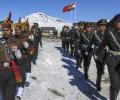
The decision to disengage the forces, locked in a bitter standoff for the last six weeks in eastern Ladakh, was taken at a nearly 11-hour-long meeting between senior Indian and Chinese commanders in Moldo on the Chinese side of the Line of Actual Control (LAC) on Monday.

Army chief General Naravane said the ongoing dialogue will sort out all the perceived differences between the two countries.
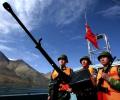
The Chinese side has particularly bolstered its presence in the Galwan Valley, erecting around 100 tents in the last two weeks and bringing in heavy equipment for construction of bunkers, notwithstanding the stiff protest by Indian troops. There have been reports of multiple incidents of transgressions by Chinese troops in several areas in Eastern Ladakh.
India's top military and strategic brass on Tuesday reviewed the overall situation in eastern Ladakh amid indications that the latest round of talks between senior military commanders of Indian and Chinese armies on the next phase of disengagement of troops may not have produced encouraging results, people familiar with the developments said.

Easy availability of drones has increased the complexity of security challenges and the Indian military is developing capabilities to effectively deal with the threats, be it from State-sponsored elements or by states themselves, Army Chief Gen M M Naravane said on Thursday.
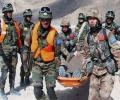
This is the first such incident along the border with China that Indian armed forces personnel have been killed after a gap of nearly 45 years.

The MEA spokesperson further said the actions and behaviour of the Chinese side since earlier this year along the LAC have been in "clear violation" of the bilateral agreements and protocols concluded between the two countries to ensure peace and tranquility on the border.
Indian military sources said no firearms were used in the clashes and that most of the injuries were sustained following stone-pelting and use of rods by the Chinese side.
'The Indian government wakes up after the fact when it can do nothing, or rather lacks the will to prosecute military actions to reverse these adverse PLA-driven developments.'
 © 2026 Rediff.com - Advertise with us - Disclaimer - Privacy Policy - Sitemap - Feedback - About us - Terms of use - Grievances