
No theory would ever justify the public humiliation of the acting head of the consulate of a friendly country. Whatever be the eventual solution, grievous damage has been done to her personally and to the relations between the two countries, says Ambassador T P Sreenivasan.

'By his very presence in Delhi on Republic Day, Obama is revisiting the most defining relationship of the 20th century after a period of stagnation,' says Ambassador T P Sreenivasan.

It is unconscionable to choose between Sardar Patel, who united India physically, and Indira Gandhi, who gave meaning, content and pride to the unity of the nation and became a martyr at the altar of national unity, says Ambassador T P Sreenivasan.

'Modi's promise of change during the election campaign was on the domestic front, but his first year in office focused on foreign policy beyond all expectations,' says Ambassador T P Sreenivasan.

'I am doing all this for the students of Kerala, and when they come and hit me, it is very frustrating.' 'My regret is that something that could set off for the future has been thwarted.' 'We have not changed the syllabus for decades, we have not accepted norms in education and technology is hardly used. Today's students are studying what I studied decades ago.'

'Ne Win kept good relations with the Nehru family even though he did nothing to do business with India. When Indira Gandhi was assassinated, Ne Win took off to an undisclosed destination, leading to rumours that he had gone to India. But we had no knowledge of his visit and days later, we were told that he was so struck with grief that he went into meditation on an island.' Ambassador T P Sreenivasan delves into Rajiv Bhatia's new book on mysterious Myanmar.

The world is still figuring out the man as he continues his enigmatic journey towards the first 100 days of his presidency.

As India gears up to honour its pravasis on January 9 to mark their contribution in the nation's development, rediff.com presents perspectives from eminent writers on the Diaspora. Kicking off the series is Ambassador T P Sreenivasan, who points out that the change of the Diaspora policy put in place by Rajiv Gandhi following the military coup in Fiji and his decision to stand by them, was the one defining moment in India's dealings with its overseas family.

Aziz Haniffa, who has covered every Indian Prime Minister's visit to the US since Rajiv Gandhi in 1985, gives us a peek into what's happening in Washington, DC on the eve of the Modi-Trump summit.

Sushma Swaraj, like Clinton, has a strong political base in her own party and is likely to have her imprint on foreign policy, says Ambassador T P Sreenivasan.

On Monday, soon after the election results were out, Ambassador T P Sreenivasan contributed a column to Rediff.com, 'Lessons for Shashi Tharoor from diminished victory', to which the newly re-elected MP from Thiruvananthapuram responds.

T P Sreenivasan was India's high commissioner in Fiji in 1987, when Sitiveni Rabuka toppled the Indian-dominated government there. Ambassador Sreenivasan stayed on for two years after the coup, fighting for the rights of the people of Indian origin before he was expelled by Rabuka. 'Meeting Sitiveni Rabuka, who had overthrown a democratically elected government, discriminated against the Fiji Indians, brought untold humiliation and suffering to them, tried to disenfranchise them, ordered me out of Fiji and closed down the Indian high commission was a difficult decision to take even after 25 years,' notes Ambassador Sreenivasan who eventually caught up with Rabuka over a game of golf.

'In the past the US has been reluctant to name Pakistan directly in an US-India joint statement.'

'I was a very late child of my father. I was suddenly a little toy, who appeared from nowhere. Everybody experimented.' 'I don't know why I took up dancing. I think I wanted to find one more excuse to drop out from school.' Kamal Haasan gives us beautiful nuggets from his life.
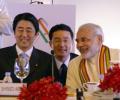
'Both nations have a common problem: A rampaging, jingoistic and hostile China which is making substantial territorial claims. In the long run, Japan and India are going to be the victims of Chinese aggression -- so they might as well hang together to contain China,' argues Rajeev Srinivasan.
 © 2026 Rediff.com - Investor Information - Advertise with us - Disclaimer - Privacy Policy - Sitemap - Feedback - About us - Terms of use - Grievances