
India's economy experienced a growth of 7.8 per cent during the October-December quarter of 2025-26, according to the new series of national accounts with 2022-23 as the base year.

'My concern is that, although everything is expressed in monetary terms, you are effectively combining values that have been adjusted using different price measures.'

The exchange rate of the rupee against the dollar may delay the economy's rise to become the fourth-largest.

The Indian economy is likely to grow at 7.4 per cent in 2025-26, up from 6.5 per cent in the previous fiscal, mainly on account of better performance of manufacturing and services sectors, as per the government data released on Wednesday.

India is the second-most-preferred destination among chief executive officers planning international investments - up from the fifth spot last year, according to PwC's 29th Annual Global CEO Survey released on Tuesday. The United States is their first choice.

The IMF on Monday raised India's growth projection to 7.3 per cent for fiscal 2025-26, up 0.7 percentage point from its October forecast, on the back of better-than-expected performance of the economy. The Washington-headquartered multilateral lending agency has also revised India's Gross Domestic Product (GDP) growth forecast to 6.4 per cent for fiscal year 2026-27 beginning April 1, 2026, from its earlier estimate of 6.2 per cent.

The Union Budget for 2026-27, presented by Finance Minister (FM) Nirmala Sitharaman on Sunday, which was a first, had an excellent domestic macro backdrop. According to the first advance estimates, gross domestic product (GDP) in constant prices is projected to grow 7.4 per cent in the current financial year, against 6.5 per cent in 2024-25.

Supported by strong buoyancy in public sector capital expenditure (capex), growth in infrastructure investment is expected to accelerate in 2025-26 (FY26) compared to 2024-25 (FY25), according to the First Advance Estimates of gross domestic product (GDP) for FY26 released by the National Statistics Office (NSO) on Wednesday.

Releasing the first advanced estimate, Union Agriculture Minister Shivraj Singh Chouhan said that though excessive rainfall affected crops in some areas of the country, most parts have benefited significantly from a good monsoon, leading to overall good crop growth.

The key question is how much of the latest growth record represents recovery from the 2020-2021 downturn, and what is the sustainable growth rate now, asks T N Ninan.

This would be due to early monsoon onset, abundant precipitation in the soil and the government's higher minimum support price (MSP) for farmers, the USDA said in its assessment.

India's mango exports to the US are registering healthy growth, and irradiation operations at a key mango treatment facility in Mumbai have been normalised after a brief disruption due to a data recording error earlier this month, an official said on Tuesday. The Mumbai-based irradiation facility, which handles the highest volume of mangoes destined for the US, faced an issue during the irradiation process conducted on May 8 and 9, 2025.

India's economic growth slowed to 7.4 per cent in the March quarter, bringing down the annual growth rate to 6.5 per cent during 2024-25, according to official data released on Friday. The growth in the January-March period was lower than the 8.4 per cent expansion in the year-ago quarter.

Unlike the Advance Estimates which missed the impact of demonetisation, CEA's survey is likely to have a better take on Indian economy.
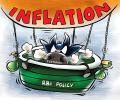
The Reserve Bank on Wednesday lowered the inflation projection for the current fiscal to 4 per cent from 4.2 per cent earlier, taking into account good agricultural output and falling crude prices.

ISRO has projected wheat production of 122.24 million tonnes.

India's economic growth rate is estimated to slip to a four-year low of 6.4 per cent in 2024-25, mainly on account of poor showing by the manufacturing and services sector, according to government data released on Tuesday. The gross domestic product (GDP) rate of 6.4 per cent will be the lowest since the Covid year (2020-21) when the country witnessed a negative growth of 5.8 per cent.

India's economic growth rate decelerated to 6.2 per cent in the October-December quarter this fiscal, mainly due to poor performance by mining, manufacturing and all other sectors, with the exception of agriculture. However, on a sequential basis, the economic growth rate in the third quarter showed improvement over 5.6 per cent recorded in the second quarter.
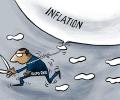
'As the Budget has taken some measures to spur growth, similar action from the MPC may be expected.'

Retail inflation dipped marginally to a nearly six-year low of 3.34 per cent in March due to a decline in prices of vegetables and protein-rich items. The Consumer Price Index (CPI) based inflation was 3.61 per cent in February and 4.85 per cent in March last year.

After declining to a three-year low in FY24, the private sector investment is expected to fall further in the current financial year, India Ratings said in a research note.. The investments in the private sector are likely to plummet to below 11 per cent of the GDP in FY25, based on the trends from the latest national accounts data and company fillings, it noted.

India Ratings on Thursday said that any broad-based or strong recovery in corporate capital expenditure was unlikely in the upcoming financial year 2026 (FY26) due to uncertainty of domestic and external demand. The uncertainty is adversely affecting the overall corporate sector capex. Interest rates on credit are not the primary deterrent to decisions about capital expenditure, said Soumyajit Niyogi, director, core analytical group, Ind-Ra, in a webinar on the credit market outlook.

Headline growth was quite weak heading into the Covid period but averaged 6.4 per cent and 6.7 per cent in the five years between FY16 and FY20 for GVA and GDP respectively, points out Abhishek Upadhyay.
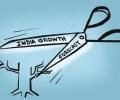
The GDP growth is expected to be about 6.3 per cent in the current fiscal year, a tad lower than the government's estimate of 6.4 per cent, owing to several factors such as weak demand, SBI research report said on Wednesday. According to the first advance estimates (FAE) of National Income for 2024-25 released by the National Statistics Office (NSO), released on Tuesday, India's economic growth rate is estimated to slip to a four-year low of 6.4 per cent in 2024-25, because of poor showing by the manufacturing and subdued investments.

The upcoming Union Budget to be presented on February 1 is likely to assume a nominal gross domestic product (GDP) growth between 10 and 10.5 per cent for FY26, a Business Standard poll of 10 economists showed. The first advance estimates released by the National Statistics Office (NSO) had estimated a nominal GDP growth of 9.7 per cent for FY25. Nominal GDP, calculated at current market prices, factors in the effect of inflation. It is used as the base to calculate crucial macroeconomic indicators, such as fiscal deficit, revenue deficit, and debt-to-GDP ratio.

The Reserve Bank of India (RBI) is expected to cut interest rates for the first time in nearly five years in Governor Sanjay Malhotra's first monetary policy committee (MPC) meeting on Wednesday. The meeting of the six-member MPC, which will culminate on Friday, aims to boost sluggish economic growth, which is seen falling to a four-year low. Malhotra took charge as the 26th RBI governor in December last year.

Overall profitability in the agriculture sector is expected to be marginally higher at the pan-India level in the 2024-25 kharif season, driven largely by higher production and low input cost, but offset by the declining price of some produce, according to a report released by Motilal Oswal Financial Services Ltd on Wednesday. The report said that region-wise farm profitability in the northern belt was expected to be relatively better than in the southern belt, while the eastern and western belts presented a mixed bag.

The finance minister, in her Budget speech, should focus more on what she is directly responsible for, rather than on programmes where her role is largely supportive, notes Nitin Desai.

Amid low growth elsewhere, gross value added (GVA) growth in agriculture and allied activities recovered during the second quarter of the current financial year (Q2FY25) to 3.5 per cent year-on-year (Y-o-Y) due to strong monsoon. Experts feel that the rains have laid the foundation of an even better GVA performance in subsequent quarters. GVA growth in the first quarter of FY25 was 2.0 per cent.
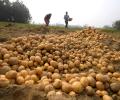
Amid the political blame game over Bengal's potato ban, which led to shortages in Jharkhand and Odisha, Uttar Pradesh farmers are the unlikely winners.

Onion and potato production is expected to be down in the 2023-24 crop year, while the tomato output could be marginally higher, the Department of Agriculture's first advance estimates of horticultural output released on Thursday showed. "Production of onion in 2023-24 is expected to be around 25.47 million tonnes compared to around 30.20 million tonnes last year due to a decrease of 3.43 million tonnes in Maharashtra, 0.99 million tonnes in Karnataka, 0.35 million tonnes in Andhra Pradesh and 0.31 million tonnes in Rajasthan," the official statement by the department of agriculture said.

After climbing to the highest level in more than five years to 4.7 million tonnes in FY24, India might import fewer quantities of pulses this financial year at 4-4.5 mt on the back of good monsoon and higher domestic production, Bimal Kothari, chairman of India Pulses and Grains Association (IPGA), said in New Delhi on Friday. Kothari was addressing reporters on the sidelines of a seminar on pulses titled "Bharat Dalhan-2024".

India's economic growth accelerated to 8.4 per cent in the third quarter of 2023-24, mainly due to good performance by the manufacturing, mining & quarrying and construction sectors. The Indian economy recorded a growth of 8.4 per cent in the third quarter of this fiscal (October-December 2023), according to data released by the National Statistical Office (NSO) on Thursday.

The economy may grow by around 7 per cent this financial year as estimated by the Monetary Policy Committee (MPC) of the Reserve Bank of India (RBI), say economists with various organisations. The first advance estimates for 2023-24 will be released on Friday by the National Statistical Organisation (NSO), an exercise done for calculating ratios such as the fiscal deficit. The interim Budget will be presented on February 1.

Updated new base years for national accounts and other macro-indicators are expected to come into effect from January-February 2026, coinciding with the first and second advance estimates of national income for FY26, senior official sources aware of the development told Business Standard. "The statistics ministry set up the Advisory Committee on National Accounts Statistics (ACNAS) earlier this week. "It will advise on the base year for GDP (gross domestic product) and its alignment with other macro-indicators.

Questions will be raised over why those changes take place and whether non-economic factors are at play, says A K Bhattacharya.
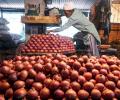
The government on Saturday lifted the ban on onion exports but imposed a minimum export price (MEP) of $550 per tonne, amid ongoing Lok Sabha elections in the country. Last night, the government imposed a 40 per cent duty on export of onions. In August last year, India had imposed a 40 per cent export duty on onions up to December 31, 2023.

Discrepancies in computation of advance estimates of the country's Gross Domestic Product for 2023-24 stood at Rs 2.59 lakh crore as against (-) Rs 3.80 lakh crore in 2022-23 and (-) Rs 4.47 lakh crore in 2021-22, according to National Statistical Office (NSO). On Friday, the NSO released its first advance estimates of national accounts which showed that the Gross Domestic Product (GDP) or Indian economy will grow at 7.3 per cent in 2023-24, slightly higher than 7.2 per cent in 2022-23.

It expects rainfall to be about 106 per cent of the long period average, aided by La Nia conditions anticipated to play a role in the second half of the monsoon season.

On the back of robust tax collection, the ratio of direct taxes to gross domestic product (GDP) this financial year is likely to be the highest in this century so far. This, along with strong goods and services tax (GST) collection, may drive up receipts from central taxes as a proportion of GDP to the highest level or close to the highest since 2008-09 despite subdued excise and customs duty receipts. This will be due also to lower nominal GDP projected in the first advance estimates for 2023-24.
 © 2026 Rediff.com - Investor Information - Advertise with us - Disclaimer - Privacy Policy - Sitemap - Feedback - About us - Terms of use - Grievances