
Industry bodies representing alcoholic beverage manufacturers have welcomed the India-UK Free Trade Agreement (FTA), which will see tariffs on UK whisky and gin reduced, boosting bilateral trade and supporting premiumisation. However, domestic manufacturers are calling for state governments to withdraw concessions currently enjoyed by imported liquor brands.

With lower GST rates taking effect, fast-moving consumer goods players face challenges in setting reduced prices for their products in round figures, but expect the magical price points to be restored within two months.

Firmly committed to prioritise national interest over all other considerations: JioStar
There remains a debate on who said this: "When the facts change, I change my mind. What do you do, Sir?" Was it the British economist John Maynard Keynes or the American economist Paul Samuelson. Irrespective of who said it, this sentiment appears to have found resonance in ITC's boardroom in recent years.

The paint sector is seeing heightened competition with the entry of deep-pocketed groups like Aditya Birla and JSW. However, some brokerages see an opportunity in select stocks.

From its recent lows, the stock of consumer major Marico is up 7 per cent on the back of a better-than-expected June quarter performance and robust outlook. In a pre-quarter update, the management indicated that domestic volume growth should witness an improvement in FY25, while other segments (growth portfolio, international business) too would see traction going ahead. The near-term trigger is strong sales and operating performance for Q1FY25.

Two young men jostle in a rickshaw as it clatters along a narrow, bustling lane of North Kolkata, each with a leg dangling over the side of the vehicle, a bulging sack of cosmetics nestled between them. The protagonists here are the founders of Emami - Radhe Shyam Agarwal and Radhe Shyam Goenka - childhood friends who gave up cushy corporate jobs to build a fast-moving consumer goods (FMCG) company. From a 200-square-foot rented space on Muktaram Babu Street in North Kolkata, brand Emami stepped into the competitive world of FMCG 50 years back, armed with just three products: Vanishing cream, talcum powder, and cold cream.

Dabur India has been the worst performer in the fast-moving consumer goods (FMCG) space this year (CY23), posting a 1 per cent decline even as its peer index, the Nifty FMCG, has delivered returns of over 29 per cent in this period.

A cocktail of heatwave and upcoming cricketing events is expected to usher in the peak season for the country's largest beer maker, United Breweries. The beer maker, which has gained share in some key markets, will be a major beneficiary as April to July is an important period contributing to 40-45 per cent of its annual beer volumes. Going ahead, the T20 Cricket World Cup in June and the ongoing IPL will have a positive impact on volumes and should be able to offset the negative impact of elections on sales, experts believe.

Hindustan Unilever's Q3FY24 performance was lacklustre, with both sales and operating profit barely moving from the year-ago period due to price cuts and higher advertising costs. Besides weak demand, the FMCG (fast-moving consumer goods) major is facing increased competitive pressures, particularly from regional players, which, coupled with a slow recovery in rural markets, could put revenues under pressure going forward. Margins are expected to remain range-bound as benefits from falling raw material costs are expected to be neutralised by rising promotional budgets.

The stock of the country's largest listed oral care company -- Colgate-Palmolive (India) Ltd is up 18 per cent over the past month. The gains were led by better than expected June quarter (Q1) performance of the 2023-24 financial year (FY24) and growth revival expectations of the oral care category. The company's volume growth is pegged at 5-8 per cent in Q1FY24. This is the second consecutive quarter of volume growth.

Analysts have given a thumbs up to the Reliance Industries (RIL) and Walt Disney Co. (Disney) proposed a joint venture (JV). The stock of the Mukesh Ambani-controlled company gained nearly 1.5 per cent on Thursday to Rs 2,952 levels as compared to the S&P BSE Sensex that traded marginally weak, down 0.2 per cent to 72,172 levels in intra-day trades.

The stock of Colgate-Palmolive (India) surged after the company delivered a better than expected operating performance for the March quarter of the 2022-23 financial year (Q4FY23) recently. The stock, however, has given up most of these gains over the last one week as the Street awaits recovery in the core toothpaste segment and sustained recovery in market share. The country's largest listed oral care company posted a gross margin expansion of 100 basis points (bps) on a sequential basis to 66.9 per cent, led by pricing and efficient sourcing.

The markets have given a thumbs down to Jubilant FoodWorks results for the April-June quarter (Q1) of 2023-24 (FY24). The company, which owns and operates Domino's Pizza and Popeyes chain of stores, reported a (standalone) net profit of Rs 75.2 crore in Q1 of FY24 - a drop of 25.5 per cent year-on-year (YoY) from Rs 101 crore, but a quarter-on-quarter (QoQ) rise from Rs 47.5 crore. What's worrying the Street is the likelihood of a dismal Q2FY24 performance, which it feels will be marred by soaring milk, cheese and vegetable prices.

While the four largest listed paint companies have seen marginal negative returns, the S&P BSE Fast Moving Consumer Goods (FMCG) and the National Stock Exchange Nifty FMCG indices have delivered a solid 16 per cent return during the same period. Initially, volume growth and reduced costs bolstered the sector's sentiment, but brokerages have grown cautious due to increased competitive pressures.

The duty hike on cigarettes by 16 per cent announced in the Union Budget 2023-24 would have a nominal impact of around 7-12 paise per stick across cigarette categories, according to experts. This upward revision in National Calamity Contingent Duty (NCCD) would have negligible impact on smokers and the companies could easily absorb the shock as it may not also have any resultant impact on margins, they said. Finance Minister Nirmala Sitharama in the Union Budget for 2023-24 on Wednesday proposed to revise and increase the duty on cigarettes to about 16 per cent.

After underperforming its peers in the consumer space in 2022-23, and experiencing a mixed bag in the 2023-24 (FY24) April-June quarter (first quarter, or Q1), brokerages are positive about the medium-term outlook for liquor stocks. Higher raw material costs, concerns regarding increased duties, regulatory changes, and competitive pressures weighed on performance returns in the past quarters. Analysts believe that the sector could experience a reversal of fortunes due to better demand and margin improvements.

Elevated food price-led inflation could become a sore point for markets, which they seem to be ignoring at current levels, observe analysts. Retail inflation in India - as measured by the Consumer Price Index (CPI) - came in at a three-month high of 6.52 per cent in January 2023, compared with 5.72 per cent in December and 5.88 per cent in November 2022. The inflation print for February, according to Madan Sabnavis, chief economist at Bank of Baroda, will be critical for the Reserve Bank of India's monetary policy committee.

The finance ministry on Thursday raised concerns over the possible impact of El Nio conditions on India this year, saying if recent forecasts came true, the country could see lower agricultural output and higher inflation. "Some meteorological agencies predict the return of El Nio conditions in India this year. "If these predictions are accurate, then monsoon rains could be deficient, leading to lower agricultural output and higher prices," the ministry said in its monthly economic review.

It may be a little early to cheer the recovery in the fast-moving consumer goods (FMCG) space as a deceleration in discretionary demand, after the festival season, may offset fragile rural recovery, analysts have cautioned. "The overall demand environment for staples remains muted, while discretionary demand trends have seen some deceleration after the festival season. "We believe margins in staples have bottomed out, but we expect only a gradual uptick with the ongoing softening in raw material prices.

Nestle's acquisition of Pfizer's infant nutrition business has an India angle to it. While Pfizer does not have its infant nutrition brands such as SMA Gold, Promil Gold, Progress Gold and Promise Gold in India yet, the threat that it could launch these products in the country was always there, thanks to its strong presence in neighbouring countries such as China, Indonesia and the Philippines.
The 2022-23 (FY23) January-March quarter performance of the country's largest listed paint companies was better than Street expectations. Asian Paints, Berger Paints, and Kansai Nerolac Paints (Kansai Nerolac) registered double-digit revenue growth, compared with the year-ago quarter, reinforced by strong volume/value growth. Falling raw material prices also helped the paint majors hoist their gross margins.

Domestic-focused agricultural chemical (agrochem) companies could face near-term headwinds, given the worries on the El Nio effect on monsoons, higher inventory, and pressure on margins. Some of these were reflected in the October-December quarter (third quarter, or Q3) results of companies and may impact them in the current quarter (fourth quarter, or Q4) as well. Nuvama Research pointed out that the sector witnessed mixed performance during the quarter as global agrochem and domestic fertiliser companies maintained growth momentum, while adverse agronomical conditions and excess channel inventory weighed on domestic market volume offtake.
Besides, the ongoing war between Russia and Ukraine has also added another blow to FMCG makers as they expect a rise in the prices of wheat, edible oil and crude. Companies such as Dabur and Parle are watching the situation and will undertake calibrated price increases to mitigate the inflationary pressures.

Leading FMCG companies in the country are expecting their sales growth numbers in high double digit in the April-June quarter, a period when the broader market was severely impacted by the second wave of the COVID-19 pandemic. FMCG companies such as Godrej Consumer Products Ltd (GCPL) and Marico, in their quarterly updates to bourses, informed about double-digit sales growth. While Tata Consumer Products Ltd (TCPL) MD and CEO Sunil D'Souza in an interview had told PTI, the Tata Group FMCG firm expects higher growth in the Q1/FY'22 over Q4/FY'21.
A hotel in 1975, entry into paperboards in 1979, India's dominant cigarette maker, ITC, read the tea - or tobacco - leaves early, leveraged its enterprise strengths and stepped up the diversification agenda to create multiple drivers of growth. Some failed, some faltered, some were transformational, adding steadily to the top line. Now those efforts are making a difference: margins from non-cigarettes - FMCG, hotels, agri, paperboards, paper and packaging - are expanding and profits are kicking in more significantly than ever before.

JSW had moved competition watchdog alleging Asian Paints threatened various dealers from dealing with the company.

Sanjiv Mehta, chairman of the country's largest consumer goods company, HUL, believes that the second wave of the Covid-19 pandemic between April and June this year has been a mere pause in India's consumption story, and that it will not change the country's overall growth trajectory. India is poised for growth, especially in the fast-moving consumer goods (FMCG) sector, Mehta told shareholders at the company's annual general meeting on Tuesday. The signs of recovery are becoming evident with many states lifting lockdown restrictions in recent weeks.

Within rural markets, the viewership share of Dangal TV, which is a free-to-air channel, is at 33%.

The bigger threat for DMart is that the Reliance-Future combine now has grocery revenues that are nearly 2.5 times of it, putting pressure on the former to improve stickiness of its consumers.

Real estate experts say rentals have corrected by 5-10 per cent across formats, including office, retail and housing, with a pick-up expected over the next few quarters as the economy recovers.

Experts are of the opinion that though the second half of this financial year will see some recovery, volume growth is likely to remain in single digit as compared to the double-digit rise recorded in past years.

A phased roll-out of prohibition will hit revenues of companies, which get 5% of their volume sales from the state

The size of the organised baby diaper market in India is Rs 5214 crore, with the year-on-year rate of growth pegged at 14%
While the American Club Cool Fresh Taste saw the minimum hike of 10 per cent, from Rs 200 to Rs 220 for a pack of 20 cigarettes, the price of Navy Cut Filter rose by about 16 per cent, at Rs 80 for a pack of 10 sticks. Flake Filter has become costlier by 14 per cent at Rs 80, while prices of Flake Special Filter, Flake Blue Special Filter and Wave Cool Mint rose by 20 per cent.
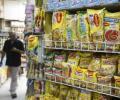
In 2019, the growth in sales of the Maggi brand of products surpassed the pre-ban level of 2014, in terms of both volume and value. While, Nestle raised prices of Maggi products by an average 3.1 per cent, its volume rose by 9.6 per cent year-on-year.

Milk products and nutrition, the largest category that contributes nearly 47.6% to the company's top line, grew 1.6%

The double-digit growth in itself is eye-popping, given the FMCG sector has seen low single-digit volume growth in recent times.

Ramping up e-commerce operations and going beyond its current strongholds are key challenges for the grocery chain in its battle with Mukesh Ambani's retail behemoth.

Experts say Biyani will now become a contract manufacturer of fashion and FMCG products, with the Reliance group being one of his customers.
