
As the rupee remains under pressure due to several headwinds and the uncertainty around the India-US trade deal, the Reserve Bank of India (RBI) has been stepping in only to calm volatility, not to stop the fall.

The Reserve Bank of India's (RBI's) short dollar forward positions rose by $6 billion in September - the first increase in seven months - indicating the central bank's readiness to defend the rupee in the forward market amid pressure on the currency, latest data showed. The net short dollar position stood at $59.4 billion at the end of September, up from $53.4 billion in August.

The Reserve Bank of India (RBI) does not target any price level on the rupee, Governor Sanjay Malhotra reiterated at an International Monetary Fund and World Bank event on Wednesday.

'I don't see 88 per dollar now.'
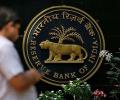
The Reserve Bank of India's (RBI's) $10 billion US dollar-rupee buy-sell swap auction for three years received bids worth $16.23 billion on Friday, reflecting robust demand amid persistent liquidity deficit in the banking system. This was the second swap auction by the central bank after it infused $5 billion via six month-swap on January 31.
The Indian rupee is likely to depreciate further against the US dollar through the end of 2024. This is due to the continued strengthening of the greenback, combined with the weakening of the Chinese yuan, which is expected to keep pressure on the Indian currency.

A potential risk to the rupee's appreciation trajectory lies in the event of a delay in the Federal Reserve's rate cut cycle, particularly if core inflation in the US remains elevated.

The Indian rupee is expected to trade between 80 and 84 against dollar in the first three months of 2023 with support from overseas inflows though worsening current account deficit (CAD) and reduced interest rate differential between the US and India pose challenges. According to a Business Standard Poll of 10 participants, most said the rupee could gain strength in January due to foreign inflows, and the Reserve Bank of India (RBI) is not expected to allow the currency to depreciate ahead of the Union Budget scheduled on February 1. The rupee depreciated 10.15 per cent in 2022, its worst performance since 2013 as the war in Europe and the interest rate increase by the US Federal Reserve prompted investors to flee emerging markets.

Surplus liquidity in the banking system as measured by absorption of excess funds by the Reserve Bank of India (RBI) fell sharply at the end of the last week due to outflows on account of advance tax payments. According to the RBI data, the net liquidity absorbed by the central bank on September 16 was at Rs 3,243.57 crore, much lower than the average of Rs 56,809.92 crore in the preceding four days of the week. The average absorption of funds by the RBI so far in September is at Rs 1.13 trillion, against the average of Rs 1.2 trillion in the previous month, the data showed.

Covid-19, US yields, dollar to weigh on equity flows in the near term.

The rupee had tumbled by 33 paise to close at 54.47 against the US currency in the previous session on Friday, due to a firm dollar overseas.

The sudden movement of the rupee - post the monetary policy - is not a reason to panic, said currency dealers. According to them, a correction was overdue for the rupee that remained the best performing currency in the region for well over a month. The rupee closed at 74.72 a dollar on Friday from its previous close of 74.60. It had dropped 1.52 per cent against the dollar on April 7 after the Reserve Bank of India (RBI) announced its monetary policy, committing to buy Rs 1 trillion of bonds in the June quarter. A weak rupee goes well with the export narrative of the government, and is consistent with the RBI's intervention strategy that prevented an appreciation.
Rs 1,000 now buys $13.5 against $14 a year ago.

The probe agency found irregularities in loans amounting Rs 3,642 crore sanctioned by Yes Bank to the travel firm.

The year 2018 is likely to be steady in terms of institutional investment into real estate

The rupee had retreated from three-week high and ended six paise down at 60.67 against the dollar on demand from importers for the US currency in Thursday's trade.

The rupee on Monday failed to maintain initial gains and ended lower by five paise at 60.21 against the dollar on fag-end demand for the US currency from banks and importers.

The rupee resumed higher at 61.57 per dollar against the previous close of 61.59 and dropped immediately to 61.70 on initial dollar demand from banks and importers.

The US stimulus programme has been credited with fuelling a global equities rally for most of the year.

Dollar sales by exporters and firm local equities also supported the local currency.

Forex dealers said strengthening of the euro against the dollar overseas and a higher opening in the domestic equity market also supported the local currency.
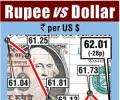
The RBI is widely expected to raise its key repo rate by 25 basis points to 8.00 per cent on Wednesday, its third such hike in four months after recent data showed both wholesale and retail inflation at multi-month highs.
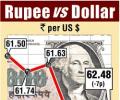
The rupee was also pressured as the euro fell for a second day on Friday, hurt by the European Central Bank's surprise interest rate cut and a downgrade to France's credit rating, while the dollar inched up before a key US jobs report.

The rupee got a boost as stock market investors cheered the Reserve Bank's steps. Fresh dollar sales by exporters amid sustained capital inflows also supported the local currency.

However, the hefty initial gains of the rupee, which had jumped to 61.05 intra-day, were substantially erased on month-end demand for US dollars from private oil firms and some defence-related purchases, amid fall in domestic stocks.

The rupee came under pressure on demand from importers as the dollar strengthened overseas.
.jpg)
In the global market, the US dollar rose against the basket currencies in early trade as US President Barack Obama called for diplomacy in dealing with alleged chemical weapons attack in Syria but kept open the possibility of military action against the Assad regime.
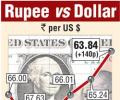
The rupee resumed higher at 64.40 a dollar from Friday's close of 65.24 and touched a low of 64.54 at the interbank foreign exchange market.

A strengthening dollar overseas also kept the rupee under pressure amid demand from importers. Goldman Sachs followed JP Morgan, HSBC and Nomura in cutting India's economic growth forecast and also said it expects the rupee to touch 72 against the dollar in the next six months.

The local currency opened higher at 61.20 a dollar from the previous close of 61.30 at the Interbank Foreign Exchange Market.
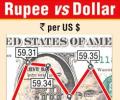
A weak dollar overseas failed to restrict the rupee's decline, a forex dealer said.

At the Interbank Foreign Exchange market, the domestic currency resumed stable at its overnight close of 60.07 a dollar and immediately touched a low of 60.09.

In dull trade, the rupee on Monday ended a mere two paise lower at 60.20 against the US dollar on weak local equities and imported-driven demand for the American currency.

While RBI may cut rates by 25 basis points in the February policy review, global monetary policies hold the key to much of the financial assets flow in 2017

Hiccups in Chinese economy and the overall strength of the dollar will continue to be a drag on the rupee in the coming year
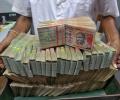
The rupee on Tuesday gained 29 paise to close at seven-month high of 60.48 against the dollar on sustained selling of the US currency by exporters and banks.
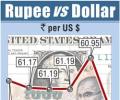
The rupee had gained 24 paise to close at nearly one-week high of 60.95 against the dollar yesterday following selling of the US currency by exporters and some banks, amid sustained heavy capital inflows.

Tracking local stocks, rupee on Tuesday regained 19 paise to end at 61.85 against dollar as reports of easing geopolitical tension between Russia and Ukraine helped emerging market currencies script a smart recovery.

The rupee on Thursday appreciated 20 paise to end at 62.37, its highest in two weeks, on positive trends in local equities and fresh dollar selling by exporters.

The rupee gained for the second day, climbing 23 paise to a one-week high of 62.07 against the dollar on Wednesday, amid a modest recovery in local stocks and sales of the US currency by exporters and banks.
 © 2026 Rediff.com - Investor Information - Advertise with us - Disclaimer - Privacy Policy - Sitemap - Feedback - About us - Terms of use - Grievances