
New Delhi remains a priggish suitor to Washington's overtures, but it has begun appreciating potential tech benefits to ties with the US.

'If you look at the relationship with Pakistan, or the relationship with China, both are today, more uncertain than they were when this government came into power.'

India must develop structured multilateralism to its defence buys

Ever pragmatic, the Americans are convinced that the future is in the Indo-Pacific.
There is a new Indo-Pacific century, and India has to decide whether it has its eyes on the prize, says Rajeev Srinivasan.

'The era of conventional wars is almost over in the Indian context.' 'In such a scenario, special forces could play a decisive strategic role in the spectrum of conflict.'
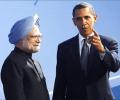
Prime Minister Manmohan Singh will meet with United States President Barack Obama at the White House next month, where the two leaders will chart a course seeking enhanced bilateral ties and defence cooperation between the two countries, US officials have said. Dr Singh will visit the White House on September 27.

There's still little indication of forward movement in Indo-US defence relations.

If the aim is to become a player with some strategic space of its own, not just in the Indian Ocean region but also in the adjoining region, then greater interaction with China is desirable, even necessary.
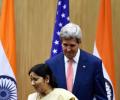
There was no breakthrough in US Secretary of State John F Kerry's India visit, but no breakdown either, says C Uday Bhaskar.
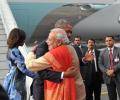
'A three generation US-Pakistan relationship is not likely to be snapped any time soon. All this presents an irritant to an India that wishes to concentrate on economic development,' says Colonel Anil A Athale (retd).

India must present its demands of America confidently, instead of fearing that its pocket will somehow be picked, says Ajai Shukla.
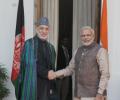
Security will be a consideration, as would protocol, but given Modi's penchant for the unconventional, it should not come as a surprise if he indeed decides to attend the ceremony in Kabul, says Ramesh Ramachandran.

Starting as a maker of hydraulic pumps, the Bengaluru-based company graduated to components for automakers like BMW and Audi, and then Airbus and Boeing
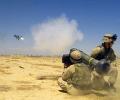
The defence ministry is finalising a decision to allow the FGM-148 Javelin missile, built by US companies Lockheed Martin and Raytheon, into a contest to supply the Indian Army with anti-tank guided missiles. This is bad news for Israelis

'India-US defence pacts are seen by many analysts as a subtle move to jointly contain China's growing militarism, especially in the strategic Indian Ocean Region.'

'Political meetings will be a mere side show; the main show is economic investment and the business partnership. The success of Modi's US visit will be judged on the basis of India's ability to attract American investment and setting up of manufacturing in India to give jobs to millions,' says Colonel Anil A Athale (retd).
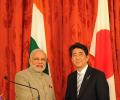
'Secretiveness and the element of surprise in announcing decisions marks the Modi style of diplomacy. From being a voluble politician, he became a reticent statesman... But the diplomatic dance is performed on thin ice and his adroitness is still to be proved,' says Ambassador T P Sreenivasan.

'It is in the interest of both sides that the visit of the US President is seen as being successful. Both sides have invested considerable political capital in it. This rapid exchange of visits and the decisions taken have to be justified, beyond the symbolism, which is no doubt important in itself. This opportunity to impart a fresh momentum to ties should not be missed,' says former foreign secretary Kanwal Sibal.

'India is no longer the India of the '70s and the '80s.' 'It's a large country with the fastest growing economy.' 'In working with India, you just can't go and humiliate the nation publicly.' USIBC President Mukesh Aghi tells Aziz Haniffa/Rediff.com about how he advises American companies to do business with India, what he thinks of Modi's government and the way forward for the India-US relationship.

'The US wants Modi to succeed because we want India to succeed. For our part, when India thinks of its partners in the world, we want it to think of the US first. That means positioning our country as the preferred provider of the key inputs that can help to propel India's rise.' 'The meeting between Modi and Obama is, and must be, an opportunity for true strategic dialogue -- not a scripted exchange of talking points, but an open discussion of the big questions. What kind of world do we want to live in? What are our true priorities? And most importantly, why does this partnership still matter?'

'Modi's investment in the relationship with Washington is the biggest deliverable of this visit. He means business and that's fantastic!'

'Our approach to India is no different from the approach that we have made in India over the years, recognising its non-aligned status. That's their decision; we're not trying to change that. We have common interests, and we have actually built on those common interests... We think there's more potential to build on those common interests.' 'Security, stability, freedom of sea lanes, economic development, energy, all those are certainly in the interest of India and the region, as they are to the United States.' The transcript of US Secretary of Defence Chuck Hagel's interaction with reporters travelling with him hours before he landed in New Delhi on Friday on a three-day visit to India.

This is the joint statement issued by the ministry of external affairs on the visit of US President Barack Obama to India.
 © 2026 Rediff.com - Investor Information - Advertise with us - Disclaimer - Privacy Policy - Sitemap - Feedback - About us - Terms of use - Grievances