
Gold is an excellent asset class for diversification and should be included in all long-term portfolios.

Brokerage firms on Wednesday appeared divided in their calls on Larsen & Toubro (L&T) after the company's 2023-24 (FY24) October-December quarter (third quarter, or Q3) performance and guidance for the quarters ahead. While few stayed optimistic about the stock over future order inflow prospects, others saw increasing exposure to West Asia and fixed price contracts as a concern. In Wednesday's trade, L&T's share price closed at Rs 3,480 per piece, 4.22 per cent down from its previous day's close.

Irregular rainfall and a pick-up in commodity costs are expected to weigh on the demand and margins of fast-moving consumer goods (FMCG) companies. Most companies reported a sharp expansion in gross margins in the April-June quarter (first quarter, or Q1) of 2023-24 (FY24), given the lower prices of key raw materials and earlier price hikes. Furthermore, there were expectations that cost savings being passed on could reflect in volume growth going forward. However, these hopes could be dashed if demand recovery, especially in the rural segment, stalls, and gains on the raw material front start to recede.

The downgraded World Bank forecast follows a similar move by the International Monetary Fund, which cut its growth forecasts two months ago

The government on Friday proposed hiking the securities transaction tax on Futures & Options (F&O) contracts, a move that will increase the trading costs in the derivatives segment as well as help in curbing excessive trades. In the Finance Bill 2023, passed by the Lok Sabha on Friday, the Securities Transaction Tax (STT) on options is proposed to be increased to 0.0625 per cent from 0.05 per cent and on futures contracts to 0.0125 from 0.01 per cent. Analysts opined that higher STT will shore up the government's revenues to some extent and also discourage excessive trading since a large number of retail traders are losing money in the segment.

Despite multiple headwinds at the start of 2023, the Indian markets delivered a strong performance, posting 19-20 per cent growth for the year. Even as new records were set, investor sentiment remains strong going into 2024, given the lower inflation, expectations of steady to lower interest rates, higher economic growth, and strong inflows. However, the overriding concern for most brokerages is valuations.

Capital markets regulator Sebi on Tuesday barred five brokerage houses for up to six months from making fresh applications seeking registration as commodity brokers as they failed to meet 'fit and proper' criteria in the NSEL case. The affected brokerage houses include India Infoline Commodities, Anand Rathi Commodities and Geofin Comtrade (banned for 6 months each), and Phillip Commodities and Motilal Oswal Commodities Broker (for 3 months each). "There were enough red flags for a reasonable person to come to conclude that what was being offered as paired contracts on NSEL were not spot contract in commodities," Sebi said in five separate orders.

After recording positive growth in September, India's exports declined 5.4 per cent to $24.82 billion in October on account of dip in shipments of petroleum products, gems and jewellery, leather, and engineering goods. Trade deficit in October narrowed to $8.78 billion as against $11.76 billion, as imports also fell 11.56 per cent to $33.6 billion during the month under review.
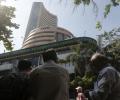
The proposal to merge the Gujarat International Finance Tec-City (GIFT City) units of the National Stock Exchange (NSE) and BSE has reached an advanced stage, and both bourses could file an application before the National Company Law Tribunal as early as this month, according to a top regulatory official. Sources indicate that the merger proposal has received approval from their respective boards. Both the NSE and BSE are arch rivals when it comes to onshore trading.

Cascading effect of rising raw materials will result in inflation, high rates, slow capex

Equity benchmark indices Sensex and Nifty on Friday reversed their six-session losing streak and rebounded more than 1 per cent on value buying in auto, IT, financial and energy stocks. Better than expected quarterly financial results of corporates also boosted investor sentiments even as uncertainties persisted over the escalating tensions in the Middle East, according to analysts. In a largely range-bound trade, the 30-share BSE Sensex rose 634.65 points or 1.01 per cent to settle at 63,782.80 points.

The medical devices, which have been in high demand during the Covid-19 pandemic, will now see a drop in prices, as the earlier margins were up to 709 per cent for some of these products.

After recording positive growth for two months in a row, India's exports dipped marginally by 0.25 per cent to $27.67 billion in February and trade deficit widened to $12.88 billion, according to preliminary data released by the government on Tuesday. Imports grew 6.98 per cent to $40.55 billion during the month, the data showed. The trade deficit stood at $10.16 billion in February 2020. Exports during April-February 2020-21 were $255.92 billion, compared with $291.87 billion during the same period of last year, exhibiting a negative growth of 12.32 per cent.

Wipro was the biggest loser among Sensex firms, sliding 2.32 per cent, followed by HDFC Bank, Power Grid, UltraTech Cement, ITC, ICICI Bank and Tata Motors. IndusInd Bank, Maruti, State Bank of India, Mahindra & Mahindra, Asian Paints and Bajaj Finserv were among the gainers.

'If rate cuts happen, bond yields will come down and investors will make mark-to-market capital gains on them.'

Most market analysts are expecting the momentum to shift towards 'quality' and 'growth' stocks in 2024 after the outperformance of 'value' stocks over the past three years. 'Value' stocks are generally well-established companies with steady profits that are trading at a discount to what they are intrinsically worth. Companies in sectors such as commodities, industrials, commercial vehicles and public sector units (PSUs) fall in this bracket.

The Centre and state governments are struggling to restart at least some industrial activity as it becomes apparent that the 21-day nationwide lockdown imposed to check the spread of coronavirus disease (Covid-19) could be extended beyond April 14, and stocks of essential commodities need replenishing across the country. State governments, particularly those like Delhi that witnessed an exodus of migrant workers after the lockdown was announced, say there are not enough labourers in the city to work in factories and warehouses.

India's exports fell 5.12 per cent to $24.89 billion in October, after recording positive growth in September, on account of drop in shipments of petroleum products, gems and jewellery, leather and engineering goods, according to government data released on Friday. Trade deficit in October narrowed to $8.71 billion as against $11.75 billion in the corresponding month a year ago. Imports also fell 11.53 per cent to $33.6 billion (year-on-year) in October 2020.

The Indian rupee may remain under depreciation pressure on account of plateauing of exports and subsequent widening of the current account deficit, said the Economic Survey 2022-23 tabled in Parliament on Tuesday. It said the "risks to the current account balance stem from multiple sources". The country's current account deficit (CAD) widened to 4.4 per cent of the GDP in the quarter ended September from 2.2 per cent in April-June due to higher trade gap, as per latest data of the Reserve Bank of India.

Allowing futures trading in commodities will not fuel inflation, government's chief economic advisor Kaushik Basu said on Wednesday.

As the next step in futures market, traders can consider putting CEOs, bollywood stars and cricketers up for trading in the market.
India's leading agri commodity bourse - the National Commodity and Derivatives Exchange said on Monday that its trading volumes have been hit by the ban on futures trading in pulses, wheat and rice.
If anyone asks who should be named the pioneer of online Futures trading exchanges in commodities, the first name that would prop up will be that of Kailash Gupta.

The ten trade unions are National Trades Union Congress, All India Trade Union Congress, Hind Mazdoor Sabha, Centre of Indian Trade Unions, All India United Trade Union Centre, Trade Union Coordination Centre, Self Employed Women's Association, All India Central Council of Trade Unions, Labour Progressive Federation and United Trade Union Congress.
The beneficiaries of future trading in agriculture commodities are the farmers in India. Any ban on futures trading is not a realistic measure to prevent inflation, because the price movement of a commodity is based on the demand and supply system.
India's leading national commodity exchanges have asked the government to immediately lift the ban on futures trading on certain agricultural commodities.
Anticipating a major shortage of professionals in Futures trading in the coming years, the Multi Commodity Exchange has decided to train 10,000 personnel in the sector this financial year.
Asia's oldest bourse, Bombay Stock Exchange on Wednesday launched currency derivatives segment (BSE-CDX) that would enable participants to hedge their currency risks through trading in the US dollar-rupee future platform.

A parallel system of futures trading in commodities, operating outside recognised commodity exchanges, better known by its colloquial epithet Dabba, has been thriving unchecked and is believed to be now generating bigger trading volumes than the regular exchanges.
India's largest agri commodity exchange -- the National Commodities and Derivatives Exchange says is chalking out several projects to connect farmers with online futures trading in commodities.

Among the Sensex stocks, Bajaj Finance, Bajaj Finserv, Sun Pharma, IndusInd Bank, Tata Motors, ICICI Bank, Tata Consultancy Services, Hindustan Unilever and Power Grid were the major gainers. NTPC, Axis Bank, Nestle, HCL Technologies and HDFC Bank were the major laggards.

The FMC on Thursday barred the National Spot Exchange and group firms from auctions of commodities held by the bourse after a complaint that firms related to the former managing director took part in the bidding process.

Since the Union Budget, gold has become costlier by 8-9 per cent because of a 2.5 per cent increase in import duty to 12.5 per cent and about a 5 per cent depreciation in the rupee.

Dwaipayan Bose simplifies the whys and hows of revisiting your financial goals

rediffGURU Ramalingam Kalirajan answers your personal finance queries.

Besides introducing a penalty for illegal trading, the Forward Markets Commission has announced a uniform penalty structure for all the commodity exchanges, while raising the penalty amount for various other offences.

There is no payment problem for Russian crude, Petroleum and Natural Gas Minister Hardeep Singh Puri said on Wednesday. He said there is no proposal to cut retail fuel prices at the moment. Addressing a press conference, the minister said India enjoys a buyers' position and foreign suppliers are approaching Indian companies with offers to sell oil.
A Cabinet panel has allowed futures trading in 54 commodities including rice, wheat, pulses, oils, oilseeds, spices and metals, a government spokesman said on Thursday.

'Earnings will be the catalyst for markets to march higher from here on out.'
 © 2026 Rediff.com - Investor Information - Advertise with us - Disclaimer - Privacy Policy - Sitemap - Feedback - About us - Terms of use - Grievances