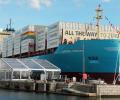
After US President Donald Trump announced a 90-day tariff pause for several nations, including India, global manufacturers are in a rush to ensure that bulk of their goods reach the US during this window. "The 90-day suspension of tariffs will be welcomed by shippers, but it should not be a cause for celebration.

'Given that India underperformed emerging markets by 28 per cent in 2025, the worst performance in over 30 years, the timing of the sharp STT hike could have been better.'
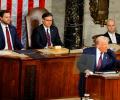
I'...additional concessions, such as opening government procurement, reducing agricultural subsidies, weakening patent protections, and allowing unrestricted data flows -- demands India has resisted for decades.'
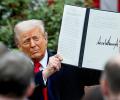
India is already negotiating a bilateral trade agreement with the US. The two countries are aiming to finalise the first phase of the pact by fall (September-October) of this year.

India and Canada are negotiating a long-term uranium supply agreement worth $2.8 billion. They are also exploring expanded civil nuclear cooperation after the passage of the SHANTI Bill.

Consumer durable companies in India have begun early-stage talks with US importers at a time when the tariffs levied on Indian products are lower than those on competitors such as China. While the discussions started some time ago, many believe that the Donald Trump administration's tariff measures will help Indian companies expand their presence in the US market.
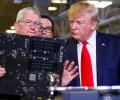
US President Donald Trump has threatened to impose tariffs on Apple products if the tech giant does not shift iPhone production from India to the United States. Trump said he expects iPhones sold in the US to be manufactured in America and not India, or anyplace else. He also said that he had a "little problem" with Apple CEO Tim Cook for building manufacturing facilities in India. Cook had previously said that the majority of iPhones sold in the US would have India as their country of origin. Experts say that shifting production to the US would be more expensive than assembling iPhones in India.
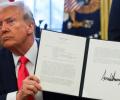
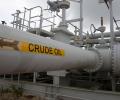
The sweeping tariffs proposed across sectors by US President Donald Trump are scheduled to be imposed starting April 2, with most analysts worried about their impact on companies, and in turn the financial markets. Recently, the US administration signaled that it will impose sectoral tariffs on energy, pharmaceuticals, semiconductors, agriculture, copper, and lumber.
India's exports to the US contracted 8.6 per cent to $6.3 billion in October, while imports rose 13.9 per cent to $4.5 billion leading to a trade surplus of $1.8 billion during the month.

Both India and the EU are likely to announce a conclusion of trade talks on January 27.

This Budget positions India's taxation ideology as not merely a revenue source but as a strategic catalyst for growth, inclusion and long-term confidence.

Trump claimed that he "got a call from Prime Minister Modi saying, 'we're done'. I said, 'you're done with what?'" Trump said and claimed Modi replied: "We're not going to go to war."
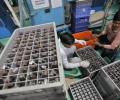
The automobile and auto-ancillary sector is expected to show strong Q3FY26 results, aided by festival-led demand, rationalisation in goods and services tax (GST) rates for select categories of vehicles, easing interest rates, and improving rural sentiment.

'A breakout above 158,000 to 160,000 could trigger the next leg higher toward 165,000 to 170,000.'

Putin's State visit will centre on fixing the huge India-Russia trade imbalance, with both sides pushing to lower duties, ease non-tariff barriers, and seal a landmark mobility pact to send more Indian workers to Russia.

Reserve Bank of India (RBI) Governor Sanjay Malhotra, and Deputy Governors Poonam Gupta, T Rabi Sankar, Swaminathan J, and S C Murmu on Friday addressed issues during the post-policy media interaction.
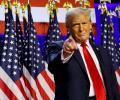
American President Donald Trump has announced imposing reciprocal tariffs on its major trading partners including China that levy higher import duties on goods shipped from the United States. He has already announced a 25 per cent duty on steel and aluminium imports, which will come into effect from March 12.

Among major engagements in 2026 is the visit of the European Union leadership, chief guests at the Republic Day parade.

Sustaining 8 per cent-plus growth rates is necessary if we are to reach high-income status by 2047, points out Amitabh Kant.

'For those in for the long haul, this is a God-given opportunity.' 'Your market is falling despite strong fundamentals, and such a clear roadmap has been announced.'

After four failed reform drives, a new plan aims to rescue India's debt-laden power discoms through privatisation, accountability and long-term financial fixes.
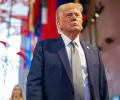
"India and everybody would think of them as an ally. I can say the same for others. But this is a group of wonderful nations that is countering other countries that look to hurt us on trade," he added.
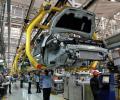
Auto parts exports from India may see a slight slowdown as US President Donald Trump's 25 per cent tariff could increase car prices for buyers by 8-25 per cent, thereby affecting demand, experts believe.
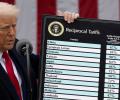
The move by the US President came following a retaliatory move by China, where it increased its tariff on US goods from 34 per cent to 84 per cent starting April 10.

Amid the ongoing global tariff war, Commerce and Industry Minister Piyush Goyal on Wednesday asked exporters not to panic and assured them that India is working on the "right mix and right balance" in its proposed trade agreement with the US.
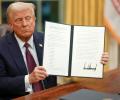
President Donald Trump delayed tariffs on Mexico and Canada for a short-term period for certain products before the 'big one' from April 2.
Unless something changes, Mr Trump is a huge threat right now, which is perhaps not being recognised fully, cautions Debashis Basu.
'President Trump believes in reciprocity and it is about time that we have a president who actually looks out for the interests of American businesses and workers'

State Bank of India, Tech Mahindra, Larsen & Toubro, Tata Steel, Sun Pharma, Infosys, HCL Tech, Axis Bank, Tata Consultancy Services and NTPC were among the biggest laggards among Sensex shares. Nestle, Hindustan Unilever, Titan, Power Grid, UltraTech Cement and ITC were among the gainers.
Prime Minister Justin Trudeau responded on Sunday to the United States' decision to impose a 25 per cent tariff on most Canadian goods, stating that "Canadians did not want this, but are prepared."

The power sector presents a puzzle. A fast-growing economy should be aligned to higher power demand but that hasn't been the case in the financial year 2026 till date (FY26TD).

'As far as the contentious issues such as agriculture are concerned, we are finding some common ground.'

India was being evaluated for a potential weight of around 1 per cent in the index, an allocation that could have translated into $25 billion of inflows, spread over roughly 10 months.

Chinese Foreign Minister Wang Yi stated that China mediated tensions between India and Pakistan, a claim disputed by India which maintains that the matter was resolved bilaterally.

This is the second-worst performance by the pack during this period over the last five years since CY20.

This is the first Budget in my memory of Budgets over the last half a century which has embraced upfront, enthusiastically and emphatically, technology, modernity and fiscal sobriety, notes Shreekant Sambrani.
A day before US President Donald Trump's additional 25 per cent tariff kicks in, Prime Minister Narendra Modi on Tuesday made a vehement pitch for swadeshi and Make in India that should help create jobs in the country.
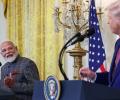
Of Trump's reciprocal tariffs and trade deals

A neutral monetary policy stance, heavy government borrowing, and issuers adjusting to a higher-for-longer yield environment have set the stage for a largely stable corporate bond market in 2026.

With US President Donald Trump "temporarily suspending" country-specific reciprocal tariffs until July 9, India sees the three-month window as an opportunity to renew its push for a proposed bilateral trade agreement (BTA) with the US and expedite finalisation of the first tranche of the trade deal.
