
The 47th GST Council meeting that is currently underway is slated to discuss a host of issues, including a mechanism for compensating states for revenue loss, tax rate tweaks in some items and relaxed registration norms for small online suppliers. Further, the meeting of the Council, chaired by the Union Finance Minister Nirmala Sitharaman and comprising state counterparts, will also clear levying the highest tax of 28 per cent on online games, casinos and horse racing, besides, measures to curb tax evasion, especially devising ways to tackle high-risk taxpayers in GST. "The meeting is being chaired by Hon'ble Union Minister of Finance @nsitharaman and many important decisions are expected to be taken at the meet," PIB Chandigarh tweeted.
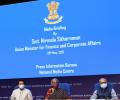
The GST Council on Friday left taxes on COVID-19 vaccines and medical supplies unchanged after the BJP- and Opposition-ruled states sparred over whether tax cut benefits will reach the common man. Congress and other Opposition ruled states have been demanding a reduction in taxes but the central government felt the move may not result in tangible gains for people. "It is one thing to rush to say - do this, it will benefit the common man. But when the technical, fitment and law committees go into the details, you realise that that could have collateral impact on many others," Finance Minister Nirmala Sitharaman said. "I am not talking about the revenue generation aspect, but how many other items will get included in it as a result of which how you are going to implement it," she added.

Hospitality and travel sector players on Tuesday demanded infrastructure status for the hotel industry besides measures such as tax exemption on LTA annually to boost domestic tourism ahead of the Union Budget. They also recommended removal of the current TDS levied on automated bookings for internal or closed user groups such as business travel platforms and reducing the total number of licenses required to establish a hotel. "A full-blown infrastructure status for the hotel sector and further rationalisation of the Goods and Services Tax (GST) and a Central single window clearance for hotel projects are some of the major expectations from the Budget 2024," Roseate Hotels & Resorts CEO Kush Kapoor said in a statement.

A 5 per cent GST rate kicked in on Monday on pre-packed and labelled food items such as cereals, pulses and flour weighing less than 25 kg.

GST Council decides to extend compensation cess beyond June 2022.

Some states are taking a legal view on the state GST rate and the compensation rules ahead of the Goods and Services Tax (GST) Council meeting, which is likely to be held in mid-June, said people in the know. While the agenda is still being finalised, several states are likely to take up the matter related to GST compensation and may pitch for its continuation beyond the June 30 deadline. States would like to know how they would divide the compensation collected after June 2022 for payment of principal and interest of compensation shortfall borrowing and arrears to states, sources said.
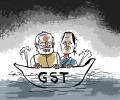
If the items and services such selected subsequently pass the test from the fitment committee and the GST Council, this would be the first of such rate hikes, after a series of cuts in the process of rate rationalisation that started in November 2017.

Experts said this will mean that companies, which have offices in multiple states, will have to raise Goods and Services Tax invoice for functions performed by employees in head office that has helped branches in other states.

New GST rates are between 5-18% on sectoral products
Telecom services providers have urged the Ministry of Finance to suspend the universal service obligation (USOF) till the existing corpus is exhausted. In their Budget recommendations, they have also pressed for an exemption from the service tax on "assignment of right to use natural resources" and the slashing of Customs duty on telecom equipment to zero. The Cellular Operators Association of India (Coai), which represents private sector telecom operators Reliance Jio, Bharti Airtel, and Vodafone Idea, called for abolishment of USOF levy.

Blocked working capital worth Rs 1,500 crore, in the almost-defunct job work diamond polishing units, is expected to be released even as diamantaires will issue fresh orders to such units following the GST relief.

Common items between Centre and states - bread, eggs, milk, vegetables, cereals, books and salt - will continue to be exempted.

There is a need to incentivise R&D investments, offer corporate tax concessions and establish an effective intellectual property rights regime in order to push the growth of domestic pharmaceutical industry, as per the industry bodies. Outlining the sector's wish list for the upcoming Union Budget, Organisation of Pharmaceutical Producers of India (OPPI) Director General Anil Matai urged the government to explore methods to incentivise R&D investments, such as deductions on R&D expenses, research-linked incentives for MNCs, and corporate tax concessions.

The panel, headed by the Union finance minister and comprising of representatives of all states and UTs, decided on tax rate based on recommendation of a group of ministers that looked at taxing casinos, horse racing and online gaming.

The GST rates for all but six items were finalised at the first day of the two-day meeting of the GST Council, headed by Union Finance Minister Arun Jaitley and comprising state representatives.

While the November 2017 round of rate revisions saw mainly eating joints unwilling to pass on GST benefits, this time round, sanitary napkin makers, TV manufacturers and even paint companies have said passing on GST benefits is not a feasible exercise.

The Centre is against giving any shock in the first year of the rollout by bringing in new services.

The GST Council's agenda includes trimming the number of items in the 28 per cent slab by 75 per cent, easier compliance for assessees and small taxpayers, and a presentation on bringing real estate under GST.

There are both positive and negative impacts of the tax, but the net result for India's infrastructure sector is advantageous, says Vinayak Chatterjee.

Neutrality and jurisdiction in international trade need to be discussed threadbare before GST is implemented in India.
A minimum levy of 12 per cent GST on tea will increase the cost, which will ultimately be passed on to consumers.

The chamber has sought clarity from government to remove uncertainty among businesses

'We have now drastically simplified it, primarily to two rates in long-term capital gains: 20% and the applicable rates. Similarly, in short-term capital gains.' 'For listed shares, there is a slight increase, but for unlisted shares, where indexation benefits are removed, there is a reduction in rates, benefiting unlisted companies, venture capital firms, etc.' 'Similarly, in real estate, wherever returns are higher, the new structure is beneficial. In very few cases, returns are lower, and those are more of an exception.'

In a set of FAQs on applicability of Goods and Services Tax on banking, insurance and stock brokers sectors, the revenue department has clarified that transactions relating to securitisation, derivatives, future and forward contracts are exempt.

'A broad-based revival of private sector investment was likely in 2018-19 after businesses had successfully made the switch to the GST.'
Rates may be raised from 5 per cent to 8 per cent and 12 per cent to 15 per cent. The Council can explore possibility of merger of slabs to bring down the number of slabs to three. The Central GST collection fell short of the Budget Estimate by nearly 40 per cent during the April-November period of 2019-20

Goods and Services Tax would usher in an unified indirect tax regime.

Lack of visibility on rates makes companies apprehensive.

Only after its recommendations will the central GST, integrated GST and state GST Bills be taken up

The real estate sector wants "high-impact" measures, like special schemes and tax breaks for developers, to revive the fortunes of the affordable housing segment in the country, multiple executives told Business Standard. This segment has been struggling since the Covid-19 outbreak, in contrast to larger and costlier homes which have been selling like hot cakes. The demand comes at a time when the government is taking suggestions from industry players before tabling the General Budget in the Parliament next month.
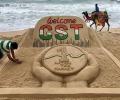
Businesses with monthly turnover of over Rs 50 lakh will have to mandatorily pay at least 1 per cent of their GST liability in cash, the finance ministry said as it moved to curb evasion by fake invoicing. The Central Board of Indirect Taxes and Customs (CBIC) has introduced Rule 86B in Goods and Services Tax (GST) rules which restricts use of input tax credit (ITC) for discharging GST liability to 99 per cent. "... The registered person shall not use the amount available in electronic credit ledger to discharge his liability towards output tax in excess of 99 per cent of tax liability, in cases where the value of taxable supply ... in a month exceeds Rs 50 lakh," the CBIC said.
The window for registration is open up to September 30

The cess levied on top of the maximum 28 per cent tax rate on petrol vehicles with capacity to carry 10-13 persons has been reduced to 1 per cent and the same for diesel vehicles has been cut to 3 per cent.

The GST Council also decided that a committee of officers will be constituted to examine the simplification of forms for annual return and reconciliation statement.
Proposals from the Centre's side include raising the 5 per cent slab to anywhere between 6 and 8 per cent, and doing away with the 12 per cent slab. A few states may oppose such a move because it involves hiking tax on items consumed by the poor. They have instead proposed raising the 18 per cent slab.

'At present, hybrids emit lesser carbon despite using fuel than pure play electric cars.' 'That is because EVs have to be charged and 76 per cent of the country's electricity is still coal-based and not renewables.'

It will reduce compliance cost as the assessee will not have to maintain multiple records for a variety of taxes

With audits and greater emphasis on anti-evasion measures, more tax demands will lead to more litigation. So, it is a bit early to start celebrating. GST is still work in progress.

Petroleum being out of the goods and services tax initially will create some anomaly as tax credit on some of the inputs to oil industry may not be given, said revenue secretary Hasmukh Adhia.

References to the repealed laws for service tax, purchase tax, etc, continue in the SEZ laws.
 © 2026 Rediff.com - Investor Information - Advertise with us - Disclaimer - Privacy Policy - Sitemap - Feedback - About us - Terms of use - Grievances