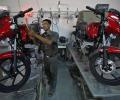
Bajaj Auto's market capitalisation (market cap) hit Rs 2 trillion mark for the first time. The stock of the two and three-wheeler major rallied 6 per cent to hit a new high of Rs 7,420 on the BSE in Tuesday's (January 9) intraday trade after its board approved Rs 4,000 crore share buyback at Rs 10,000 per share. The stock ended the day at Rs 7,093.75, up 1.55 per cent and its market cap a shade above Rs 2 trillion.
Foreign portfolio investors (FPIs) sold shares worth Rs 20,170 crore ($2.4 billion) recently. This marked the fifth-highest weekly outflow from overseas funds since the beginning of 2008 and the largest since the last week of March 2020. Due to the Covid scare, FPIs had sold shares worth Rs 21,951 crore during that week, causing the market to decline by nearly 20 per cent.
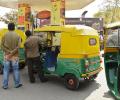
Amid a shift in mobility trends and people increasingly opting for less polluting energy sources, sales of compressed natural gas (CNG) vehicles increased more than 82 per cent in the past five years. A total of 729,902 CNG vehicles were sold in 2022-23 against 400,825 in 2017-18, according to VAHAN Dashboard. Though the increase in sales of CNG-powered vehicles has been significant, their share in overall vehicle sales remains minuscule as is the case with EVs.
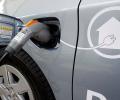
At a time when consumers increasingly embrace green mobility solutions, it is not electric cars but hybrids that are taking the lead, as automotive sales data indicate. Since January, 64,097 electric cars have been sold compared to 266,465 hybrids, according to data from the ministry of road transport and highways' Vahan dashboard. Hybrid car sales have surged from 4.42 per cent of the 4.1 million cars sold in calendar year 2022 to 7.2 per cent this year.
At a time when consumers increasingly embrace green mobility solutions, it is not electric cars but hybrids that are taking the lead, as automotive sales data indicate. Since January, 64,097 electric cars have been sold compared to 266,465 hybrids, according to data from the Ministry of Road Transport and Highways' Vahan dashboard. Hybrid car sales have surged from 4.42 per cent of the 4.1 million cars sold in calendar year 2022 to 7.2 per cent this year.
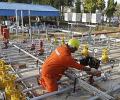
It is rare for Cabinet ministers to tick off state-owned companies publicly, yet that was what then petroleum and natural gas minister Dharmendra Pradhan did for ONGC. Speaking at an event on June 29, Pradhan said he has asked India's premier exploration company to find fresh oil acreages fast. "Do it yourself through some joint venture (or) through a new business model. But the government cannot permit you to hold resources for an indefinite time." The reason for this stricture is India's rising dependence on imported oil and gas. Or, to put it another way, falling domestic production (see chart: "Crude truth"), especially from ONGC, which faces a simple problem.

Buying a car, particularly a diesel-powered one, is set to pinch the customers' pockets even more from the next financial year, as the second phase of Bharat Stage VI (BSVI) emission norms kicks in. The rules require cars to be compliant with real driving emission (RDE) norms, which measure pollutants emitted by cars while they are being driven on the road, unlike in a laboratory test. The norms may increase the cost of producing diesel vehicles by nearly Rs 75,000 to Rs 80,000, and petrol-powered ones by Rs 25,000 to Rs 30,000, analysts said.
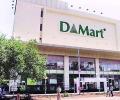
Shares of Avenue Supermarts, which owns and operates the DMart stores, hit a two-year high of Rs 4,710.15 as they surged nearly 6 per cent on the BSE in Thursday's (April 4) intraday trade after reporting strong revenue growth in the January-March quarter (Q4) of the previous financial year (FY24). DMart, in the Q4FY24 pre-quarter update, said the company reported 20 per cent growth in standalone revenue from operations at Rs 12,393 crore, as against Rs 10,337 crore in the third quarter (Q3) of 2022-23 (FY23), driven by a 7 per cent growth in revenue per store and a robust 13 per cent year-on-year (Y-o-Y) increase in store additions. In Q3 of 2021-22, the company reported revenue of Rs 8,606 crore and in Q3 of 2020-21, it posted revenue of Rs 7,303 crore.
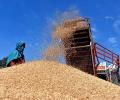
The uptick in prices ranging from steel to wheat could benefit lots of commodity-based companies -- from State-owned SAIL to the agro exporters.

'Like all long-term bull markets, the Indian stock market will continue to climb the proverbial wall of worry.'
The breadth, indicating the overall health of the market, turned negative from positive

All nine Adani stocks saw a rise in their share price in H1FY23, ranging from 6.1% in case of Adani Ports to 102% in case of Adani Power.

Benchmark Sensex trimmed early gains to close marginally higher while Nifty settled flat in choppy trade on Tuesday as gains in auto shares were offset by selling pressure in banking and energy shares. The 30-share BSE barometer closed marginally up by 37.08 points or 0.06 per cent to 60,978.75 with 15 of its stocks ending in green and the rest in red. The index opened higher and gained over 300 points to a high of 61,266.06 in early trade.
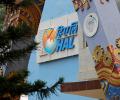
India's defence sector presents an ordering opportunity worth $138 billion between fiscal years 2023-24 (FY24) and FY32, said a latest note by Nomura, which has initiated coverage on two defence-related players - Hindustan Aeronautics (HAL) and Bharat Electronics (BEL) - with a 'buy' rating. The research and broking house sees an upside potential of 28 per cent and 32 per cent, respectively in these two stocks from the current levels.

The S&P BSE Sensex shed 286 points to close at 24,539 and the Nifty50 lost 100 points to end at 7,456.

JSW Steel (3.37 per cent), Tata Steel (3.33 per cent), Maruti (3.24 per cent), Power Grid (3.07 per cent), IndusInd Bank (2.95 per cent), Bajaj Finance (2.12 per cent) and Tech Mahindra (2.22 per cent) were among major gainers. On the other hand, Ultratech Cement, Sun Pharma, Nestle and L&T were the losers.

ICICI Bank was the top Sensex gainer after S&P Global Ratings affirmed its 'BBB-' long-term issue ratings on the senior unsecured bonds.

Equity markets rallied after softer-than-expected inflation data in the US and UK rekindled hopes of the end of the rate-hiking cycle by major central banks. The soft inflation reading drove down bond yields and the US dollar, whetting the appetite for risky assets. The 10-year US bond yield fell below 4.5 per cent after topping 5 per cent less than a month ago.

Life Insurance Corporation of India (LIC) February 8 for the first time ever crossed the Rs 7 trillion market capitalisation, as the stock price of state-owned insurer hit a new high of Rs 1,144,45, on rallying 10 per cent on the BSE. The board of directors of the Corporation are scheduled to meet today i.e. February 8, 2024, to consider a proposal for declaration of interim dividend for the financial year 2023-24 (FY24). The board will also consider and approve the unaudited financial results for the quarter and nine-month period ended on December 31, 2023.

On BSE, 1,826 shares declined and 982 shares rose, while a total of 194 shares were unchanged

Among Sensex shares, HDFC Bank fell the most by 2.58 per cent, followed by SBI (2.12 per cent), HDFC (2.09 per cent), and IndusInd Bank (2.02 per cent). Axis Bank, Bajaj Finserv, M&M, L&T, Reliance, Infosys and TCS were among the major losers. In contrast, Tata Motors, Maruti, NTPC, Sun Pharma, Power Grid and Titan were among the gainers.

'For experienced and risk-taking investors, now may be the time to go all in.' 'By 'experienced and risk-taking', I refer to those who remained net buyers in equities during the early stages of the 2020 pandemic.' 'On the other hand, those who exited the markets during the pandemic may go the SIP way.'
While the collapse of a large financial intermediary can wreak havoc on the system because of the interconnectivity, a large business conglomerate too can play spoilsport if the banks have too much exposure to the entity, explains Tamal Bandyopadhyay.

The 30-share BSE Sensex surged by 477.24 points or 0.83 per cent to close at more than one-week high of 57,897.48. As many as 28 of its constituents closed with gains while two declined. The broad-based Nifty of the National Stock Exchange rose by 147.20 points or 0.86 per cent to settle 17,233.45, tracking gains in Sun Pharma, Asian Paints, and Reliance Industries.
Benchmark BSE Sensex rose by 160 points on Thursday in choppy trade following gains in select banking and auto counters amid mixed global cues. The 30-share index gained 160 points to settle at 62,570.68 as 13 of its components advanced while 17 declined. The barometer opened lower but later gained momentum to touch a high of 62,633.56 in the day's trade.
Equities are the go-to asset class as far as ultra-long-term returns are concerned. Over the past 123 years, global equities have provided an annualised real return of 5 per cent in US dollar terms, while bonds have delivered 1.7 per cent and short-term bills just 0.4 per cent, according to Credit Suisse's Global Investment Returns Yearbook 2023. In collaboration with the London Business School, Credit Suisse has analysed over 100 years of returns for key asset classes in 35 countries.
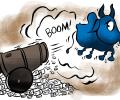
Investors' wealth eroded by more than Rs 2.21 lakh crore in early trade on Wednesday, with the market witnessing a selling-off amid prospects of aggressive rate hikes by the US Federal Reserve to tackle high inflation, and sluggish global trends. In less than an hour of the start of trading on Wednesday, the key indices -- Sensex and Nifty -- were deep in the red and witnessed significant volatility, reflecting jittery investor sentiments. The market capitalisation of BSE-listed companies, which is also an indicator of wealth of investors, tumbled more than Rs 2.21 lakh crore to Rs 2,84,49,727.56 crore amid the 30-share Sensex falling 564.76 points to 60,006.32 points.

Analysts have given a thumbs up to the Reliance Industries (RIL) and Walt Disney Co. (Disney) proposed a joint venture (JV). The stock of the Mukesh Ambani-controlled company gained nearly 1.5 per cent on Thursday to Rs 2,952 levels as compared to the S&P BSE Sensex that traded marginally weak, down 0.2 per cent to 72,172 levels in intra-day trades.

ICICI Bank and SBI were among the top Sensex gainers along with FMCG majors ITC and HUL.

Earlier in May, Ford India announced that it had dropped its plans to make electric vehicles (EVs) in India, which it intended to export, under the production-linked incentive scheme (PLI). Ford was among 20 companies that had signed a Champion OEM Incentive Scheme under the PLI project with the government in February this year. The decision comes as a blow for the 4,000-odd employees at Ford India's Maraimalai Nagar plant near Chennai and in Sanand, Gujarat. In September last year, the company had announced that it would exit the India market, which it had entered in 1995 through an on-again, off-again joint venture with Mahindra & Mahindra (they split in 1998, signed a JV in 2019 and split again in December 2020), retailing petrol and diesel brands such as the EcoSport, Figo, Aspire, and Endeavour.

IT shares lost ground tracking a sell-off in tech stocks on Nasdaq on Friday

From the Sensex pack, IndusInd Bank, Mahindra & Mahindra, PowerGrid and Bajaj Finserve gained up to 2.01 per cent. On the other hand, bellwether stocks such as ITC, Kotak Mahindra, Tech Mahindra and Reliance were the laggards. ITC shares closed the session with a loss of 3.87 per cent lower and Reliance ended 1.92 per cent lower.
Most analysts have downgraded the stock of SBI Cards and Payments (SBI Card) as the credit card issuer posted weak results during the December quarter (Q3) of financial year 2023-24 (FY24). The sub-par show, analysts said, was for the eighth straight quarter. With this, they have slashed their earnings estimates by as much as 20 per cent over FY24-26 amid near-term pressure points in the company's growth outlook.
The buyback price is at around 28 per cent premium to the current market price of Rs 67 on the Bombay Stock Exchange
Shares of ICICI Bank may outperform those of HDFC Bank in the near-term, analysts said recently, after the Sandeep Bakhshi-led private sector lender reported a strong set of numbers for the July to September quarter (Q2) of financial year 2023-24 (FY24). The result, they said, reiterated that ICICI Bank is maintaining a sustainable and prudent growth led by tech-driven initiatives as against HDFC Bank, which is facing merger related challenges. According to analysts at Prabhudas Lilladher, ICICI Bank is valued at par with HDFC Bank at 2.2x/1.9x on FY25/26E core adjusted book value (ABV) basis.

Logistic players have seen a sharp correction at the bourses over the past six months as intense competition from new-age-tech startups, higher freight rates, and weak macros dented listed players' growth outlook. Analysts warn that the emergence of tech-based startups could weigh on organised players' profit-pool, and can potentially erode their market share. Thus, a stock-specific strategy would be prudent at this juncture with focus on companies that are rapidly innovating and investing in technology.

From the Sensex pack, JSW Steel, Tata Steel, NTPC and UltraTech Cement emerged as major winners, closing the day with a gain of up to 3.33 per cent. On the other hand, Asian Paints, ITC, L&T and SBI were the laggards, ending the session up to 3.95 per cent lower. Of the 30 Sensex stocks, 14 closed the day in green, while on the 50-stock index Nifty 25 scrips ended with gains.
Stock market barometers Sensex and Nifty ended marginally higher on Monday as rise in wholesale inflation capped early gains despite a positive trend in global markets. The 30-share index settled 32.02 points or 0.05 per cent higher at 60,718.71 with half of its constituents ending in green. The broad based Nifty edged up 6.70 points or 0.04 per cent to close at 18,109.45.

'From a risk-return perspective, large-cap funds may generate lower-than-historical average returns in 2024, whereas mid-, and small-cap funds hardly have any upside left.'

The S&P BSE Sensex has gained 149 points to open at 25,802.
 © 2026 Rediff.com - Investor Information - Advertise with us - Disclaimer - Privacy Policy - Sitemap - Feedback - About us - Terms of use - Grievances