
Fitch Ratings on Tuesday raised India's growth forecast for the current fiscal to 7.2 per cent, from 7 per cent projected in March, saying elevated consumer confidence will drive spending, besides increased investments. In June update to its global economic outlook report, Fitch said it expects inflation to decline to 4.5 per cent by end of this year and RBI to cut policy interest rates by 25 basis points to 6.25 per cent.

'The structural story of India is a multi-decadal story.' 'One should stay invested in that story and avoid reacting to what is happening globally.'

Hopes of revival and earnings growth in 2020, surprise tax cuts, and robust foreign flows - thanks to easy global monetary policies - are a few reasons why the markets have managed to digest the low GDP footprint. Select bluechips such as Reliance Industries, Bajaj Finance, Asian Paints, and ICICI Bank have gained sharply this year. On the other hand, YES Bank, Zee Entertainment, and Indiabulls Housing have seen a sharp fall.

Chief executive officers (CEOs) across sectors have expressed intentions to expand capacities, expecting the government's target to invest a record Rs 11.11 trillion on infrastructure development will act as a catalyst for a jump in consumer demand. "With the government planning a capex of Rs 11.11 trillion, private sector investment will come in a big way. Companies will be preparing for it right from today," H M Bangur, chairman of Shree Cement, told Business Standard. For the past few years, the investment scene in India has been dominated by government capital expenditures; private investments in the manufacturing sector have remained muted.

Equity markets may witness a gradual up-move this week with some volatility as both election and earnings season are nearing their end, analysts said, adding that global trends and trading activity of foreign investors would hold significance in dictating investors' sentiment. Benchmark indices, which had a record-breaking rally last week, would also track global oil benchmark Brent crude and the rupee-dollar trend. The monthly derivatives expiry on Thursday may also fuel volatility in markets.

The Reserve Bank's growth projection for next financial year is lower than 8-8.5 per cent projected by the finance ministry in the recent Economic Survey which was tabled in Parliament on January 31. Unveiling the bi-monthly policy, RBI governor Shaktikanta Das said, "Recovery in domestic economic activity is yet to be broad-based, as private consumption and contact-intensive services remain below pre-pandemic levels."

Long-term macro trends indicate growth in demand for air travel. Trends from the ticketing website MakeMyTrip indicate a likely annual growth of between 11-17 per cent in Indian air travel demand over FY24-30. Through that period, InterGlobe Aviation or IndiGo may continue to make gains in market share in both domestic and international travel, aided by large fleet additions. IndiGo is the largest global customer of Airbus by far with 950 aircraft orders outstanding.

Gold prices tumbled by Rs 3,350 to Rs 72,300 per 10 grams in the local market in New Delhi on Tuesday amid subdued demand by jewellers after the government announced the customs duty cut on the yellow metal and silver to 6 per cent.

'The first job you pick up may not be your ultimate dream job.' 'When the situation is no job or any job, my advice to them will be, pick up any job at the moment.' 'You should use that job as a learning experience.' 'It is easier to find a job when you are working somewhere than when you are sitting at home with no work.'

Singapore government's sovereign wealth fund Temasek is looking to invest $10 billion in India during the next three years, Ravi Lambah, Temasek's head of India and strategic initiatives, said.

India's gross domestic product product (GDP) growth rate between 2011-12 and 2016-17 should be about 4.5 per cent instead of the official estimate of close to 7 per cent, he said in a research paper published at Harvard University. "The Indian policy automobile has been navigated with a faulty, possibly broken, speedometer," he says in the paper.
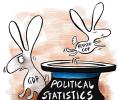
India Ratings and Research on Friday revised down India's FY22 real GDP growth forecast to 10.1 per cent, from earlier projection of 10.4 per cent, citing the second wave of COVID-19 infections and slower pace of vaccination. At a time when large parts of the country are experiencing tremendous pressure on medical infrastructure, the agency said it expects the second wave to start subsiding by mid-May. Earlier this month, the Reserve Bank maintained its 10.5 per cent GDP growth estimate, but Governor Shaktikanta Das has flagged the rising cases as the biggest impediment to recovery.

Stating that an economic recession gripped global economy following the lockdowns due to COVID-19 pandemic, Fitch Ratings on Friday said the initial disruptions to regional manufacturing supply chains in China have now broadened to include local discretionary spending and exports.

Sheikh Hasina, who was elected for a record fourth consecutive term and fifth overall term this year, was always admired by her supporters as "Iron Lady", before the dramatic development that abruptly ended her 15-year-rule in Bangladesh.
The country's gross domestic product (GDP) growth is likely to be 8.8 to 9 per cent in the current financial year, driven by agriculture and industry sectors, Care Ratings said in a report. The country's economy had contracted by 7.3 per cent in fiscal 2020-21. The agency said the outlook for the Indian economy on almost all counts in FY22 would look seemingly better than FY21 on account of the negative base effect.

The Indian economy is coming out of the pandemic-induced degrowth and GDP growth will enter the positive territory in the fourth quarter of this fiscal, Niti Aayog Vice-Chairman Rajiv Kumar said on Wednesday. In an interview to PTI, Kumar also said the Centre's new agriculture reform laws are aimed at increasing the income of farmers and the present agitation was a result of misunderstanding and miscommunication which need to be removed.

The US Fed interest rate decision, domestic inflation data and global trends would be key driving factors in dictating movement in the market this week, as the Lok Sabha elections outcome and the RBI policy decision are behind us, analysts said. The past week was a roller-coaster ride for investors as markets swung sharply in both directions before closing with strong gains.

'We expect the bull-market phase to still persist, but now led by large-caps which offer better valuation and benefit from FII inflows.'
'We expect continued pressure on midcaps, but any sharp correction looks unlikely from here on.'
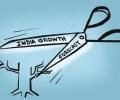
The Reserve Bank on Friday retained the real GDP growth projection at 9.5 per cent for 2021-22 as domestic economic activity has started normalising with the ebbing of the second wave of the virus and the phased reopening of the economy. In the June monetary policy, the RBI had lowered the growth projection for 2021-22 to 9.5 per cent from 10.5 per cent estimated earlier. Unveiling the bi-monthly monetary policy, RBI Governor Shaktikanta Dad said high-frequency indicators suggest that consumption (both private and government); investment; and external demand are all on the path of regaining traction.
The downward surprise in Q2 stemmed from a stronger-than-anticipated drag from gross fixed capital formation and marginal weakness in private final consumption expenditure. In Q3, projection errors emanated mainly from a steep unanticipated contraction in gross fixed capital formation, which was the deepest in the new series of GDP.

The Reserve Bank on Wednesday approved a Rs 2.11 lakh crore dividend payout to the central government for 2023-24, more than double the amount it paid for the previous 2022-23 financial year. The decision was taken at the 608th meeting of the Central Board of Directors of the Reserve Bank of India held under the chairmanship of Governor Shaktikanta Das.
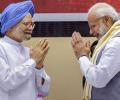
In a scathing attack on Prime Minister Narendra Modi, former prime minister Manmohan Singh on Thursday accused him of lowering the dignity of public discourse and the gravity of the office of the PM by giving "hateful speeches" during the poll campaign.
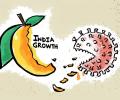
The International Monetary Fund (IMF) on Tuesday cut its economic growth forecast for India to 9.5 per cent for the fiscal year to March 31, 2022 as the onset of a severe second COVID-19 wave cut into recovery momentum. This forecast for 2021-22 is lower than the 12.5 per cent growth in GDP that IMF had projected in April before the second wave took a grip. For 2022-23, IMF expects economic growth of 8.5 per cent, larger than the 6.9 per cent it had projected in April.

The revision of the consumer price index and GDP base years from 2011-12 and 2012, respectively, were dependent on the outcomes of the consumer expenditure survey of 2017-18 that the government decided to junk recently.

The ongoing fourth quarter earnings season, global factors and macroeconomic data would guide the trends in the equity markets this week, analysts said. Markets would also take cues from trading activity of foreign investors, rupee-dollar trend and movement of global oil benchmark Brent crude. "Domestically, the next batch of Q4 earnings reports will drive stock-specific movements, Hero MotoCorp, Larsen & Toubro, BPCL, State Bank of India, Eicher Motors and Tata Motors are some of the big names in the list and the next phase of voting," said Pravesh Gour, senior technical analyst, Swastika Investmart Ltd.

It has been a slow year for the Indian media and entertainment (M&E) business. After two years of double-digit growth, it grew at just about 8 per cent in 2023 over 2022. It now stands at Rs 2.33 trillion in advertising and pay revenues.

Hospitality players want the government to accord infrastructure status to hotels to make investments on new properties more attractive rather than categorising them as luxury or even 'sin goods' in the upcoming Union Budget considering the sector's potential to play a key role in India's growth. They also want the government to consider incentives in the form of tax breaks or subsidies for adopting sustainable and eco-friendly practices, while asserting that the upcoming budget must accelerate the tourism agenda saying it is an opportunity to make Indian hospitality the emerging engine for GDP growth and employment generation.

Have the markets already played out their dynamics before the economy has even properly taken off? Are we now destined for a period of mediocre returns despite a strong economy? asks Akash Prakash.

From connectivity woes to infrastructure advancements and the startup boom, there is a gulf between claims and reality in India's economic landscape, points out Devangshu Datta.
The truth can no longer be hidden despite 'headline management' by the ruling dispensation, the opposition party said.

BSE-listed companies' market capitalisation reached Rs 197.7 trillion on January 21, against India's nominal GDP of Rs 190 trillion during 12 months ended December 2020.

'As we expect the economy to continue to grow above the trend line, we expect capex decisions to be taken next year when there is more certainty about the cost of funding and the economy.'

In the manufacturing sector, output is expected to decline by about 70 per cent as only food-processing, and drugs and pharma industries are allowed to operate while other segments, such as engineering and metals, have shut operations.

The new numbers show India's economic growth rate averaged 6.7 per cent during the Congress-led United Progressive Alliance regime as compared to 7.3 per cent under the present government. Previous numbers had put the average growth rate during the 10-year UPA rule at 7.75 per cent.

In the volatile international situation where 'nativism' is on the rise and immigrant communities are being targeted, the Leader of the Opposition's statement is like adding fuel to fire. If the Indian diaspora numbering 4 crores is threatened it will constitute a grave threat to national security, warns Colonel Anil A Athale (retd).

Yes Bank was the top loser in the Sensex pack, shedding 2.50 per cent, followed by HUL that fell 2.37 per cent, M&M 2.12 per cent, SBI 2.03 per cent, Tata Motors 2.03 per cent and Vedanta 1.97 per cent.

Larsen & Toubro, Axis Bank, Reliance Industries, UltraTech Cement, Mahindra & Mahindra, IndusInd Bank, ICICI Bank and Tata Steel were the other big gainers. Sun Pharma, HCL Technologies, Asian Paints, Nestle and Infosys were the laggards.

He argued that if inflation is low, stable and moving towards the 4 per cent target, why has the RBI not revised downward the bank rate fixed in June 2023?

'With continued focus on votes, upcoming by-polls and purchasing politicians, the political hierarchy has little time for national defence.' 'They would do well to heed a veteran scholar, who says, "There will be war with China in the next few years. The next full scale war will have the involvement of Pakistan and terror elements, insurgents and intelligence assets operating inside India",' warns Lieutenant General Prakash Katoch (retd).

Domestic institutional investors pumped Rs 2.3 trillion into equities during H1 CY24. Of this, mutual funds contributed 80%.
 © 2026 Rediff.com - Advertise with us - Disclaimer - Privacy Policy - Sitemap - Feedback - About us - Terms of use - Grievances