
The domestic unit closed lower by 6 paise at 66.71.
The rupee resumed higher at 61.13 per dollar as against yesterday's closing level of 61.40 at the Interbank Foreign Exchange and strengthened further to 60.90 per dollar before ending at 61.05 per dollar, a gain of 35 paise or 0.57 per cent.
The rupee has been under immense pressure due to a host of reasons including soaring crude oil prices, sustained foreign fund outflows and widening current account deficit.

The US dollar's weakness against some currencies overseas capped the losses.

Overall forex market sentiment suffered a sudden reversal of fortune contrary to expectation largely moving in line with local equities, reversing all early strong gains.

The demand for the US currency from importers outweighed capital inflows and firm local equities.

The dollar index, which measures the greenback's strength against a trade-weighted basket of six major currencies, was up by 0.19 per cent at 95.48.

Weakness of dollar in the overseas market also boosted the rupee value.

The swap windows were closed on November 30.

Indian corporate are fast tapping the international bonds market to raise funds for their operational expenses even as they reduce their presence in the rupee bond market. As bonds are costlier for companies and investors are more sceptical than the banks, chief financial officers say they are looking at other avenues for raising funds in the coming months as dollar bond rates are lower in the range of 100 to 250 basis points. "For corporate with reasonable credit quality, the Indian bond market has become less of an option from a cost point of view. "In addition, conditions imposed in the Indian bond market by investors post Franklin episode have also become very onerous," said Prabal Banerjee, president-finance of Bajaj group. "Hence very few corporate are looking at the local bond market for resource mobilisation, since both, bank loans and the overseas bond markets are much more attractive," he said.

Unwinding of long dollar positions by banks too aided the sentiment

The ballooning of crude prices has significantly increased the country's oil import bill and it can also lead to a worsening of the current account deficit and fiscal deficit for the domestic economy.

This is the highest closing level since May 11, 2016 when the rupee had finished at 66.56

Indian rupee appreciated by 35 paise to end at two-week high of 63.03 against the greenback.

The rupee plunged by 28 paise to more than 2-month low of 66.47 against the US dollar on Monday.

The rupee resumed marginally lower at 67.24 per dollar against Wednesday's closing level of 67.21.

Falling for the fourth day in succession, the rupee today dipped by 23 paise to close at nearly three-week low of 59.38 against the dollar amidst the RBI announcing an SLR cut that is expected to release nearly Rs 40,000 crore into markets.
.jpg)
Gold tumbles by Rs 1,250 to Rs 30,950.

After three sessions of weakness, the rupee strengthened by 50 paise against the dollar.

Tracking local stocks, rupee on Tuesday regained 19 paise to end at 61.85 against dollar as reports of easing geopolitical tension between Russia and Ukraine helped emerging market currencies script a smart recovery.

The gains were capped due to month-end dollar demand from importers, mainly oil firms

Good foreign capital inflows failed to restrict the rupee's fall against the dollar

Healthy demand for the American unit from importers and corporate weighed on the rupee

The ever-astute Ravi Matthai, Director of Indian Institute of Management, Ahmedabad in 1971, offered me a basic salary of Rs 1,000 per month on my return from the United States. I doubt if IIMA could hire a faculty member at Rs 55,000 per month today! points out Dr Shreekant Sambrani.

'After multiple days of losses, any relief rally is welcome. However, the trend hasn't changed.'

The rupee is expected to remain volatile in the new financial year.

The rupee continued to slide against the pound sterling and finished at 102.64 as against 102.25 previously.

Fresh dollar selling by banks and exporters largely helped the home currency to recover from early losses

Adequate dollar supply gave a boost to the local currency

The rupee ended marginally lower by three paise at 66.36 against the US dollar.

The domestic currency had last touched 65-level and ended at 65.24 on September 6, 2013. It moved in a range of 64.63 and 65.23 during the day.

The rupee appreciated by 29 paise to close at 63.38 against the greenback following fresh dollar selling by exporters.

Bearish greenback overseas and robust capital inflows predominantly supported the domestic currency

The rupee recovered by three paise to close at 67.65 on fresh selling of dollars by banks and exporters amidst a recovery in equities.

Gold funds have returned -5.2 per cent, while the Sensex is down 7 per cent in the past year.

The reason for the stickiness in bond yields can be many, but the most responsible is the liquidity deficit stance taken by RBI, says Anup Roy.

The rupee had strengthened by 19 paise on Monday.

A massive outflows of foreign funds on the back of stricter participatory notes and renewed possibility of Fed lifting US interest rates largely impacted the domestic unit.
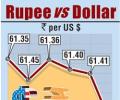
The rupee had ended almost flat at 61.41 against the Greenback in the previous session on Wednesday on alternate bouts of buying and selling.
A weak dollar against major world currencies supported the domestic unit.
 © 2026 Rediff.com - Investor Information - Advertise with us - Disclaimer - Privacy Policy - Sitemap - Feedback - About us - Terms of use - Grievances