
India's current account deficit narrowed sharply to just $300 million

RBI governor Raghuram Rajan, on Monday, said the current level of the rupee is "pretty reasonable" and any attempt to devalue it may lead to a surge in inflationary pressures and "offset any benefits"

Weak equity markets too hit rupee sentiment

The Indian rupee ended slightly lower at 64.01/02 per dollar compared with Tuesday's close of 63.98/99 per dollar due to month-end dollar demand by importers.

The rupee strengthened by 13 paise to 61.67 against the US dollar at close.

A weak dollar in overseas market boosted the rupee sentiment

A weak US dollar in overseas markets was the main reason for the rupee's rise even as losses in domestic stocks and some fag-end dollar demand from importers prevented further gains

Snapping its two-day gains, the rupee on Monday declined by 48 paise to settle at nearly four-week low of 62.17 against the US currency.

The rupee largely shrugged off the high volatility in stocks and rebounded sharply towards the fag-end trade following bout of dollar selling by exporters

Rupee ends day at 61.91 against the US dollar.

The Rupee is seen recovering from its all-time lows against the dollar.

For the week, the battered rupee gained 26 paise against the greenback
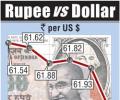
Forex dealers said weakness in local equities cast a shadow on the rupee. Dollar losing in overseas markets didn't impact the fall of the local currency, they added.

Bucking a strong trend in share market, the Indian rupee on Monday gave up all its initial gains and slipped 18 paise to close at 61.94 against the Greenback on rising dollar demand from importers.

In dull trade, the rupee on Monday ended a mere two paise lower at 60.20 against the US dollar on weak local equities and imported-driven demand for the American currency.

Volatile currency market sentiment across Asia following a fresh round of China's yuan depreciation further added to gloom.

The rupee extended gains for the fourth straight day against the US currency on Thursday.

Foreign investors have injected close to Rs 33,700 crore in domestic equities in this month so far primarily due to interest rate cut in the US and resilience of the Indian market. This also marks the second highest inflow in a month in this year so far, the last one being in March, when Foreign Portfolio Investors (FPIs) infused Rs 35,100 crore, data with the depositories showed. Going ahead, the trend of FPIs buying is likely to continue in the coming days, V K Vijayakumar, Chief Investment Strategist, Geojit Financial Services, said.

In worldwide trade, the US dollar continued its highly bullish trend against all major emerging market currencies
.jpg)
The local currency opened at 62.20 a dollar from the previous close of 61.93 and immediately touched a low of 62.29 at the interbank foreign exchange market.

India's foreign exchange reserves declined by a whopping $4.343 billion to $367.646 billion.

The rupee ended the day stronger against the dollar.

The American currency regained its buoyant strength after a brief sideways movement following overnight US Fed's optimistic tone about the future of the US economy

'Investors with foreign currency-denominated goals, such as foreign education or foreign travel, should go for US equity funds.'
A firming trend in domestic stock markets, however, capped the rupee fall to some extent

After a a steep fall last week, the rupee has closed slightly stronger against the dollar.

The rupee resumed lower at 61.15 per dollar as against the last weekend's level of 61.07 at the Interbank Foreign Exchange market and hovered in the range of 61.15 and 61.28 before quoting at 61.24 per dollar at 1030 hours.

The rupee continued its downslide for the second session in a row, depreciating by 20 paise to close at more than one-week low of 62.51 against the greenback.

Ongoing trade-war rhetoric between the US and China added some nervousness on the trading front coupled with extremely bullish dollar sentiment overseas.

In the forward market, the premium for dollar moved up on fresh paying pressure corporates.

Robust capital inflows alongside a slightly weaker greenback too reinforced the dominance of the home currency

Gold, a safe-haven bet, is likely to continue its record-smashing journey in the New Year, rising to Rs 85,000 per 10 grams and even Rs 90,000 level in domestic markets if geopolitical tensions and global economic uncertainties continue.

Overall forex market sentiment remained cautious

India's rupee is likely to remain under pressure due to high prices of crude oil and other commodities, and may stabilise at around 79-80 against the US dollar in the near term, say experts amid limited headroom available with the Reserve Bank to check the weakening of the domestic currency. The currency has slumped over 5 per cent this year after Russia's invasion of Ukraine sent international crude oil prices soaring to a decade high. On Monday, rupee ended at a fresh all-time low of 78.34 (provisional) against the US dollar.
The sudden movement of the rupee - post the monetary policy - is not a reason to panic, said currency dealers. According to them, a correction was overdue for the rupee that remained the best performing currency in the region for well over a month. The rupee closed at 74.72 a dollar on Friday from its previous close of 74.60. It had dropped 1.52 per cent against the dollar on April 7 after the Reserve Bank of India (RBI) announced its monetary policy, committing to buy Rs 1 trillion of bonds in the June quarter. A weak rupee goes well with the export narrative of the government, and is consistent with the RBI's intervention strategy that prevented an appreciation.

Banks and exporters preferred to reduce their dollar position in view of its weakness.

Bharti Airtel , RCom and Tata Communications ended down between 0.1-1%.

MNC required to bring in only 10% of issue value upfront during buyback; domestic currency lost 12% since offer was announced

A weak rupee, though seemingly good for exporters, would push up input cost further for Indian companies.

The Indian rupee is down nearly 2 per cent against the US dollar since the beginning of January 2019. Experts attribute the Indian rupee's relatively poor performance to a sharper-than-expected fall in economic growth in India.
 © 2026 Rediff.com - Investor Information - Advertise with us - Disclaimer - Privacy Policy - Sitemap - Feedback - About us - Terms of use - Grievances