

'You are a guest in the US. It's not your home, you're a guest. If they don't feel comfortable, you have to step out.'
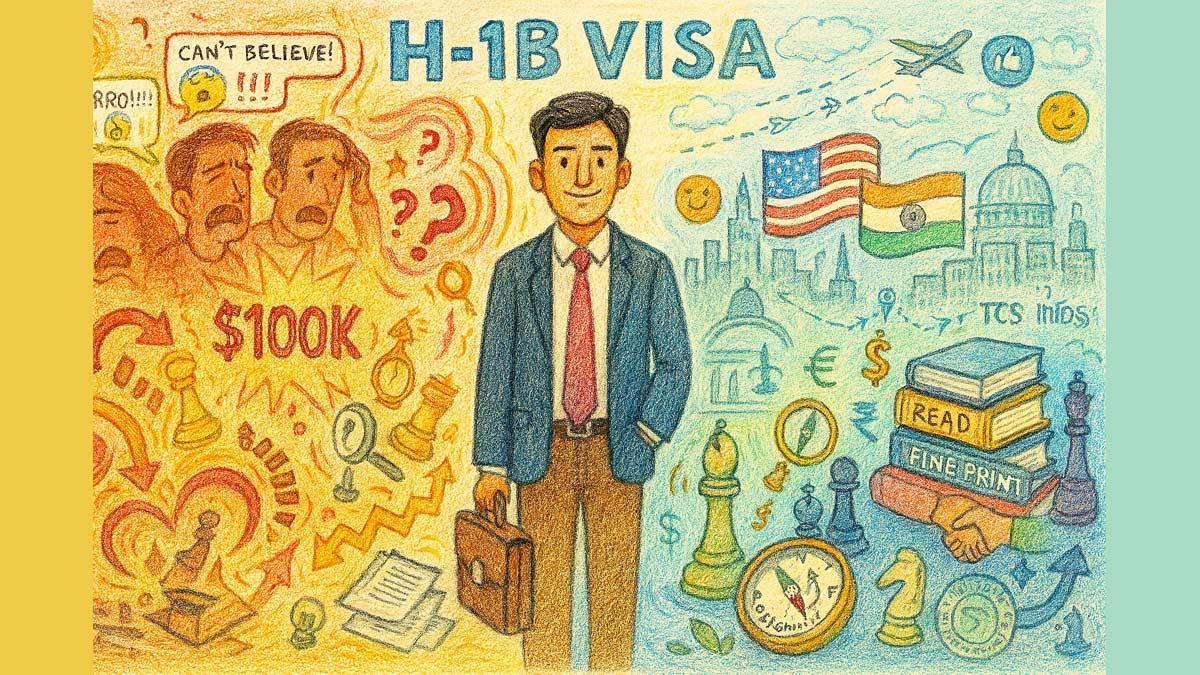
The drama began on September 20, 2025 when US President Donald Trump signed a sweeping executive order on immigration reform.
As Commerce Secretary Howard Lutnick addressed the media, his mention of a $100,000 H-1B visa fee hike sent shockwaves across India's technology corridors.
The initial confusion was palpable -- Lutnick's reference to the fee applying 'every year' led many to believe it would affect current H1B visa holders, triggering immediate panic amongst the estimated 300,000 Indians already working in America on these visas.
Within hours, WhatsApp groups exploded with frantic messages. Indian professionals on a holiday in India began contingency planning to return home to the US, whilst aspiring techies wondered if their American dreams had just become prohibitively expensive.
Yet not everyone was hitting the panic button.
The Voice of Reason Amid the Chaos
"People are panicking because if somebody puts a word about H1B, people panic and assume that things are going to go wrong," says Raju (name changed on request), an Indian professional working in the New York area on a non-immigrant visa.
Speaking to Rediff on condition of anonymity, Raju shares his perspective, which, interestingly, cuts sharply against the prevailing narrative of doom and gloom.
The confusion began during a press conference when Commerce Secretary Howard Lutnick mentioned the fee hike would apply 'every year', leading many to believe it would affect current H1B holders. Only later did the Unted States Citizenship and Immigration Services (USCIS) clarify on X that the new fee structure would apply solely to new applicants, not existing visa holders.
"This is exactly what it is -- people panicking," Raju explains. "There's nothing beyond that. This is just a panic situation. This really isn't a situation that's impacting anybody here."
The proposed policy, which would require companies to pay $100,000 for each H1B petition filed from outside the United States beginning with the FY 2027 lottery, has created a storm of anxiety within India's vast IT services sector.
Major Indian firms such as TCS, Infosys and Wipro, which have historically relied on H1B visas to send thousands of engineers to work at client sites in America, now face dramatically increased costs.
A Contrarian's Analysis
Raju holds a strikingly different view. "I completely disagree when somebody says this is going to impact H1B," he states firmly. "This is actually benefiting us who are in H1B in the US."
His reasoning is pragmatic: The fee hike affects only new applicants being hired from outside the United States, not those already working in America or students graduating from US universities who apply for H1B status.
"People already in the US, students in the US who want to apply for H1B -- I don't think it impacts them," he explains.
This distinction is crucial. Whilst the policy may create challenges for Indian IT companies looking to send fresh cohorts of engineers to America, it doesn't directly affect the estimated 300,000-plus Indians already working in the US on H1B visas or those on other visa categories.
Raju's measured response to the initial news reflects his methodical approach: "A lot of people react before they understand. That's the problem with the (Indian) community (in the US)."
The Guest Worker Reality Check
Perhaps most striking is Raju's philosophical acceptance of America's sovereign right to set immigration policy. "You're living in a country where you're a non-immigrant. You can't complain about it affecting your career," he says. "You're a guest there. It's not your home, you're a guest. If they don't feel comfortable, you have to step out."
This perspective, whilst potentially controversial amongst those advocating for immigrant rights, reflects a pragmatic understanding of the H1B programme's temporary nature.
"I can't expect somebody from a foreign country coming to my country, India, and then talking about not getting opportunities. It's the same way it works here."
His confidence stems from a belief in meritocracy: "If you have talent, if you have real talent to survive, it doesn't matter where you are... If you work in India, it doesn't matter if tomorrow I get a situation where I have to pack up and leave. I'd be happy to do that."
The Bigger Picture: Trade and Geopolitics
Looking beyond the immediate impact, Raju sees the H1B fee hike as part of a larger geopolitical chess game. "That's where trade agreements are. That's where international politics comes into play. We've got to wait and see what our Indian government does."
He points out that H1B visas, while receiving outsized attention, represent just one piece of the India-US economic relationship. "Indians work with L-1, people work with O visas, J visas. There are lots of other factors as well. The reason why H1B is big hype here is because you see lots of big companies sponsor H1B as a majority to get them to the US, but other than that, it's not that big a deal."
The domino effect of policy changes in a globalised world means outcomes are unpredictable, avers Raju.
"Making a policy change eventually has impacts... it's going to start moving those dominoes. It's going to create a domino effect, and the domino effect can be positive or negative."
Raju reserves his harshest criticism for what he sees as premature panic driven by incomplete information and sensationalised reporting by the media.
"When you try to convey messages without doing your due diligence, it conveys lots of false messages. That is intentional or unintentional, but it creates lots of panic."
His advice to fellow Indians: "Tell only what you know. Don't exaggerate."
Whether his contrarian optimism proves prescient or naive will likely depend on how the policy ultimately gets implemented and how Indian companies adapt their business models. But his voice offers a counterpoint to the prevailing narrative of crisis -- suggesting that for those already navigating the complex world of US immigration, perhaps the sky isn't falling after all.
The interviewee spoke on condition of anonymity. Some details have been changed to protect identity whilst preserving the substance of the conversation.






 © 2026