

He chose what was best for India, not for himself.
Few can deny that when god took Shastri away so soon, they did India an injustice, points out Harishchandra.
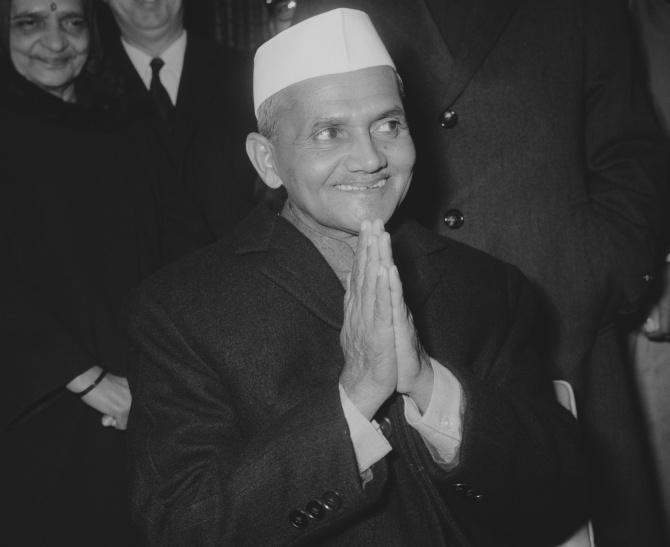
January 11 marks the 60th death anniversary of India's second prime minister, Lal Bahadur Shastri, who died in Tashkent, then in the Soviet Union, now the capital of Uzbekistan.
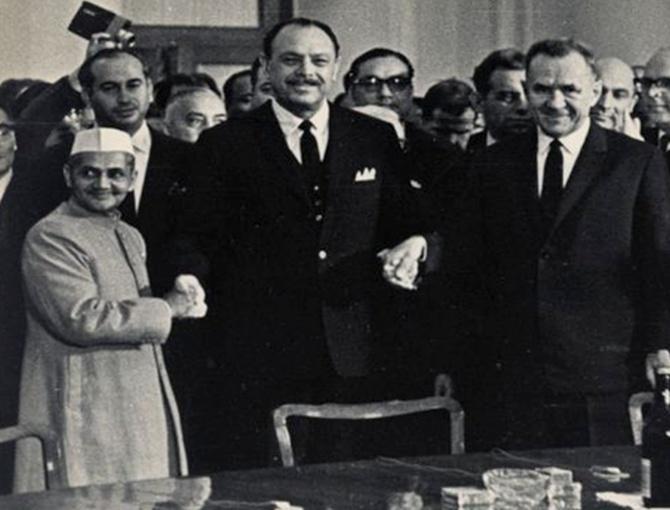
Shastri died at a relatively young age: he was only 61. He passed away just hours after signing the Tashkent Declaration, which formally ended the 1965 India-Pakistan war, after suffering a massive heart attack.
His sudden demise sparked off multiple conspiracy theories and claims of foul play, all of which remain unproven till date.
Unlike most other prime ministers of yore whose legacies have been questioned and the halo around their tenure becoming less lustrous over the decades, Shastri is the exception whose popularity has grown over the years and who, even today, is remembered fondly for his humility and his honesty.
In such a scenario, a question is invariably asked: what if Shastri had not died and returned to India, staying on as PM for at least a few more years? How different would his India have been, and what impact would a longer Shastri reign have had on the country?
It is one of the great 'What ifs...' of our nation.
Let's see how it might have panned out.

A leader's choices are based on the prevailing situations.
Regardless of Shastri's personal sentiments, he would have leaned closer to the Soviet Union.
After the Sino-Soviet split in 1969, followed by the formation of a US-Pakistan-China alliance, both Moscow and New Delhi had little choice but to fall into each other's arms.
He too would have certainly gone to war to liberate what was then East Pakistan; after all, he is the person who sent Indian tanks towards Lahore! There is no doubt that many of his policies and politics would not have been too different from what eventually came to pass.
But where Shastri would have certainly made a huge difference is in two aspects that tragically bedevil Indian politics: Dynastic politics and corruption.
In 1966, Shastri was succeeded by Indira Gandhi, the daughter of Jawaharlal Nehru, and she in turn was succeeded by her son, Rajiv Gandhi, setting the course for dynasty politics to become not just part of India's political system, but to be accepted as perfectly normal by most, though not all, political parties.
After all, if the Congress can do it, so can the other parties.
The Congress endorsing dynastic succession has had another rippling effect: Today most Indian political parties are family-run enterprises.
It is possible that Shastri's children may have entered politics. And it is certainly possible that many other politicians would have pushed forward the case for their own owards to be nominated as candidates for the legislature or Parliament.
But Shastri's honesty and strength of character probably meant that he would not have promoted his children over other meritorious persons.
And by doing so, he would have been on firmer ground in refusing to endorse the offsprings of other politicians pushing forward the case for their own wards.
If offsprings did join politics, they would have had to earn their spurs alongside the others in the party.
It is likely that newcomers, whether offsprings of current leaders or not, would be judged by their efforts in the social sector or as political workers before being nominated for the post of legislator or minister.
It is almost certain that a longer Shastri tenure would have kept dynastic politics at arm's length, and which in turn would have had a deep effect on how political parties' function.
The second, perhaps more significant, difference of a longer Shastri reign would have been less corruption. Far less!
Shastri was renowned for his honesty; when he died, his family was still paying off the instalment for a car the family had purchased for their private use.
It was a stellar example and just what a poor country like India needed.
In 1969, Indira Gandhi amended the Companies Act to ban corporate donations to political parties, saying it was being done to prevent companies from exerting influence on politics.
She certainly had a point: We have seen how political bonds are being used by barely qualified companies to win tenders.
While Mrs Gandhi's intention may have been noble, what actually happened was that donations went underground.
Corporations did not donate funds to the party but clandestinely handed it over to the top leader of the party.
This only strengthened the top leader rather than the party itself, to the extent that she or he could (and still can) impose their will upon the rest of the party.
Individual party leaders having the funds rather than the party itself has had a deep impact on the political scene.
For instance, it led to parties splintering with every leader keen to have their own party, and thereby, possession of the party funds.
The fact that even after all these years, this law has not been overturned shows how much political leaders gain from having a party of their own.

Shastri was too honest a person and would have frowned upon such nefarious activities.
He may have heeded the criticism against corporate donations, but he would not have permitted a law that would have strengthened an individual (himself) rather than the political party.
What the solution might have been is beyond this article, but Shastri would have sought to find a solution that benefitted the country rather than the individual.
No one can doubt that a less corrupt India would certainly have been a better India.
By setting an example of higher standard, a leader inspires others to follow suit. It also allows for stricter laws to punish those guilty.
An honest Shastri may not have made India free of corruption, but his actions would certainly have made corruption less endemic across the nation.

There are many who think that Shastri would have overturned many of Nehru's policy decisions, but that is unlikely.
In 1964, Congress leaders preferred Shastri over the other contender, Morarji Desai, simply because Shastri represented continuity in terms of his preference for continuing with many of Nehru's policies.
But as a leader, he was also open to reason and suggestions.
It is noteworthy that while Shastri was personally against building nuclear weapons (he was a Gandhian at heart), after China tested a nuclear bomb in 1964, he gave the go-ahead for India to also work on a nuclear bomb, though publicly he declared that India would not be doing so.
He chose what was best for India, not for himself.
Few can deny that when god took Shastri away so soon, they did India an injustice.
Feature Presentation: Aslam Hunani/Rediff


 © 2026