

Kaziranga remains a critical stronghold for tiger conservation in India, but the recent deaths underscore the growing challenges of managing a thriving population within a limited landscape.

The Kaziranga National Park and Tiger Reserve in Assam has recorded the death of three Royal Bengal tigers within a span of two weeks, with preliminary assessments indicating infighting as the likely cause.
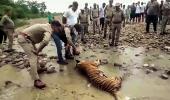
The latest death was reported on Sunday after forest personnel detected the carcass of a female tiger in the Kathpora area under the park's Western Range, Bagori.
Post-mortem examination was conducted in accordance with the standard operating procedure of the National Tiger Conservation Authority, with initial findings suggesting that injuries sustained during infighting led to the death.
The park later released photographs and video footage of the deceased animal.
Two similar incidents were reported earlier this month. On January 4, the carcass of a female tiger was recovered from the Paschim Bimoli area of the Western Range, Bagori.
Another case was recorded on January 14, when a male tiger was found dead by patrolling staff in the Gopaljarani anti-poaching camp area under the Eastern Range, Gamiri.
The deaths come at a time when Kaziranga has one of the highest tiger densities in the country.
Spread across 1,307 square kilometres, the park currently hosts 148 tigers as per the 2024 estimate, a sharp rise from 104 tigers in 2022.
With a density of 18.65 tigers per 100 square kilometres, Kaziranga ranks third nationally, after the Bandipur National Park (19.83) in Karnataka and the Corbett National Park (19.56) in Uttarakhand.
Clash Over Territory
While infighting among tigers is considered a natural phenomenon, especially in high-density landscapes, conservation experts point out that such incidents may also reflect spatial limitations.
Tigers typically clash when territories overlap, particularly if dispersal options outside core habitats are restricted.
In Kaziranga's case, prey availability remains high, ruling out food scarcity as a trigger.
Experts note that surrounding landscapes such as the Karbi Anglong hills can support only a limited number of tigers due to lower prey density, restricting natural dispersal.
Other neighbouring habitats like Laokhowa and Burhachapori wildlife areas could potentially accommodate dispersing tigers if habitat quality and prey base are improved through sustained conservation efforts and community engagement.
Long-term conservation, specialists argue, will require scientific management of both tiger and prey populations within core areas, alongside habitat restoration beyond Kaziranga, to reduce pressure, enable natural movement, and improve coexistence between wildlife and people.
Tiger deaths in January
January 4: Female tiger carcass found in Bagori Range
January 14: Male tiger found dead in Eastern Range, Gamiri
January 18: Female tiger carcass detected in Bagori Range
Kaziranga remains a critical stronghold for tiger conservation in India, but the recent deaths underscore the growing challenges of managing a thriving population within a limited landscape.
Rescued Rhino Calves Return To Kaziranga After Floods

Two orphaned one-horned rhinoceros calves, rescued after losing their parents in devastating floods in and around Kaziranga, were released back into the wild on Tuesday, marking a significant milestone in wildlife rehabilitation efforts in Assam.
The two male calves, named Chandra and Kanai, were released inside the Kaziranga National Park and Tiger Reserve by a team of wildlife experts and forest officials, following internationally accepted conservation translocation protocols.
Both calves had been rescued from floodwaters in separate incidents. Chandra was rescued from Kaziranga on August 2, 2020, while Kanai was evacuated from Kuthori in Nagaon district on August 31, 2021.
Since their rescue, the calves had been under specialised care at the Centre for Wildlife Rehabilitation and Conservation (CWRC).
According to a statement issued by the park authorities, the release followed due legal and scientific procedures.
Permissions were obtained from the Chief Wildlife Warden, Assam, under the Wildlife (Protection) Act, after which a site selection committee identified suitable locations for pre-release enclosures.
The rhinos were first moved to these enclosures, where they were gradually habituated to natural conditions before being released to roam freely in the park.

CWRC, a joint initiative launched in 2002 by the Assam forest department, the Wildlife Trust of India and the International Fund for Animal Welfare, specialises in rescuing and rehabilitating flood-affected and orphaned wild animals, particularly from the Kaziranga landscape.
So far, the centre has rescued and handled over 7,397 animals across 357 species, with nearly 4,490 animals -- about 65 per cent -- successfully released back into the wild after treatment and rehabilitation.
Of the 25 hand-raised rhino calves cared for at CWRC over the years, 23 were earlier released into the Manas National Park, while the two latest releases mark the return of rehabilitated rhinos to Kaziranga.
"There is currently another rhino calf under care at the centre," the park authorities said, adding that CWRC's primary role involves rescuing flood-distressed and orphaned animals, providing emergency veterinary care, hand-raising them where necessary, and eventually rehabilitating fit individuals back into the wild through scientific protocols.
Calling the release a testimony to scientific wildlife management, the park said the exercise highlights Kaziranga's commitment to giving every wild animal -- especially the iconic greater one-horned rhinoceros -- a chance to return to its natural habitat, even after suffering severe stress due to natural calamities such as floods.

Floods Threat To Kaziranga
Kaziranga is home to the world's largest population of one-horned rhinoceros, with 2,613 animals recorded in the 2022 census.
While annual floods continue to pose a serious threat, often claiming the lives of several animals including rhinos, park authorities note that conservation outcomes have otherwise improved significantly.
Incidents of poaching have declined drastically in recent years, with the park recording zero rhino poaching cases last year, reflecting strengthened protection measures alongside sustained rescue and rehabilitation efforts.
Feature Presentation: Aslam Hunani/Rediff




 © 2026