

Union Minister J P Nadda sharply criticised West Bengal's Trinamool Congress, alleging a breakdown of the rule of law and disrespect for democratic institutions amid controversy over electoral roll revisions.
Key Points
- Union Minister J P Nadda accuses West Bengal's TMC government of disrespecting the judiciary and democratic procedures.
- Nadda claims the 'rule of law has gone for a ride' in West Bengal, particularly regarding electoral roll revisions.
- TMC leader Sukhendu Sekhar Ray alleges 'coercive measures' during the special intensive revision (SIR) of electoral rolls.
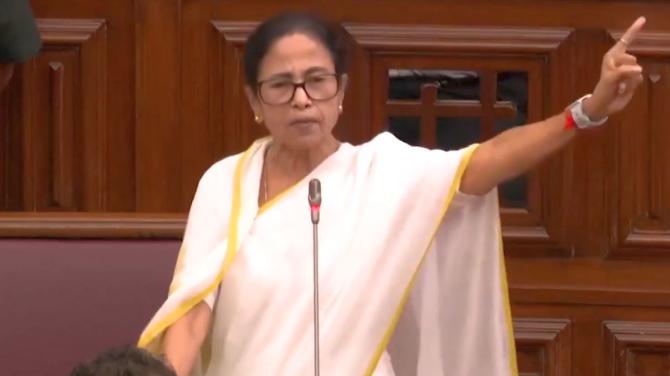
- Mamata Banerjee is protesting the SIR exercise, which has led to the deletion of millions of names from the voter list.
- The central government is urged to investigate the situation and the reasons behind the Chief Minister's protests.
Union Minister J P Nadda on Tuesday took on the ruling Trinamool Congress in West Bengal and accused it of not having any respect for judiciary, Election Commission of India or democratic procedures, and alleged that the "rule of law has gone for a ride" in the state.
Replying to a supplementary query during Question Hour in the Rajya Sabha, Nadda said the government in West Bengal was to blame for the situation arising out of special intensive revision (SIR) of electoral rolls in the state.
The Leader of the House asserted that the Centre was following the rule of law.
Nadda was responding to a query by TMC leader Sukhendu Sekhar Ray related to Ministry of Chemicals and Fertilizers, which is under Nadda.
While asking the supplementary, Ray charged that "coercive measures" have been taken in West Bengal in the name of SIR.
The TMC leader demanded that the Centre send a team to West Bengal and find out the reason behind Chief Minister Mamata Banerjee's protest on Kolkata streets for the last five days.
Responding to his allegations, Nadda said, "He (Ray) has talked about why a lady chief minister is being punished and why so much of coercive steps have been taken".
"...It is being done because the only state left is West Bengal, where the rules and regulations and the rule of law have gone for a ride. They have no respect for democratic procedures. They have no respect for political norms. They don't believe in democratic activities, and they even threaten the judiciary," he said.
Recently, Nadda said, a lady chief minister has disrespected a lady President of India.
"A lady chief minister has disrespected the seat of President of India, who happens to be a lady and a Tribal. No respect for law, no respect for judiciary, threatening everybody, and no respect for Election Commission of India.
"It is not Government of India. It is her own activity. And because Government of India works on the rule of law, and because of the rule of law, things are happening like that," the senior BJP leader said.
While asking the supplementary, TMC leader Ray said the central government talks about cooperative federalism and therefore it should look into the fact that the West Bengal chief minister is on the streets for protection of the rights of millions of Indians.
"The central government must send a team of representatives to find out why it has happened and why the chief minister is on the streets...for the past five days. I have a request to the government, that this fact should be found out why these coercive measures have been taken in West Bengal alone in the name of SIR," Ray added.
The chief minister is sitting on dharna in Kolkata against the SIR exercise.
Electoral Roll Revisions Spark Controversy
According to official data released on February 28, 63.66 lakh names, around 8.3 per cent of the electorate, have been deleted since the SIR process began in November last year, reducing the voter base from about 7.66 crore to just over 7.04 crore in West Bengal.
In addition, over 60.06 lakh electors have been placed under the "under adjudication" category, meaning their eligibility will be determined through legal scrutiny in the coming weeks, a process that could further reshape constituency-level electoral equations.





 © 2026