
...the DMK chief minister's campaign -- which includes criticism of the BJP's 'pro-Hindutva, anti-Tamil, anti-federal' policies and building on his own government's social welfare programmes targeting especially women and youth -- appeals to Tamil Nadu's voters in next year's assembly election, explains N Sathiya Moorthy.

Now that the battlelines for next year's assembly elections have been drawn, Tamil Nadu Chief Minister M K Stalin of the Dravida Munnetra Kazhagam is single-handedly carrying the party's re-election bid on his shoulders, as during the previous outing in 2021.
The question is if his twin-engine campaign would bear fruits this time too.
There are two major elements to Stalin's campaign. One is criticism of the Bharatiya Janata Party-ruled Centre's 'pro-Hindutva, anti-Tamil, anti-federal' policies and programmes, not necessarily in that order.
The other is a positive campaign, building on his own government's social welfare programmes targeting especially women and youth, over and above the inherited schemes from six decades of alternating Dravidian dispensations.
There are multiple elements to the campaign programmes. One aims at enrolling fresh members to the party through a six-point list that is critical of the Centre and Prime Minister Narendra Modi's alleged partisanship to the state.
Another is for the chief minister to personally take his government's programmes, particularly for the youth, to individual villages and communities.
In the post-Covid 2021 campaign, it was a huge hit with the voters than even the more frequent visits of then chief minister Edappadi K Palaniswami of the AIADMK.
If the reverse is true this time, even for argument's sake, the results would be known only in the weeks and months to come.
On the positive side, Stalin has the free bus scheme for all women, Rs 1,000 monthly cash-assistance programme for women and youth, the revival of free laptop scheme for college students, free breakfast scheme for elementary school children over and above the existing nutritious noon meal scheme.
By conservative estimates, the monthly government-spending on each beneficiary family may work out to Rs 5,000.
It is a substantial sum, especially in a state that is reeling under a massive debt that is only mounting. But it may not stop there, even by the DMK's standards.
Launching his solo campaign like Stalin, the AIADMK's EPS has promised to increase women's dole to Rs 1,500 per month.
This means, now or through his election manifesto, Stalin would have to promise even more.
Of course, there are other non-cash initiatives of the DMK government that aim to help build a 'better tomorrow' for the state's youth.
It may take at least a few years, if not more, for the benefits of those schemes, like MGR's noon meal scheme, to accrue to society -- and become accepted by academics and economists alike.
The question thus is if the ruling party could hope on the near-complete support of the substantial number of first and second-time voters, along with women, who had shifted allegiance from the AIADMK of the MGR-Jaya era.

It is here that the DMK hopes to garner all the 'pan-Tamil, Dravidian ideology' voters through Stalin's unsparing criticism of the Centre, Modi and the BJP's Hindutva agenda.
Their numbers are growing, yes, though not in geometric progression as the ruling party would like.
It is rare in Indian democratic history that the same issue has won or lost two successive elections.
For the BJP, Modi has been the single-most important issue, be it for the Lok Sabha elections or for multiple state assembly polls.
And he has won elsewhere but not even once in Tamil Nadu -- three parliamentary elections (2014, 2019 and 2024) and two assembly polls (2016 and 2021).
Hence, it makes political sense for the DMK and Stalin to keep targeting the BJP, especially after the rival AIADMK hurriedly revived its electoral alliance after deliberately parting ways for the Lok Sabha polls last year.
But without convincing the reversal in logical terms, EPS shook hands with visiting BJP chief strategist Amit A Shah in April to revive the alliance.
A decade-long agenda fixated against a single personality, even if he is the prime minister, may have outlived its shelf-value as an election issue, for and against.
This will be under test in Tamil Nadu next year. In the interim, what the state government and DMK have been able to add to their long list is further items of negativities on three specifics, 'pro-Hindutva, anti-Tamil and anti-federal', not necessarily in that order.
On the positively negative front, despite the chief minister's fairly acceptable image personally, anti-incumbency is a factor that the DMK has to work on.
There is no magic wand and party ministers, MLAs and other office-bearers down the line too have ensured as much.
The police and bureaucracy are also not seen as being helpful.
From Stalin's father M Karunanidhi's days as chief minister, law and order has been an Achilles' heel of the DMK whenever in power.
This is one department, unlike economic performance or social welfare, comparisons don't matter. Delivery-based perceptions do.
Like the rival AIADMK dispensation before it, Stalin's DMK too is yet to come to terms with the realities of the social media era, when lock-up deaths, campus rapes and the like get instant publicity, leaving traditional media with little choice but to compete with them.
Otherwise, too, increases in milk price, power-tariff and property tax, one following the other, has actually punctured a hole in the common man's pocket.
The BJP-ruled Centre should share at least a part of the blame, but the DMK propaganda machinery has been wholly ineffective in the department.
Against this, the BJP since the beginning of the Stalin regime, and the AIADMK over the past few months at least, have been at it, hammer and tongs.
At the organisational level too, the DMK is stymied by the continuing presence and local-level dominance of a worn-out old guard.
To ensure a smooth and incident-free transition, Stalin had accommodated them as ministers when he became CM for the first time in a 50 year-long political career, despite their known proclivity for speaking out-of-turn before the camera and arrogance from the past.
Owing to age, many of them are also ineffective as ministers in the new era. Overall, they and their children have blocked promotional avenues for stand-alone youth for organisational and elected positions like MPs, MLAs down to the panchayat level.
Of course, that excludes Stalin's son and Deputy Chief Minister Udhayanidhi, whom the party has readily accepted as heir apparent.

Where Modi may fail the DMK as an election issue, the party seems hopeful of the 'unnatural alliance' between the BJP and the AIADMK to do the trick this time too.
EPS especially seems to have been handed down a difficult task and he is not finding the going smooth.
From the launch of his campaign, in the presence of state BJP president Nainar Nagendran, EPS began defending their alliance.
Subsequently, he also overdid his piece, as if identifying or even hijacking an aspect of the BJP's Hindutva agenda in the Dravidian state.
EPS charged the Stalin leadership with diverting funds from government-owned temples for opening arts and science colleges.
Government running temples, but not churches and mosques, has been a frequent talking point for RSS affiliates in the state, including the BJP.
But for a Dravidian party boss like EPS to stall the progress of the state's youth when rival Stalin was going all out in the matter has not gone down well with AIADMK cadres.
EPS' statement that the media misquoted him did not sell.
Even without it and despite criticism and social media memes by multiple pro-Hindutva (rather, anti-Periyar/anti-Karunanidhi) groups, the Stalin government recovering temple properties from squatters, conducting consecration, or kumbabishekam, in many of them, big and small, has not gone unnoticed.
Pious voters in the state, for whom religion has been a personal affair all along, feel a bad taste when such criticism is directed at Durga Stalin, the chief minister's wife, who has not hidden her religious beliefs and frequent temple visits.
If Stalin and son Udhayanidhi were not believers, so be it.
Hence, religion is not an election issue in Tamil Nadu, now as always, though traditional hardline Hindutva ideologues and practitioners in the state alone are incapable of acknowledging it as such.
Instead, their over-assertion is seen as they wanting to create communal trouble in an otherwise harmonious state, down to the village level, just as they had done elsewhere in the country.
This is what the AIADMK is concerned about.
The real issue between the AIADMK and its BJP ally this time would centre on power-sharing and chief ministerial candidate.
At his campaign rallies, EPS has been reasserting that it would be an AIADMK-only government with him as chief minister.
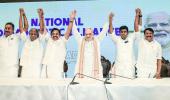
For the BJP, his assertion goes against the grain of Amit Shah's declaration on 'power-sharing', originally under EPS but later on under an AIADMK chief minister (name left out).
The BJP's Nainar also seemed to be acquiescing to it, when he told party cadres in Madurai how the 2029 Lok Sabha polls was theirs and why they should not cause impediments to the AIADMK ally.
However, in a subsequent interview, Shah revived his commitment to a 'coalition government' if the alliance won. This has ruffled alliance feathers in both camps.
Shah's assertions in the midst of EPS' energetic campaign tour has once again disheartened AIADMK cadres, who were the main cause for alliance-split last year.
This comes at a time when they were coming to terms with what they saw as an alliance forced by the 'BJP master' at the Centre but also agreed in principle that their fight was against a common rival -- and was not an ideological union.
The mutual distrust between the two allies now runs back down to the grassroots, and can worsen if the BJP forces EPS to allot them a high number of seats than the AIADMK might be willing otherwise -- and seats that the other may not want to part with, especially in the western region, where they have common strongholds.

In campaigning for a single-party government, EPS has relied on the post-Independence electoral history of the state, claiming that Tamil Nadu had never ever voted a coalition government (and would not do so this time either).
This voter-psyche was also among the reasons why Karunanidhi could complete a full term beginning 2006, with only 96 MLAs in a House of 234.
As the leader of the UPA-II coalition, the Congress too extended 'outside' support for the ally from UPA-1.
In tactical terms, EPS' 'one-party government' call would have served the DMK's purpose, too. But here again, questions remain.
Taking their cue from the BJP in the rival camp, the DMK's long-term anti-Hindutva allies like the VCK, MDMK and the two Communist parties, even leaving out the Congress, now the leader of the national-level INDIA bloc, had hoped to press for more seats and a share in power.
Unless EPS is able to quell the BJP's voice in the matter, Stalin may have a tough task on hand, convincing his own allies to give up on their prospective demands for power-sharing and more seats than what the DMK thinks they are capable of winning.
Otherwise, the DMK's hopes of playing the 'stability card' against the internally feuding rival alliance could still produce electoral dividends, not otherwise.

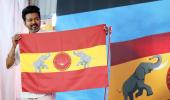
Then, there is the question -- whose votes actor-politician Vijay's TVK will cut into.
Competing speculation alternates between a division in the anti-incumbency votes of the AIADMK-led combine and the DMK alliance's anti-Hindutva votes, including 'minorities', youth and women -- the last two forming the core of Vijay's massive fan-following.
In the past, only MGR as a matinee idol could convert his fans as voters, but then, they were already in the DMK, of which he was the most charismatic vote-getter.
A clearer picture may emerge, if at all, only when Vijay launches his much-delayed maiden poll campaign in September.
For instance, in the past, the late actor Vijayakanth's DMDK, lacked the crucial delivery mechanism of established political parties to convert campaign crowds into votes, to be able to win seats on his own.
There are thus chances that Vijay, like Vijayakanth before him, could play spoilsport for the other two.
With both parties targeting young voters especially, the TVK may also cut into actor-politician Seeman's NTK 8.2 per cent vote-share in the Lok Sabha poll last year, up from 6.57 per cent in the assembly elections three years earlier.
What has gone unnoticed is the TVK's recent decision to enrol 20 million members.
If the voter shuffles his memory, he would recall how within days of launching the TVK's website last year, Vijay's aides claimed that they had already enrolled as many members -- and the website too crashed many times in between, owing to the high traffic.
For now, for EPS to become chief minister, Stalin has to lose.
Despite signing up for the revival of their past alliance, state leaders of the AIADMK and BJP gave the early impression that they would need more allies and their votes to win 2026.
This psyche has only returned to the AIADMK, especially after the TVK declared Vijay as its chief minister candidate.
It implied that the TVK would not accept EPS as chief minister.
It meant that there was no possibility of the TVK joining the existing Opposition alliance, or tempting the AIADMK to walk out still and form a third alliance sans the BJP.
The TVK's choice in the matter was limited as his fans-turned-cadres would feel cheated if he was not their chief minister candidate, the 'man who can change' and 'wants to change' the system.
They will find no justification to 'market' a new-face chief minister.

Well aware of the inherent limitations, EPS has slowly but surely changed it all into a DMK versus AIADMK war, one between Stalin and self.
This has the potential to sell but other ingredients should fall in place. That does not seem to be happening just now.
There is also the mind games that Stalin and EPS are playing without possibly knowing it.
Through four years of increasing anti-incumbency issues, Stalin is still being seen as less cunning, power-hungry and authoritarian than Karunanidhi and Jayalalithaa, his predecessors from the two Dravidian majors.
Unknown to himself, EPS has been attacking this 'paavam', or 'decent man' image of Stalin, by claiming that the state has got the most inept, inefficient chief minister, who is incapable of running an effective government.
To begin somewhere, EPS will have to break this mould, an impression that Stalin is a do-gooder but has inherited a rotten system, be it the party or the government.
That includes EPS' own four-year term as chief minister, 2017-2021, post-Jayalalithaa's death.
N Sathiya Moorthy, veteran journalist and author, is a Chennai-based policy analyst and political commentator
Feature Presentation: Aslam Hunani/Rediff





 © 2025