

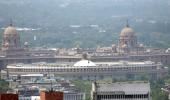
For decades, several key government offices and ministries functioned from fragmented and ageing infrastructure spread across multiple locations in the Central Vista area.

Key Points
- Prime Minister Narendra Modi inaugurates Seva Teerth, the new PMO building, and Kartavya Bhawan 1 and 2, consolidating key government offices.
- The new building complexes aim to improve administrative efficiency and coordination by housing multiple ministries in modern facilities.
- Seva Teerth will house the Prime Minister's Office, National Security Council Secretariat, and Cabinet Secretariat.
- Kartavya Bhavan 1 and 2 will accommodate law, defence, finance, health, agriculture, and other key ministries.
- The building complexes are designed with environmentally sustainable features, including renewable energy systems and water conservation measures.
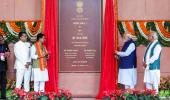
Prime Minister Narendra Modi will inaugurate the Seva Teerth, the new building of the Prime Minister's Office, and Kartavya Bhawan 1 and 2, on February 13, his office said on Wednesday.
The Friday inauguration marks a transformative milestone in India's administrative governance architecture and reflects the Prime Minister's commitment to building a modern, efficient, accessible and citizen-centric governance ecosystem, a statement from the Prime Minister's Office said.
For decades, several key government offices and ministries functioned from fragmented and ageing infrastructure spread across multiple locations in the Central Vista area.
This dispersion led to operational inefficiencies, coordination challenges, escalating maintenance costs and sub-optimal working environments. The new building complexes address these issues by consolidating administrative functions within modern, future-ready facilities, it said.
Key Features of Seva Teerth and Kartavya Bhawan
Seva Teerth houses the Prime Minister's Office, the National Security Council Secretariat, and the Cabinet Secretariat, all of which were previously located across different locations.
Kartavya Bhavan 1 and 2 accommodate law, defence, finance, health, agriculture, and several other key ministries.
Both building complexes feature digitally integrated offices, structured public interface zones and centralised reception facilities.
Designed in accordance with 4-Star GRIHA standards, the complexes incorporate renewable energy systems, water conservation measures, waste management solutions and high-performance building envelopes.
These measures significantly reduce environmental impact while enhancing operational efficiency, the PMO said.
The building complexes include comprehensive safety and security frameworks, such as smart access control systems, surveillance networks and advanced emergency response infrastructure, ensuring a secure and accessible environment for officials and visitors.





 © 2026