
'Nor would it have serious implications in India's relations with Saudi Arabia that stand on their own and have improved significantly in recent times, including in defence and strategic affairs.'
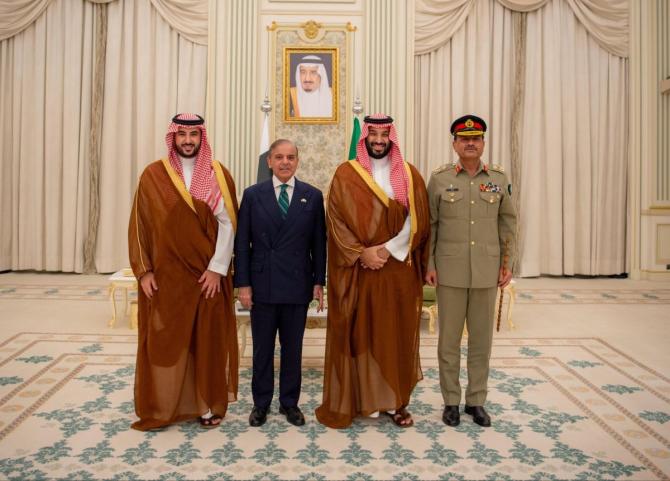
"In a way, the agreement shows the now rediscovered proximity between the US and the Pakistani military establishment," says Dr Mohammad Mudassir Quamar, Associate Professor, School of International Studies, Jawaharlal Nehru University whose area of speciality is Saudi Arabia's domestic politics and foreign policy.
"Additionally, Riyadh and Pakistan too have been working to reset their relations under the Shehbaz Sharif government and in a way, we are witnessing a renewal of the Pakistani economic dependency on Saudi Arabia and Saudi reliance on Pakistan for security," says the academic who is the co-author of India's Saudi Policy: Bridge to the Future and Editor Contemporary Review of the Middle East, and Politics of Change in the Middle East and North Africa since Arab Spring.
In an interview to Rediff's Archana Masih, Dr Quamar discusses the defence deal signed between two Muslim countries that states that 'aggression against either country will be considered an aggression against both' -- and what it means for India.
The defence pact between Saudi Arabia with nuclear-armed Pakistan states that any attack on either nation will be considered an attack on both.
What does it mean for India? How will it impact India's strategic security?
The defence agreement between Saudi Arabia and Pakistan formalises a long-held informal arrangement between the two Islamic countries concerning security.
It is neither targeted against India nor would have its serious implications in India's relations with Saudi Arabia that stand on their own and have improved significantly in recent times, including in defence and strategic affairs.

Or is Israel the real target of this defence pact?
Has Israel's violation of the sovereignty of Iran, Lebanon, Syria, Yemen, and the attack on Hamas leaders in Doha rattled the Arab states and made them realise that the US, despite hosting its military bases in Qatar, has proved to be an unreliable partner when it comes to Israel?
The Saudi-Pakistan agreement is a reflection of the evolving global and Middle Eastern geopolitical dynamics wherein the Gulf States have been feeling increasingly insecure due to Israeli military impunity and the Trump administration's complete and unconditional support to it.
At the same time, for the Gulf States the ability to find reliable security partners is limited. They continue to depend on the US and its allies or partners.
How is this strategic partnership going to shift the balance of power in the region?
In a way, the agreement shows the now rediscovered proximity between the US and Pakistani military establishment.
Additionally, Riyadh and Pakistan too have been working to reset their relations under the Shehbaz Sharif government and in a way, we are witnessing a renewal of the Pakistani economic dependency on Saudi Arabia and Saudi reliance on Pakistan for security.
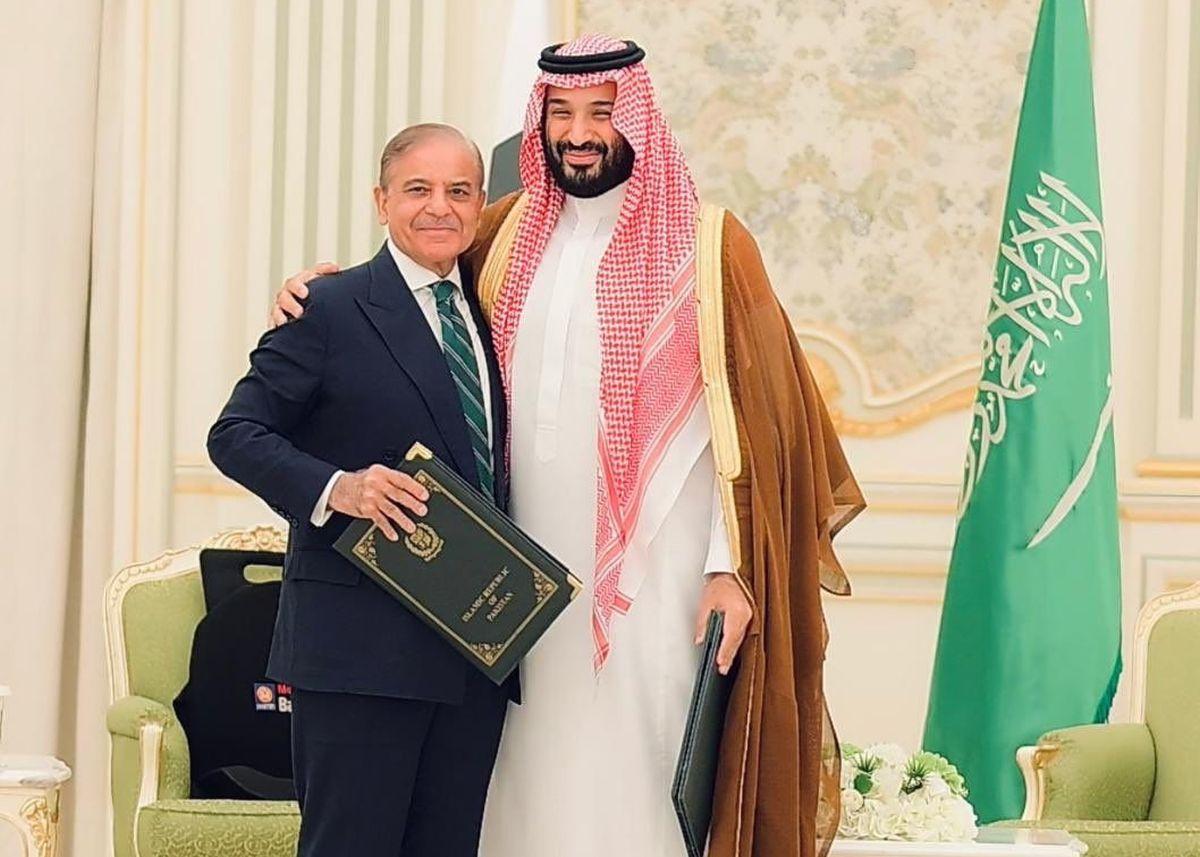
Can this lead to the formation of an Arab-Islamic NATO-like alliance?
There is no indication of a NATO-like organisation emerging in the Middle East at this moment.
The need for a major military axis that can provide an anchor for such an organisation is missing.
Plus, the regional countries suffer from trust-deficit among themselves for obvious reasons.
Feature Presentation: Aslam Hunani/Rediff









 © 2025