

'Today, the State looks at everyone with suspicion.'

Months before the Bihar state assembly election, the Election Commission of India (ECI) started a Special Intensive Revision (SIR) of the electoral rolls in the state.
The reason for SIR according to the ECI was to 'ensure that no eligible citizen is left out while no ineligible person is included in the Electoral Roll'.
But the Opposition parties did not take kindly to the SIR, which they charged with discriminating and disenfranchising voters.
What was shocking was the exclusion of the Aadhar card and Voter ID card as identity proof.
Those who feared that the ECI's move would affect the vulnerable population, especially those in the rural areas, migrant labourers, and individuals who might have lost personal belongings in floods or other natural disasters over the years, appealed to the Supreme Court.
The Supreme Court came heavily on the Election Commission's decision to ask for multiple documents for roll revision in Bihar. The Supreme Court urged the Election Commission to accept Aadhaar, ration cards and EPICs for voter identity verification.
It appears the ECI is firm on its decision to exclude the Aadhar card and Voter ID card.
The enumeration drive in Bihar began on July 1 and the draft electoral roll will be published on August 1. The final roll will be out on September 30.
"What is the purpose of this whole exercise? If it is de-duplication, this hurried and form-driven way seems no answer," Dr Usha Ramanathan, who has been campaigning on the social, legal and economic aspects of the Aadhar card project from 2009 onwards as an independent legal researcher, tells Rediff's Shobha Warrier.
- Part 1 of the Interview: 'Linking Aadhar With Voter ID Is Very Dangerous'
The Supreme Court wanted the Election Commission to consider Aadhar and Voter id as valid identity proof. But the Election Commission is not ready to accept that...
There are two things. One, it is deeply disappointing that the Supreme Court has no institutional memory.
It was seven years ago that a judgment was given by the Supreme Court warning against the expansion of the UID.
A year before that, in 2017, a 9-judge bench had unanimously recognised the right to privacy as a fundamental right, and that was a question that arose from the UID case.
Unfortunately, the Supreme Court of today is not cognisant of it at all.
The interesting thing is the Supreme Court did not say you must use the UID. What they said was you must consider UID also.
It seems they considered it, and decided not to go ahead with it.
It would be interesting to hear from them the many reasons why.

The Election Commission told the Supreme Court that Aadhar only shows 'I am I, and you are you'... just an id card.
If you read the UID majority judgment, the same sentiment was reflected there.
And do you know the source? It was a WhatsApp forward!
This made me very uncomfortable, that the source for the Supreme Court was a WhatsApp forward.
Can you imagine the beginning of a majority judgment in a matter of deep Constitutional significance quoting a WhatsApp forward?

Even today, the situation is, we don't exist if we don't have an Aadhaar card. This is moving away from that. Do you think sense will prevail?
If you look at the document the Election Commission prepared for the block officers, it is dated the 24th of June 2025 and the exercise according to them starts from the 25th of June.
The whole exercise was to get over within a month.
In that time, they were to set a protocol for undertaking the exercise, train all the officers and then they were to finish the task in the time left to them before the month was out.
That included the block level officers going from house to house, filling forms, uploading them, while helping those who are unable to handle the forms on their own. Among the tasks listed out for the BLO is to 'give recommendations on each enumeration form received'.
What is the kind of onus are you putting on a block level officer?
And all this has to be done in one month.
Today, in this country the block level officer or, as we are seeing in other circumstances, the local policeman decides if our citizenship is in question!.
It is not over. The Election Commission says this is just the first step.
They want to do SIR for the whole country. They are starting with Bihar as the elections are close.
The electoral roll that was built up over the years was doing fine.
There have been periodic revisions and updates, dating to as recently as earlier this year.
What did they find wrong with it that they thought it necessary to do a SIR now?
Especially with there being little to no time to do a proper job, and with anxieties rising about disenfranchisement and exclusion.
After all, with regular updating, many elections have been held without all this.
In 2018-2019, when the Election Commission was asked, how many foreigners they have found, they said, three. That is, one each in three states.
What are they expecting to find, and why now, and why in this rush?
The Election Commission has said that if people do not manage to upload their forms, or have not submitted it, they will be taken off the voter's list.
This is serious.
Reports from the ground show the short cuts being taken by the block level officers because of the impossible targets set for them.
I was also looking at the documents needed, in the list. Birth certificate, passport, permanent residence certificate, caste certificate, 'family register', forest rights certificate, matriculation certificate, house or land allotment certificate, ID or pension payment order issued to regular government employee or pensioner, any ID, certificate or document issued by the government prior to July 1, 1987.
Where do we have all these documents?
How many may have none of these?
Is that how the State functioned, maintaining impeccable registers and giving people IDs?
Notice that there is no onus on the State, at all. It is all on the individual.
Let's look at one more thing. What is the purpose of this whole exercise? If it is de-duplication, this hurried and form-driven way seems no answer.
It is a digital system, and using AI to find potential duplicates and checking up on it with the human in the loop could have been tried.
Have they done that? If they did, what happened? If not, why not?
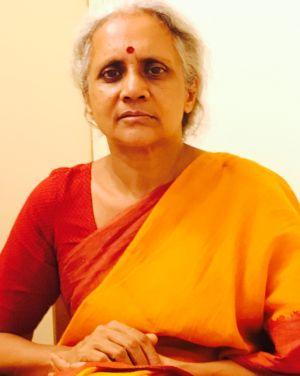 IMAGE: Dr Usha Ramanathan
Where will this lead to?
There is little doubt that this will lead to a heavily damaged electoral roll.
Those who have helmed the ECI earlier are also saying this, that it is going to be an utter disaster.
In the process, you are making every citizen of this country a 'doubtful voter'.
When the block level officer recommends that a voter be treated with suspicion, there is neither any guideline on what may raise suspicion, nor do they have to furnish a reason.
Only when the decision is made does the officer have to give what is called a 'speaking order'.
The individual may then appeal, and appeal again.
In the meantime, their voting right, even their citizenship, may be suspended with consequences I will leave to your imagination.
The first election commissioner wrote a report about the first election in 1951-1952 in which he says how they saw their task.
What they tried to do, he said, was to give voting rights to people, because people should have the right to vote.
It is not some charity given by the State to people.
Why was it decided to adopt adult franchise? Because, he said, the State respected people.
Today, the State looks at everyone with suspicion.
The direction they are going is not right.
It is as though the country is territory, not the people.
It is as if the State is the country, not people.
That is a very tragic way to look at a country.
Feature Presentation: Aslam Hunani/Rediff







 © 2026