

When the technology gap between China and India will remain large, cost-effective hardware of the kind that proved their worth in Operation Sindoor should be our priority, points out R Jagannathan.

After the Pahalgam massacre of innocents and Operation Sindoor, India is faced with a brutal reality check.
First, even though we achieved what we set out to do -- raising the costs of terrorism for Pakistan -- the ground has shifted beneath us.
China is doubling down on backing Pakistan, and it is joined by Islamic countries like Turkey and Azerbaijan.
One can be sure that the grand HQ of world terrorism will be rearmed and supported economically by China and other allies.
Then, there is also the porous eastern border and an increasingly unfriendly regime in Bangladesh.
The United States under Donald Trump has turned out to be a superpower with a flexible spine. Far from being supportive, it has ended up re-hyphenating Pakistan with India.
The two superpowers, the US and China, seem to have an unstated common interest in keeping India down a notch.
Clearly, we will have to prepare for and manage our battles largely on our own, with help only from tactical allies like Israel and Russia.
But Russia, thanks to the Ukraine war, is now in a closer embrace with China, and Israel is increasingly getting isolated from the West, thanks to its aggressive actions in Gaza.
We can't ultimately count on them, if they come under pressure themselves.
India has to rethink, restrategise, reorient and rearm appropriately to respond to these developments. A few questions come up immediately.
One, how much should India build on its own, and how much of its military hardware must it buy from vendors abroad?
Two, when it comes to the crunch, which countries will prove to be more reliable partners -- both in terms of defence and economic alliances?
Three, in the context of the lessons of Operation Sindoor itself, where drones and missiles played the biggest part on both sides and where our air defences and land-based artillery turned out to be the trump cards blunting Pakistani attacks, is our focus on costly military acquisitions for land, air and sea warfare really going to provide a bang for the buck in future?
A fourth challenge is more immediate. One has to expect more aggression from Pakistan, possibly in the months ahead, and since military buildups can take years to materialise, we need short-term defence options too.
Build or buy?
India's 'atmanirbhar' approach (self-reliance) is most relevant in defence, where self-reliance pays off in spades.
Military supplies can be incredibly hard to source at reasonable cost, both for political reasons and because demand is hitting new highs due to several ongoing wars -- Russia-Ukraine and West Asia being just two examples.
The US military-industrial complex is stretched even to meet its own military needs and those of its allies.
Russia is over-stretched with its war in Ukraine still dragging on. The GE engines for India's Tejas Mark 1A combat aircraft have been incredibly delayed, and so have Russian supplies of the S400 missile system.
Even if this weren't the case, there will be political costs to be paid for relying too much on Western or even Russian supplies, especially when Europe itself is seeking to rearm.
The big success during Operation Sindoor was the indigenous Akash missile system, which not only thwarted Pakistani drone attacks, but cost us very little to develop and deploy.
It is estimated that the Akash missile costs around $500,000, against Western systems that cost twice or three times as much.
Even in the case of drones, where quantity matters almost as much as quality -- it would be far cheaper to develop them locally, especially when it may take a $500,000 missile to take down a $25,000 drone.
We must develop cheap, smaller, and more agile and 'intelligent' drones in large quantities.
While indigenously-built offensive and defensive hardware has to be prioritised, it will not be enough in the short-to-medium term.
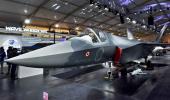
With China now signalling the sale of even more sophisticated fifth generation fighters with stealth capabilities (J35A) to Pakistan, India has to match this capability in the shortest possible time.
The Rafale, which is said to have faced some hits in Operation Sindoor, can be improved, but for that France must be willing to share the source codes -- which it has been reluctant to do.
Buying some squadrons of stealth aircraft, possibly from Russia, with the promise of technology transfers, may need consideration, not least because the ecosystem for Russian equipment already exists.
Who to build with?
This brings us to the next question: Which countries are likely to prove most reliable in enhancing our defence output and capabilities?
Russia and Israel are obvious choices here -- at least, until they prove otherwise.
But our next bets may well be the midi powers of Europe and Asia, not the US, which can never be counted upon in a crisis.
France, West Germany, Sweden and Japan are some of the countries with which to build co-development partnerships, along with some of the lesser powers in Europe (Spain, Italy, Poland), Latin America (Brazil), and the rest of Asia (South Korea, Indonesia).
We should explore joint development of aircraft engines, warships, and submarines with these partners, with no partner having overwhelming dominance in our supply chains.
The one key consensus we already have is that our private sector will have a growing role in defence production.
What to build or buy?
In the Russia-Ukraine and West Asia wars, and in our own Operation Sindoor, we saw that high-cost defence hardware like fighter aircraft or tanks or warships were not as important as drones and missiles.
Swarms of cheap drones and a rain of missiles can often cause more damage at lower cost than expensive aircraft and warships -- as Ukraine's Spiderweb drone strikes on Russia's bombers showed.
While we cannot do without these instruments of war, one must question whether large aircraft carriers and expensive fighter stealth aircraft will prove all that useful in future wars.
Some defence websites suggest that stealth aircraft can also be detected and neutralised.
As for the big armadas, the less said the better.
The US aircraft carrier Harry S Truman lost three modern fighter jets and had to turn back and return home after a brief attempt to target the Houthis in Yemen.
A superpower with high-tech hardware had to beat a hasty retreat when faced with missiles dispatched by a ragtag military regime.
When a supersonic cruise missile can damage a large warship easily, and when hypersonic missiles are already under development and increasingly ready for deployment, large and easily targetable platforms may not be the way to go.
We probably need small, and more agile platforms that are fast and harder to detect.
This writer is no military expert, but these are common-sense observations -- more so when we compare the relative costs, both actual and in terms of opportunity.
In the immediate future, when the technology gap between China and India will remain large, cost-effective hardware -- of the kind that proved their worth in Operation Sindoor -- should be our priority.
While we do need a sharp increase in defence spending, targeted spending based on an understanding of where our offensive and defensive hardware will actually be needed, will ensure that this defence spending does not come at the cost of our development goals.
R Jagannathan is a senior journalist
Feature Presentation: Aslam Hunani/Rediff








 © 2026