

If we, as an audience, are mature enough to dissect facts from fiction, and propaganda from creative storytelling, the director and technical team deserve full credit for putting together an entertaining masala film that deserves a sequel, notes Divya Nair.

Key Points
- Dhurandhar released on Netflix on January 30.
- Dhurandhar's OTT version is 9 minutes shorter than its original theatre version.
- Responding to criticism over low quality print and colour grading, Netflix has now uploaded a revised version of the film.
Why people are talking about Dhurandhar's OTT version

After months of speculation, 2025's biggest blockbuster Dhurandhar arrived on OTT on January 30. While the makers would have expected the audience to binge watch the 3 hour 25 minute film, Dhurandhar's OTT version found itself in the middle of a fresh controversy.
Within hours, the Internet was flooded with fans criticising the 9 minute cut, which included offensive words being muted and certain scenes being cut short abruptly.
But most of all, Dhurandhar fans couldn't help but notice the poor quality of visuals and colour grading issue in the OTT version. While Netflix did not address any of the feedback, members of the audience have pointed out that Netflix has fixed the glitches by releasing an updated version of the film.
Is Dhurandhar real or fictional?

In Dhurandhar, Director Aditya Dhar attempts to tell a fictional story inspired by real events about an Indian spy Hamza aka Jaskirat Singh (played by Ranveer Singh), assigned to infiltrate into Pakistan as a part of a covert operation to gather and provide intelligence to India.
Once in Lyari, Pakistan, Hamza secures the trust of gangster Rehman Dakait (Akshay Khanna), eventually joining his gang and decoding their modus operandi.
Though the film's disclaimer states that the events and people are fictional, the director has used several minutes of real footage of the 2001 Parliament attack in Delhi and the 26/11 Mumbai attack for impact, raising questions about the film's political intent and purpose.
Dhurandhar: The best performances

Ranveer Singh is exceptional as Hamza. His subtle, restrained acting and gradual transformation is winning praise from all over. He uses his eyes to express pain, sorrow, love, anger, guilt, terror and sometimes even emptiness.
Akshaye Khanna is splendid to watch as Rehman Dakait, a man anyone would be tempted to google and know more about.
Sanjay Dutt and Arjun Rampal contribute equally powerful performances as SP Chaudhary Aslam aka Jinn, and Major Iqbal aka 'angel of death', justifying their titles.
Among the supporting cast, Naveen Kaushik breathes life into Donga, Dakait's right hander.
The makeup team has done a stellar job especially with Ranganathan Madhavan who looks unrecognisable as Intelligence Bureau director Ajay Sanyal.
Gaurav Gera's transformation and performance as Mohammad Aalam is also worth applauding.
Dhurandhar's music evokes nostalgia
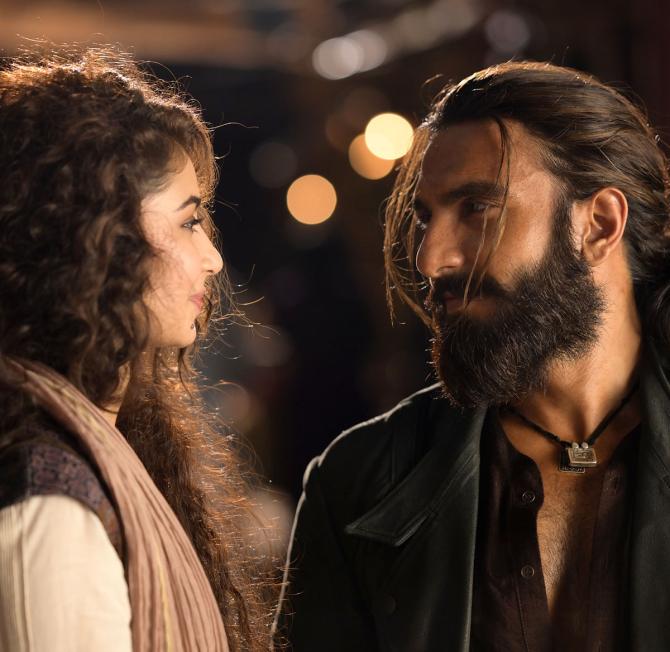
Aditya Dhar's second collaboration with Shashwat Sachdev (they previously worked together on Uri) deserves applause for taking us on a nostalgic musical rendezvous of the 1980s and 1990s.
The standout tracks including Rambha Ho, Piya Tu Ab To Aaja, and Hawa Hawa are reintroduced during key moments of the film, amplifying the whole audio experience.
Was extreme violence necessary in Dhurandhar?

The makers have gone all out trying to introduce creative and extreme ways of torture and violence designed to make audiences squirm and wince, or maybe close their eyes and look away from the screen; particularly the scenes where Major Iqbal interrogates an Indian spy and Hamza confronting one of Dakait's men pushed the boundaries of onscreen brutality.
Obviously, some scenes are intended to make you feel angry and uncomfortable.
If we, as an audience, are mature enough to dissect facts from fiction, and propaganda from creative storytelling, the director and technical team deserve full credit for putting together an entertaining masala film that deserves a sequel.
Photographs curated by Satish Bodas/Rediff




 © 2026