

You don't need a six-figure salary to build wealth -- you need discipline and a smart plan, says Ramalingam Kalirajan and shows you how.
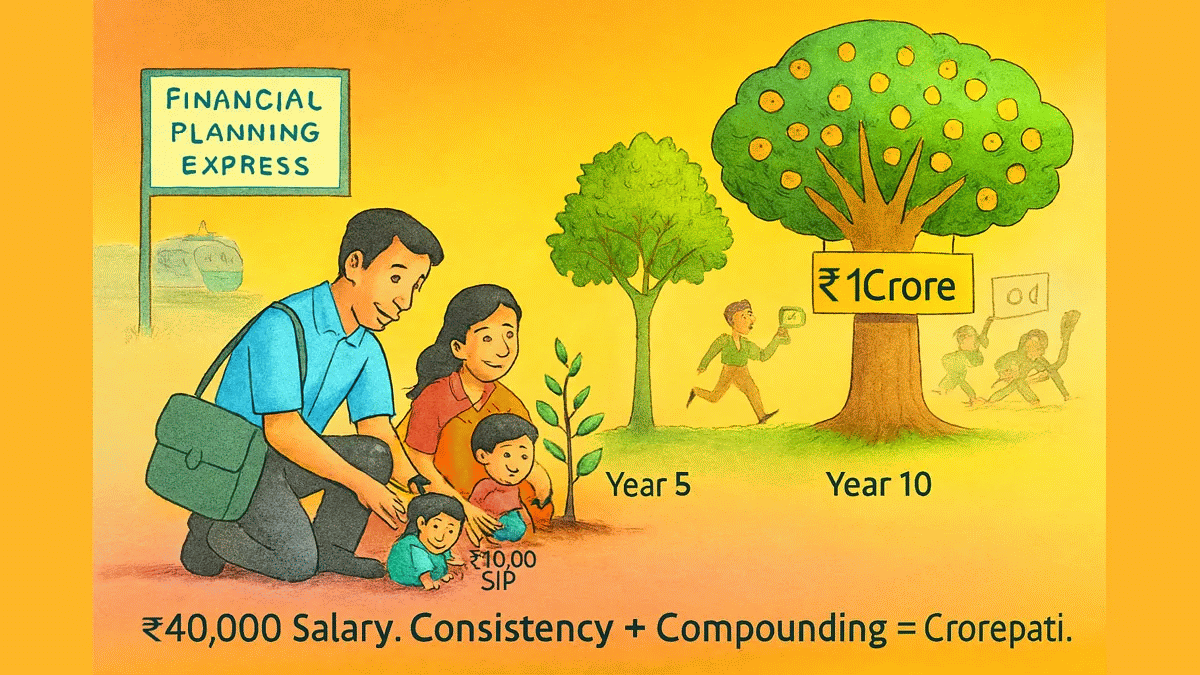
Imagine standing at a railway station without knowing where the train is going. Would you just hop on and hope for the best? Probably not.
Yet, many people do exactly this with their money.
They invest without knowing the destination, the timeline, or the resources required.
This is where financial planning steps in -- it's not just a compass, it's your roadmap to financial independence.
It helps you:
- Define what you want (retirement at 55, child's education, a dream house).
- Assess how much risk you can handle without losing sleep.
- Match your investment vehicle with your goal's timeline.
Without planning, even the best investments may not serve you.
1. Investment Vehicles: Choosing the Right Mode of Transport
Every journey needs a mode of transport, right?
Similarly, wealth creation depends on which 'vehicle' you choose to carry your money forward.
Fixed Deposits (FDs): These are safe, predictable, and familiar. But just like a bus, they move slowly. They might not beat inflation, which means your purchasing power weakens over time.
Debt Mutual Funds: A train journey -- faster than a bus, still relatively safe, but with occasional halts. Perfect for conservative investors who want slightly better returns than FDs.
Equity Mutual Funds: Think of them like flights -- fast, efficient, and ideal for long journeys. Yes, there's turbulence, but if you stay seated long enough, you'll land safely at your destination with significant growth.
Stocks: This is like driving your own sports car on an open highway -- thrilling, high-speed, but very risky if you don't know the terrain. One wrong turn and you could crash.
So, the question is: would you take a bus when you need to reach your goal quickly, or would you fly?
The answer depends entirely on your risk appetite, timeline, and financial discipline.
2. Common Challenges Investors Face
Many investors think simply putting money somewhere is 'investing.'
But without clarity, it's just wandering. Let's break down the real challenges:
- Suitability: Not every investment is right for every goal. Saving for retirement in an FD may leave you short; using equities for a 2-year goal may expose you to unnecessary volatility. Are you matching the right tool to the right job?
- Liquidity: Life is unpredictable. Emergencies arise. If all your money is locked in non-liquid investments, how will you access it when you need it most? Liquidity ensures flexibility.
- Safety: High returns are tempting, but at what cost? If safety is ignored, you risk losing your hard-earned money. Is the scheme backed by trust and stability?
The lack of strategy is what turns potential wealth into disappointment.
Without answering these questions, investments remain blind bets.
3. Behavioural Mistakes That Derail Wealth Creation
You might think markets or inflation are the biggest threats to your wealth.
But the real danger is your own behaviour.
Human psychology often works against smart investing.
Loss Aversion: Losing Rs 1,000 feels worse than the joy of gaining Rs 1,000. That's why many investors refuse to sell a bad investment, waiting endlessly for recovery. Isn't this like keeping a sinking boat afloat just because you don't want to admit it's sinking?
Herd Mentality: 'My neighbour invested in this stock, so I will too.' Familiar story? Following the crowd often means buying at the peak and selling in panic. If everyone is rushing in one direction, shouldn't you pause and ask why?
Overconfidence: After a few successful trades, many investors believe they've cracked the code. But markets are unpredictable, and overconfidence often leads to reckless risks. Isn't humility safer than arrogance when it comes to money?
Greed: The fastest way to destroy wealth. Promises of doubling money overnight -- be it crypto hype, penny stocks, or intraday trading -- lure many. But let's be honest: if getting rich quick was so easy, wouldn't everyone already be rich?
Recognising these biases is the first step toward smarter investing because often, it's not the market but our own mind that stands in the way of financial success.
4. Short-Term vs. Long-Term Investing: What Really Matters
Many investors often confuse short-term with long-term.
Some believe that holding an investment for one year is 'long-term.' But the reality?
True wealth creation requires time, patience, and discipline.
Short-term goals (under 3 years): These are things like saving for a vacation, buying a two-wheeler, or building a small emergency fund. Since safety matters more than high returns here, options like Fixed Deposits (FDs) or Debt Mutual Funds are better. Why risk volatility for a short-term need?
Medium-term goals (3 to 5 years): Think about saving for your child's school admission, or a down payment on a house. Here, Hybrid Funds (a mix of debt and equity) work best. They provide growth but cushion you from extreme ups and downs.
Long-term goals (5+ years): This is where the magic of compounding truly shines. Retirement planning, wealth accumulation, or funding your child's higher education fall into this category. Equity Mutual Funds and Stocks can deliver 12–13% annually over long periods -- far outpacing inflation.
Remember, time is your best ally.
Isn't it amazing that by simply holding your investments longer, you allow compounding to do the heavy lifting for you?
5. Can a Salaried Person Really Become a Crorepati?
The answer is a resounding YES.
You don't need a six-figure salary to build wealth -- you need discipline and a smart plan.
Let's break it down with an example:
- Suppose you earn Rs 40,000 a month. If you:
- Invest Rs 10,000 monthly via SIP
- Increase it by 10% every year (Step-Up SIP)
- Stay invested for 17 years
- And earn an average of 12% annual returns
- You could build a corpus of Rs 1 Crore or more.
Surprised? Most people think only business owners or high-salary professionals can become crorepatis.
But the truth is, even with a modest income, consistency beats size.
Think of it like fitness: you don't need to lift 100 kg weights on day one.
But if you lift smaller weights consistently, increasing them gradually, you'll build serious strength over time. Isn't wealth creation the same?
6. The Role of Family Budgeting in Wealth Creation
If investing is the engine of wealth, then budgeting is the steering wheel.
Without it, you'll go off track no matter how powerful your engine is.
That's where the 50:30:20 rule comes in -- a simple framework that keeps you balanced.
Category Allocation Example (Rs 40,000 salary):
- Needs (rent, EMIs, groceries) -- 50% (Rs 20,000)
- Savings & Investments -- 30% (Rs 12,000)
- Wants (lifestyle, shopping, dining out) 20% (Rs 8,000)
This method ensures that you live comfortably today while securing tomorrow.
But here's the catch -- most people reverse this ratio. They spend 50% on wants, 30% on needs, and only 20% (or less) on investments.
Then they wonder why their money never grows.
Isn't it smarter to pay your future self-first before indulging in today's luxuries?
Even better, by applying this principle in your 20s, you give your money decades to grow.
And the earlier you start, the less you need to save later.
7. Why You Need Expert Guidance
Financial planning isn't about chasing the next hot stock or copying what your friends are investing in.
It's about making smart, consistent decisions that align with your unique goals, risk profile, and life stage.
Yes, even with a modest Rs 40,000 salary, you can become a crorepati if you plan, invest, and stay disciplined.
But let's face it -- navigating the world of mutual funds, equities, and tax-saving instruments can be overwhelming.
Why walk this journey alone?
A Certified Financial Planner (CFP) can help you avoid costly mistakes, guide you toward the right strategies, and keep you disciplined through market ups and downs.
When it comes to wealth creation, having the right guide can make all the difference.
- You can ask rediffGURU Ramalingam Kalirajan your questions HERE.
Ramalingam K, an MBA in Finance, is a Certified Financial Planner. He is the Director and Chief Financial Planner at holisticinvestment, a leading financial planning and wealth management company.

Disclaimer: This article is meant for information purposes only. This article and information do not constitute a distribution, an endorsement, an investment advice, an offer to buy or sell or the solicitation of an offer to buy or sell any securities/schemes or any other financial products/investment products mentioned in this article to influence the opinion or behaviour of the investors/recipients.
Any use of the information/any investment and investment related decisions of the investors/recipients are at their sole discretion and risk. Any advice herein is made on a general basis and does not take into account the specific investment objectives of the specific person or group of persons. Opinions expressed herein are subject to change without notice.










 © 2026