

Investors should be mindful of the high volatility in cryptos: Bitcoin has fallen more than 80 per cent in past corrections.
Bitcoin surged to an intraday peak of $123,153.22 on July 14 and is now trading at around $118,000 -- a rise of about 25 per cent since January.
Indian investors, who led the 2024 Global Crypto Adoption Index by Chainalysis, a New York-based blockchain data and analytics firm, must avoid getting carried away by the euphoria in this market.
Drivers of the rally
Stronger regulatory signals from the Donald Trump administration and progress in US crypto legislation are driving institutional interest.
"The GENIUS (Guiding and Establishing National Innovation for US Stablecoins) Act officially became law, while key Bills like the Clarity Act and Anti-CBDC Surveillance Act made progress through the House Rules Committee," says Ashish Singhal, cofounder, CoinSwitch.
The rally may sustain if regulatory clarity improves.
"The Clarity Law is expected to be passed by the US Senate soon. This will result in clearer regulations for crypto trading in the US," says Himanshu Maradiya, founder and chairman, CIFDAQ, a fintech company that offers solutions related to blockchain and cryptos.
He also cites the possibility of 401(k) retirement plans -- which manage approximately $9 trillion -- being allowed to invest in cryptos. Even a small allocation by these plans could attract billions into crypto.
"With institutional, high networth individuals, retail investors, and even sovereign wealth funds moving towards investing in crypto, the outlook is positive," says Maradiya.
Key risks
Macroeconomic developments that affect risky assets could have an adverse impact.
"Macroeconomic pressures like Federal Reserve rate hikes or strengthening of the US dollar, and large institutions unwinding their positions for profit-taking, or to liquidate their leveraged bets, could trigger a sell-off," says Abhishek Kumar, Sebi-registered investment advisor and founder, SahajMoney.com. The current rally is being driven by regulatory clarity.
"If regulatory hurdles arise, they could affect the rally," says Maradiya.
Investors should also be mindful of the high volatility in cryptos: Bitcoin has fallen more than 80 per cent in past corrections. Regulatory uncertainty in India compounds risks.
"Cryptocurrencies are not legal tender in India, which means they cannot be used for payments," says Kumar. Tax provisions are stringent.
"Gains are taxed at a flat rate of 30 per cent plus 4 per cent cess.
"One per cent TDS (tax deducted at source) must be paid on transactions above Rs 50,000. No loss offsetting is allowed," says Kumar.
Non-disclosure could lead to steep penalties, and accounts could be frozen.
Investors also face cybersecurity risks, as seen in the $325 million WazirX hack and $44 million loss (of its reserves) at CoinDCX.
Since crypto assets are not regulated products, limited protection is available to consumers.

Limit your allocation
Securities and Exchange Board of India registered investment advisors cannot advise on unregulated crypto assets.
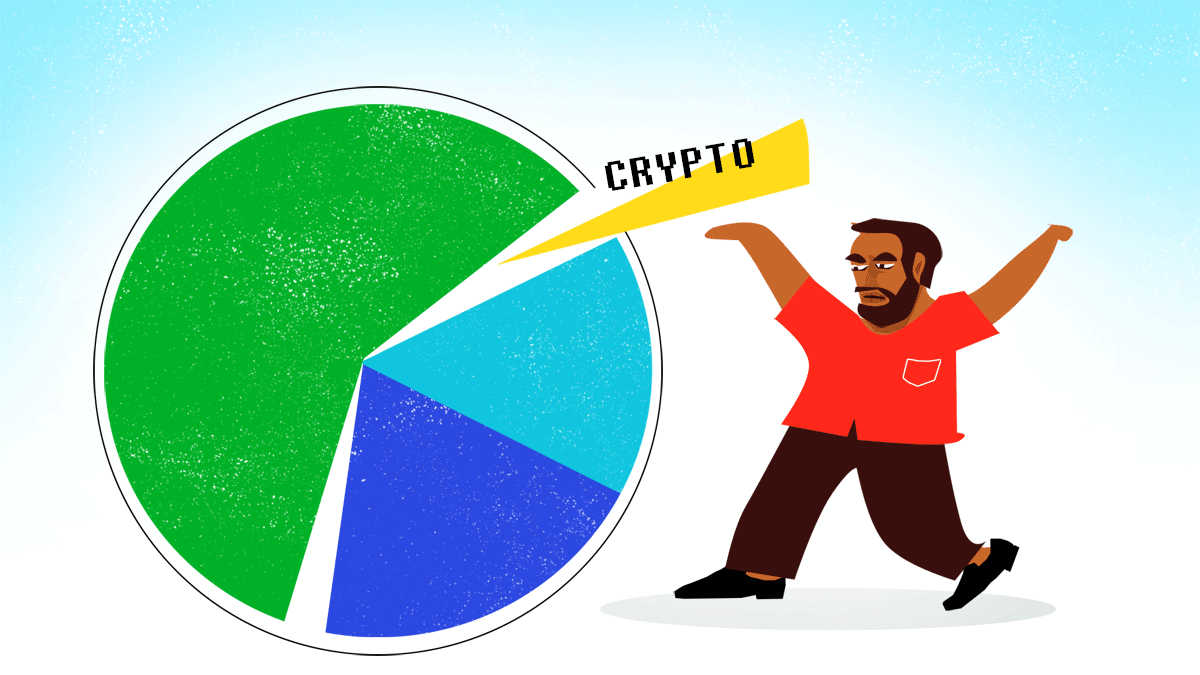
Informally, most recommend capping exposure at 2 to 5 per cent of one's portfolio. They suggest only investing what one can afford to lose without affecting financial stability.
Store only actively traded cryptos in hot wallets.
"If you plan to hold cryptos for a long time, store it in a cold wallet, which could be a hardware wallet or with a good custodian," says Maradiya.
Large holdings should be spread across multiple wallets and stored securely.
"Set up PINs, biometric authentication and two-factor authentication. Never share sensitive data with anyone," says Singhal.
Disclaimer: This article is meant for information purposes only. This article and information do not constitute a distribution, an endorsement, an investment advice, an offer to buy or sell or the solicitation of an offer to buy or sell any securities/schemes or any other financial products/investment products mentioned in this article to influence the opinion or behaviour of the investors/recipients.
Any use of the information/any investment and investment related decisions of the investors/recipients are at their sole discretion and risk. Any advice herein is made on a general basis and does not take into account the specific investment objectives of the specific person or group of persons. Opinions expressed herein are subject to change without notice.
Feature Presentation: Ashish Narsale/Rediff



