

Most people think tax-saving deductions exist only in the old regime. But the new one quietly retains 40+ ways to ease your tax load.
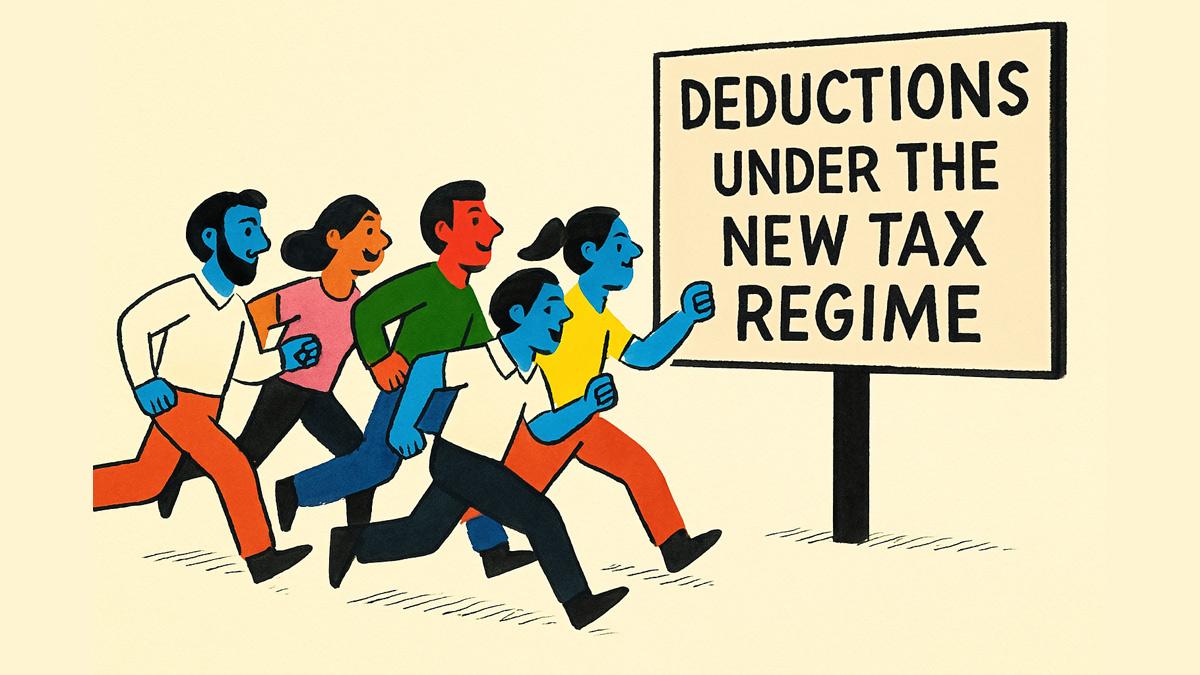
India's New Tax Regime isn't exemption-free. From standard deduction to NPS benefits and capital gains reliefs, several tax-saving provisions remain.
The popular shorthand for India's New Tax Regime -- 'no exemptions, just slabs' -- misses important nuance.
The new slab structure does simplify tax computation, but it doesn't sweep away every tax relief. For FY 2024-2025 (Assessment Year 2025-2026) the government has retained and even clarified a clutch of exemptions and allowances that taxpayers can (and should) use.
Here's a practical guide to the clearest savings still available under the New Tax Regime.
ITR Deadline Qs? Ask Rediff Tax Gurus
What's still on the table?
Standard deduction for salaried taxpayers
Salaried individuals and pensioners filing under the New Regime can claim a standard deduction of Rs 75,000, a change made explicit in official FAQs released by the Income Tax Department. That means a meaningful automatic cut to taxable salary before slabs are applied.
Section 87A rebate: When your tax can fall to zero
A rebate under Section 87A continues to protect low-to-middle incomes: taxpayers with taxable income up to Rs 7 lakh (under the New Regime) can potentially reduce their tax liability to nil, though treatment of incomes taxed at special rates (like certain capital gains) calls for care during filing.
"There have been instances where the ITR utility doesn't auto-apply this rebate for special-rate incomes -- so manual scrutiny is advised," suggests chartered accountant and rediffGURU Vipul Bhavsar.
Employer contribution to NPS and related retirement benefits
Employer contributions to the National Pension System (NPS) retain favourable treatment under Section 80CCD(2) -- such contributions remain deductible (subject to the standard percentage limits tied to salary), even for those on the New Regime.
"This keeps employer NPS deposits an attractive, tax-efficient retirement vehicle," says Bhavsar.
Income-specific exemptions & allowances
- Leave encashment: Exemption limits for non-government employees have been widened; leave encashment up to Rs 25 lakh can be exempt on retirement/cessation in specified cases, so check the applicable conditions when you receive such payouts.
- Gratuity: Exemptions for gratuity payments continue (different caps apply for government and non-government employers).
- Family pension, travel and conveyance allowances, certain perquisites -- many continue to enjoy partial or full tax relief under specific conditions; the Income Tax department's pages on salary income lay out the qualifying rules.
Savings, investments and capital-gains rules
Not all investment returns are swallowed by the New Tax Regime.
Interest and maturity proceeds from PPF and Schemes like Sukanya Samriddhi remain exempt, and interest on notified tax-free bonds continues to be tax-free.
For equities and equity mutual funds, the LTCG exemption has been adjusted: LTCG up to Rs 1.25 lakh on listed equities/equity mutual funds is exempt, with amounts above taxed at the new specified rates -- a change flagged in budget updates.
"When capital gains are present, taxpayers must examine how they interact with Section 87A and slab computation for the year," says Bhavsar.
Gifts, inheritances and other carve-outs
Gifts received from close relatives remain fully exempt; gifts above a threshold from non-relatives attract tax unless covered by specific exceptions (marriage, inheritance, etc.). Property transferred by will or inheritance is not treated as taxable income.
"While the Income Tax department's FAQs explain these boundaries well it is always good to consult a tax expert before assuming taxability," cautions Bhavsar.
Why this matters -- and three quick action points
The New Regime isn't a 'one-size-fits-none' removal of reliefs; it is a leaner menu. That makes planning simpler in some ways, but it also means you must deliberate before picking a regime. Bhavsar suggests this checklist:
- Run a numbers comparison: For your salary, investment profile and capital gains, compute tax under both regimes before choosing.
- Use the preserved exemptions: Don't overlook the Rs 75,000 standard deduction, employer NPS credits, leave-encashment rules or LTCG carve-outs.
- Be precise at filing: Watch how special incomes (STCG/LTCG) interact with Section 87A -- the ITR utility may not auto-apply some rebates; claim them where due.
Bottom line
For FY 2024-2025 the New Tax Regime pares down complexity but preserves several targeted exemptions and reliefs. Treat the regime as a toolkit, not a straightjacket: with a little homework -- and a quick cross-check against official Income Tax Department guidance -- many taxpayers can still keep their tax bills noticeably lower.










 © 2026