

Banks offer a wide range of group insurance plans -- personal accident, health, hospital cash, home insurance, credit protection, and critical illness.
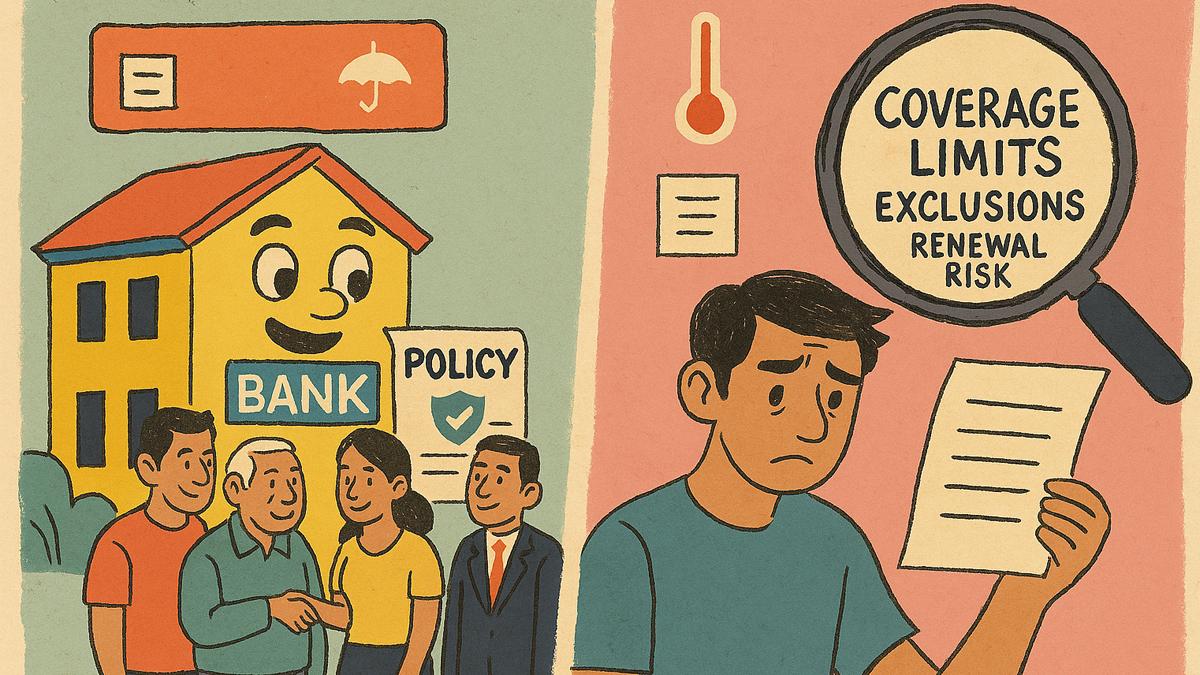
Sagar Malik, 54, a Delhi-based content writer, was recently informed by his bank that a group policy for which he had been paying the premium for several years was being terminated.
The abrupt termination of the policy left him feeling short-changed.
Range of group policies
Banks offer a wide range of group insurance plans -- personal accident, health, hospital cash, home insurance, credit protection, and critical illness.
"Typically, these products are linked to savings accounts, fixed deposits, credit cards, and other core banking products," says Arti Mulik, chief technical officer, Universal Sompo General Insurance.
Some policies are complimentary, with the bank bearing the premium.
"When a bank offers an insurance cover as an added benefit, it bears the premium for them. An example of such a bundled cover is personal accident with credit card," says Mulik.
Others are opt-in covers, for which customers provide consent and pay the premium.
Affordable, easy to onboard
A major advantage of group policies is affordability.
"A large customer base allows for effective risk distribution. This kind of risk pooling helps keep the insurance premiums affordable," says Mulik.
Group policies are also easier to onboard.
"The enrolment process gets simplified due to the established bank-customer relationship," says Sanjiv Roy, head -- affluent banking, wealth management and fee products, RBL Bank.
Customers often do not have to undergo medical checks.
"For standard group covers, medical waivers are provided for younger customers with a good health declaration, especially for lower sum insured options," says Roy. Health-related disclosures, however, are essential.
Customers can get tax relief on premiums.
"Premiums paid by customers for health-related group insurance covers may be eligible for tax benefits under Section 80D of the Income Tax Act, 1961," says Roy.
Dependent on banking relationship
Complimentary covers usually depend on product usage.
"They cease if the bank account is closed," says Shilpa Arora, chief operating officer and co-founder, Insurance Samadhan.
Paid covers usually continue even if the relationship ends.
Some plans -- like home loan protection -- are bundled with loans.
"In such group policies, material facts are often not properly disclosed. This can lead to claim rejection later," says Arora.
Group health plans may come with exclusions.
"Waiting periods or specific disease sub-limits can impact the effectiveness of the cover," says Binita Shah, director -- banking business, Anand Rathi Insurance Brokers.
Understand policy limitations
Do not sign up without understanding the nature of coverage -- life, health, accident, or critical illness.
Clarify whether it is an individual or floater cover.
These policies often come with limits.
The typical ones include room rent capping, disease-specific sub-limits (say, Rs 50,000 for cataract, Rs 3 lakh for cardiac surgery), limits on ambulance, ICU, or AYUSH treatments, and caps on maternity and modern procedures.
Shah recommends reviewing the benefits table and policy schedule. Understand the claim process and the insurer's turnaround time and claim settlement record. Also check if the sum insured meets your family's needs.
"One of the most important aspects to verify is whether pre-existing illnesses are covered, and if so, what is the waiting period," says Anita Upadhyay, chief executive officer, Lords Mark Insurance Broking Services.
Don't assume the policy will renew automatically each year.
"Check whether annual renewal is guaranteed or it is at the discretion of the bank or insurer," says Upadhyay.
- You can post your insurance related questions HERE
Disclaimer: This article is meant for information purposes only. This article and information do not constitute a distribution, an endorsement, an investment advice, an offer to buy or sell or the solicitation of an offer to buy or sell any securities/schemes or any other financial products/investment products mentioned in this article to influence the opinion or behaviour of the investors/recipients.
Any use of the information/any investment and investment related decisions of the investors/recipients are at their sole discretion and risk. Any advice herein is made on a general basis and does not take into account the specific investment objectives of the specific person or group of persons. Opinions expressed herein are subject to change without notice.
Feature Presentation: Ashish Narsale/Rediff











 © 2026