

'Exiting during corrections tends to lock in losses. Patient investors have benefited from holding through similar drawdowns in past cycles.'

Bitcoin, which touched a peak of $125,261 on October 6, 2025, is now trading at $91,691, down 26.8 per cent from its recent high.
The correction has triggered nervousness among investors.
Correction follows steep rally
According to experts, the decline is a natural market correction after an overheated rally.
"The dip could be a long-due correction after unchecked enthusiasm in recent months," says Rajagopal Menon, vice-president, WazirX.
With macroeconomic uncertainty increasing in the US, global risk appetite has weakened.
"Elevated US yields and inflation data surprising on the upside have played a part," says Sumit Gupta, co-founder, CoinDCX.
Exchange-traded fund (ETF) inflows have slowed after months of strong absorption, triggering profit-taking by short-term traders, Gupta explained.
The unwinding of leveraged positions has also contributed to the selling pressure.
Fears of a possible burst of the AI bubble have impacted tech stocks.
"Due to their correlation with cryptos, this decline has spilled over into digital assets," says Ashish Singhal, co-founder, CoinSwitch.
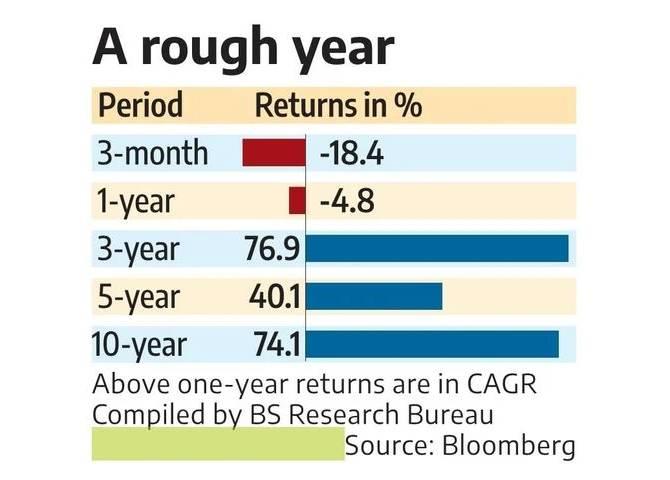
Near-term volatility expected
Volatility may persist in the short term as markets await clearer macro cues.
"Bitcoin will face downward pressure due to concerns over inflation, interest rates, and the overall market sentiment," says Abhishek Kumar, Sebi-registered investment adviser and founder, SahajMoney.com.
Another factor contributing to the current bearishness, according to Kumar, is regulatory uncertainty.
"Recovery will depend heavily on positive regulatory developments," he adds.
Gupta is of the view that the long-term outlook remains favourable.
"The supply of long-term holders is near all-time highs, showing strong conviction," he says.
Historically, he adds a 20 to 30 per cent correction has formed the basis for the continuation of major bull runs.
Some experts point out that not all investors have exited their positions.
"The sell-off is largely positional. Short-term holders and a small percentage of long-term holders are selling," says Menon.
"Institutions have paused investments but have not undone their crypto reserves," adds Menon.
Existing investors should stay put
Staying invested is the most prudent approach during corrections.
"Exiting during corrections tends to lock in losses. Patient investors have benefited from holding through similar drawdowns in past cycles," says Gupta.
The long-term factors in favour of Bitcoin -- increasing institutional participation, ETF adoption, etc -- remain intact, adds Gupta.
Investors with a multi-year horizon, he says, should even consider adding to their Bitcoin holdings, as it is trading at a more attractive price after the recent correction.
Menon, too, says that volatility can create windows for accumulation, though he does not favour purchasing blindly.
Other experts suggest that investors should review their risk tolerance and investment horizon carefully.
"Those not willing to experience high volatility should think about exiting from Bitcoin gradually," says Kumar.
Should new investors enter?
Any new investor thinking of entering the market at these levels should remember that price fluctuations may continue for some time.
The current correction does offer a more rational entry point than buying near all-time highs.
"New investors should only consider entering Bitcoin if they believe that they have the required risk tolerance and can stay invested for the long term," says Singhal.
Gupta suggests that new investors adopt a systematic investment plan-style approach, as it removes the need to time the market.
Menon adds that the allocation to Bitcoin should be proportional to an investor's tolerance for volatility.
Disclaimer: This article is meant for information purposes only. This article and information do not constitute a distribution, an endorsement, an investment advice, an offer to buy or sell or the solicitation of an offer to buy or sell any securities/schemes or any other financial products/investment products mentioned in this article to influence the opinion or behaviour of the investors/recipients.
Any use of the information/any investment and investment related decisions of the investors/recipients are at their sole discretion and risk. Any advice herein is made on a general basis and does not take into account the specific investment objectives of the specific person or group of persons. Opinions expressed herein are subject to change without notice.
Feature Presentation: Ashish Narsale/Rediff









 © 2026