

'It was tough to give up cricket. But I received very good guidance from my mother. She told me to become a nice human being, whether I am a good cricketer or not.'
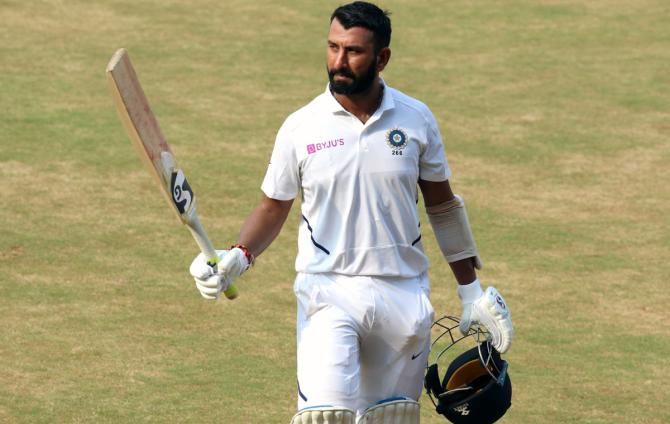
One of India's batting greats Cheteshwar Pujara called time on his illustrious Test career, on August 24, 2025.
Pujara could well be the last of his breed -- a Test specialist who prided himself on his match winning performances in red ball cricket, even in the cash-rich T20 era.
The Saurashtra right-hander was an integral cog of the Indian batting line-up, having featured in 103 Tests in which he raked up 7195 runs with 19 centuries.
He is famously remembered for his gritty knock in India's historic victory in the Brisbane Test of 2020-2021 when he kept the Australian pacers at bay for over five hours despite taking 11 hits on the body -- scoring 56 from 211 balls, helping India secure a three wicket win to clinch the series 2-1 -- their second successive series triumph in Australia.
Pujara revealed he played with a fractured finger in the Brisbane Test, grinding through the pain even after suffering another blow to that same finger during the match.
In the Delhi Test in 2013 as well, the India No. 3 had batted with a broken finger to guide India to victory.
"To sustain those blows, to stay strong during those adverse moments, I think that the spiritual journey has helped me immensely. Because when you believe in a superpower, when you believe in God, you get that strength, you get some help. And you get that internal strength to survive in adversities in tough moments and come out on top," Pujara tells Rediff's Harish Kotian in the first of a two-part exclusive interview.
You are one of the legends of the game. You are among an elite list of 14 Indian players to have played 100 Test or more. Looking back at your journey, how satisfied are you with your achievements?
I am really honoured to have represented the country for such a long time, to have played more than 100 Test matches. So, when I look back at my journey, at my career, I am really satisfied.
Also, I was a kind of a player who gave my best, whether I was playing for Saurashtra, or the India Under-19 team or the Indian team.
So, whatever level I have played, I always gave my best. I know that whenever I stepped on the field, especially for the Indian team, I gave my best.
The biggest satisfaction for me is that I have been part of some of the most memorable Test series victories for India, including the 2018-2019 series win in Australia and then again in 2020-2021.
Then the 2016-2017 home series against Australia, which was also one of the toughest series I have been a part of. So, when I look back at my journey, I am very satisfied
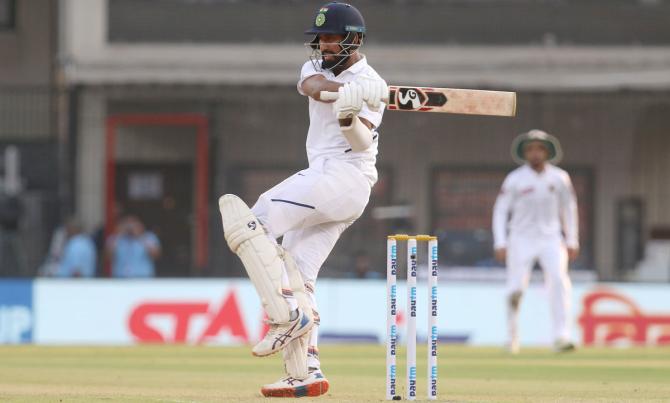
You played 278 first class games, scoring 21,000-plus runs including 7,195 runs in 103 Tests, you spent countless hours in the nets working on your batting. So finally one fine day, how tough was it to give up cricket completely?
Honestly, it was tough. But at the same time, I have always been guided. I have received very good guidance from my mother when I was young. She told me to become a nice human being, whether I am a good cricketer or not. But her advice, which I still remember, is to become a nice human being.
She was the one who introduced me to my spiritual guru Shri Haricharan Das Ji Maharaj, who is no more. He used to reside at Gondal (in Rajkot), and I used to seek his blessings often.
I used to ask him about my cricketing matters, but at the same time, also about my spiritual and religious journey.
And because of all those lessons, I could detach myself from the game. And I had to take this decision to move on from the game.
I thought it wasn't that difficult. Yes, when you are attached to something for such a long time, it becomes difficult. But for me, I think it was slightly an easier decision, because I could detach myself from the game. My Guruji gave me this lesson that nothing is permanent in life.
I lost my mom, when I was 17, that was one of the most difficult times in my life. Even at that time, I could move on from that, I could still stay in the present.
I received a lot of guidance from my spiritual guru. And that's why I thought that when I took that decision to retire, I took it happily. I never thought that I have been forced out of the game or I still want to play for another couple of years.
I thought this was the right time for me to move on from the game, try and provide opportunity to the younger players who can participate in the Saurashtra team.
And if I want to stay attached to the game, I have already started doing this media work, where I am commenting on the game. And if any of the young players needs my guidance at any point, I am always more than happy to help them.
If I can be of any help to any cricketer, not just cricketers in Saurashtra, but any cricketer in India or across the world, whenever I have been asked about the game, I have always been more than happy to try and tell them about my experience. I will always be happy to help them.
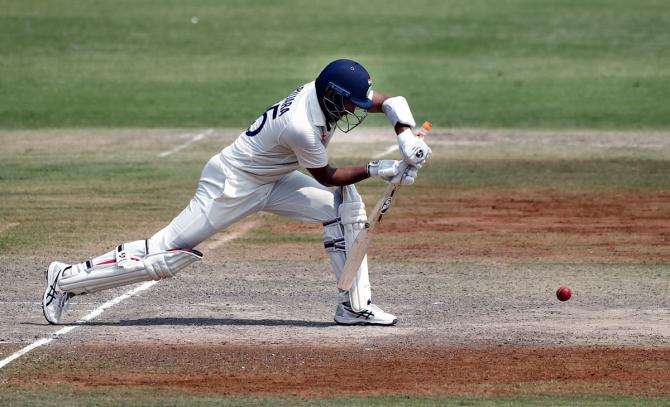
You spoke about spirituality and how your Guruji helped you immensely. Did spirituality help you in the field as well because at times when you batted you looked completely in your zone?
Yes, it did. I never did that for my game itself. I just wanted to do it in my life. But it helped me immensely in my game.
There were times where I was under pressure on the field. And those are the times where I can definitely recollect that I got that strength, I got that belief.
Also, the knock, people have been talking a lot about my innings in the Brisbane Test in 2020-2021, where I took a lot of body blows. But to sustain those blows, to stay strong during those adverse moments, I think that the spiritual journey has helped me immensely.
Because when you believe in a superpower, when you believe in God, you get that strength, you get some help. And you get that internal strength to survive in adversities in tough moments and come out on top.
You had a long first class career of nearly 20 years. Do you remember your debut as a 17 year old at your home ground in Rajkot?
I do remember that game (against Vidarbha in Rajkot). I scored a century against Goa in the next game. I have fond memories from those moments. When you make your first-class debut, you do remember those games.
Also, Saurashtra was in the Plate Group that season but eventually, we got promoted into the Elite Division and we started becoming a better team.
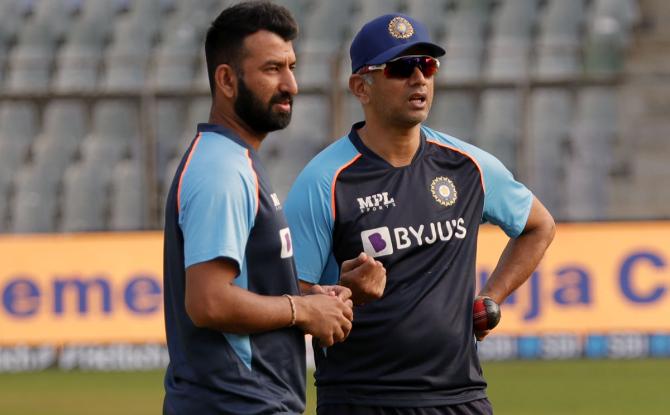
Talking about the Indian team, what was it like to fill the boots of a great player like Rahul Dravid at No. 3 in the Indian Test team?
I never looked at it that way because when I made my debut, I was playing alongside Rahul bhai. Also, I have learned a lot from him.
So, I never wanted to fill in that shoes. I never thought that I will be replacing or batting at No. 3 because when I made my debut, I was batting at No. 5. So, for me, it was about learning from senior players like Sachin paaji (Tendulkar), V V S Laxman, Gautam Gambhir, Virender Sehwag, Zaheer Khan, Harbhajan Singh. Mahi bhai (Mahendra Singh Dhoni) was captain.
We had so many senior players in the team and I wanted to learn from them, try and sustain at the highest level, so that was the goal initially.
But yes, once Rahul bhai retired, I was given an opportunity to bat at No. 3. And I have enjoyed that journey but I have never tried comparing myself or never said that I want to replace Rahul bhai because he has been a great ambassador of the game.
He is someone who has scored more than 10,000 runs in both Test and ODIs so, I didn't want to try and compare myself with him. He is someone whom I have admired and learnt a lot from.
When I look back at this journey, I would say I have done well at No. 3. But I don't think there is any comparison between me and Rahul bhai.
I am happy that whenever I got this compliment that my technique or my game is very similar to Rahul bhai, which was a big compliment. But at the same time, I have never tried comparing myself.
Tell us about the challenges of batting at the crucial No. 3 position where you batted in 155 out of your 176 innings in Test cricket, scoring 6,529 runs with 18 centuries. What are the key requisites for a batter at No. 3?
Firstly, when you are batting at No. 3, you don't know when you will be walking into bat.
Sometimes it can be in the first over before the non-striker gets to play his first ball or sometimes it can also be, say, 20th, 30th over. As a No. 3, you just need to be ready to go and bat at any time.
Also, I felt that, especially in overseas conditions, you play an important role because if the top three of your team performs well in overseas conditions, as a team, you will always put a decent total on the board.
In the SENA (South Africa, England, New Zealand, Australia) countries, I thought I played an important role.
When you are playing in India, it's slightly different. But overseas, that's where the major contribution should come from -- the top three or top four. That's when the team will be in a very good position.
- Part II of the Interview: 'I Was In Pain But I Always Put My Team First'










 © 2026