

'Once the currency goes out of the hand, then possibly your major challenge is that it will not come back.'
Key Points: India's Macros In Numbers
- Record FII exodus: Foreign investors pulled more than $20 billion (approximately Rs 1.92 lakh crore) from Indian equities in the first four months of 2026 -- surpassing the entire 2025 annual outflow of $18.9 billion -- as an Iran war-driven oil spike soured sentiment on Asia's third-largest economy.
- Rupee and markets under siege: The Nifty 50 and Sensex have fallen 8.2% and 9.8% respectively in 2026, while the rupee -- the worst-performing Asian currency this year -- has depreciated nearly 10% over twelve months, hitting a record closing low of Rs 95.71 to the dollar on May 13.
- OMC losses mounting to breaking point: State-run oil marketing companies IOC, BPCL, and HPCL are bleeding Rs 30,000 crore every month, losing Rs 14 per litre on petrol, Rs 42 per litre on diesel, and Rs 674 per litre on LPG at frozen retail prices -- with cumulative under-recoveries hitting Rs 1.98 lakh crore for the quarter.
- Growth downgrade and forex pressure: Moody's slashed India's 2026 GDP growth forecast by 0.8 percentage points to 6% -- down from 6.8% in 2025 -- citing high energy costs and subdued consumption, while forex reserves have fallen from a record $728.49 billion in February 2026 to $691 billion, as Bank of America projects the current account deficit widening to $87.6 billion, or 2.1% of GDP, in FY27.
- Domestic investors hold the line: Even as FIIs fled, domestic institutional investors pumped a record $15.4 billion (approximately Rs 1.4 lakh crore) into Indian equities in March alone -- offsetting the highest-ever monthly foreign outflow of $12.7 billion (approximately Rs 1.17 lakh crore) -- pushing DII ownership in Nifty-500 companies to a record 20.9%, overtaking FII ownership of 17.1% for the first time.
When Prime Minister Narendra Modi stepped before the nation last week and urged Indians to voluntarily curb gold purchases, cut fuel consumption, and forgo foreign travel, he did something Indian prime ministers rarely do: He signalled publicly that the good times, at least for now, may be over.
The appeal -- framed as a patriotic call to conserve foreign exchange amid the grinding West Asia conflict -- sent an immediate shockwave through Indian markets. The Nifty 50 and Sensex have fallen 8.2% and 9.8% respectively since the start of 2026, according to Business Standard data, with the bulk of the damage inflicted since Iran hostilities escalated in late February.
Foreign portfolio investors have fled in numbers not seen in a generation, pulling more than $20 billion from Indian equities in just four months -- surpassing the entire outflow of $18.9 billion recorded in 2025, according to National Securities Depository data.
The rupee, meanwhile, has depreciated over 10% in twelve months, plumbing record lows near Rs 95.65 to the dollar.
Markets were already on edge. Modi's words turned anxiety into alarm.
'The Damage Is Reversible -- For Now'
Ambareesh Baliga, one of Mumbai's closely followed independent market analysts, urges investors not to panic -- but is careful not to dismiss the warning either.
"It is a warning sign, no doubt," Baliga tells Rediff. "But even as of now, I would say the damage is reversible. If it continues for a year like this, then I think we'll have serious problems."
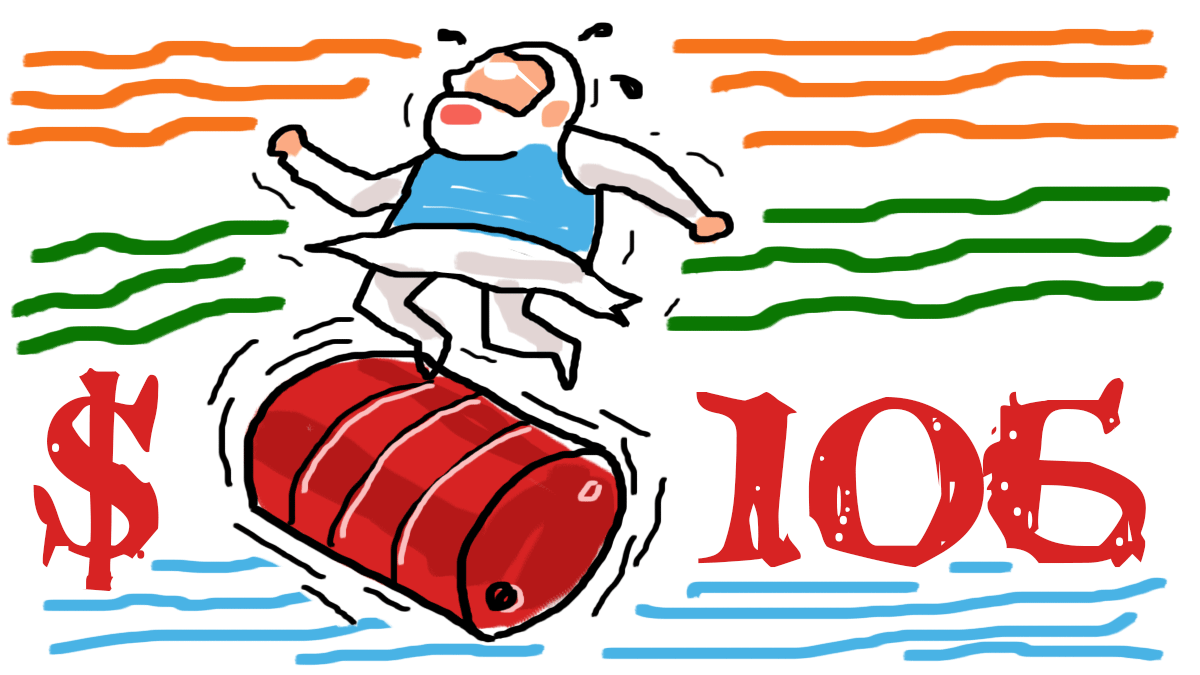
Baliga's qualifier matters enormously. Crude oil, which briefly dipped below $90 a barrel after early hopes of a quick ceasefire, has since surged back above $106, reflecting an 11-week conflict that both Washington and the markets badly miscalculated.
The United States had initially estimated a two-to-four week resolution. That confidence now looks strikingly naive.
For India, which imports approximately 90% of its energy requirements -- including crude and LNG -- according to Moody's Investors Service, every week of sustained elevated oil prices compounds the fiscal arithmetic. State-run oil marketing companies (OMCs) -- Indian Oil, BPCL, and HPCL -- are collectively absorbing losses estimated at Rs 30,000 crore per month, according to Business Standard, as the government has so far declined to pass on the full shock to consumers. Under-recoveries on petrol alone stand at roughly Rs 20 per litre, on diesel close to Rs 100 per litre, according to government statements cited by the publication
Oil Minister Hardeep Singh Puri, speaking at CII's annual business summit on May 12, gave the most authoritative official figure: OMCs are currently losing Rs 14 per litre on petrol, Rs 42 per litre on diesel, and Rs 674 per litre on LPG.
Baliga believes a fuel price hike is politically imminent, even arithmetically inevitable. "My feeling is they may do it only by Rs 10 so that it can be absorbed," he said. The calculus, he suggests, is partly opportunistic: The war gives the government a cleaner narrative than the alternative -- a cold fiscal correction with no external alibi.
"They can like, blame the war and increase the prices."
India's Forex Fortress Under Siege

India's foreign exchange reserves, long touted as a robust buffer, are eroding faster than comfort allows. The RBI's coffers have fallen from a record $728.49 billion in February 2026 to approximately $690.69 billion by May 1, according to Reserve Bank data, as the central bank has spent aggressively to defend the rupee.
Bank of America projects India's current account deficit could widen to $88 billion -- or 2.1% of GDP -- in fiscal year 2027, a level not seen since the 'Fragile Five' crisis of 2013, when India was lumped alongside Brazil, Indonesia, South Africa, and Turkey as the world's most vulnerable emerging economies.
Every $10-per-barrel rise in crude is estimated to add $13 billion to $14 billion to India's annual oil import bill, according to RBI-cited estimates. At current prices, the arithmetic is brutal.
Andrew Holland, head of New Asset Classes at Nippon Asset Management, offers a more global framing, arguing that India's distress is not uniquely its own.
"The red flag is what's happening in the Straits of Hormuz," Holland tells Rediff. "That's the biggest red flag for the whole world, not just for India. The whole of Asia."
He draws a historical parallel that is as clarifying as it is sobering. When oil approached $140 a barrel in 2008, he notes, the outcome was not a prolonged energy crisis -- it was demand destruction on a global scale, followed by the worst financial crisis since the Great Depression, and eventually a sharp collapse in oil prices themselves.
"If the oil price goes to $150, you have demand drop globally. Countries around the world start going towards recession. So the oil price will fall."
Holland's deeper concern, however, is not about the deficit or the currency -- it is about the consumer. "The most important thing I'd worry about is consumption going lower rather than the deficit going higher," he said.
FIIs, Taxation, and the Virtuous Cycle That Went Into Reverse

Baliga traces the roots of India's FII exodus not just to geopolitics but to a structural grievance that predates the West Asia conflict: Taxation.
"Selling started off along with the taxation," he says, pointing to July 2024 as the inflection point when higher capital gains levies on foreign investors began souring sentiment. "For FIIs to sell, they needed one reason. For them to start buying, they need a number of reasons."
Those reasons remain elusive. The Nifty 50's price-to-earnings ratio sits at approximately 21x -- reasonable but not cheap -- according to market data. Meanwhile, the buzz in global capital allocation is all about artificial intelligence, and India's place in that conversation remains ambiguous.
South Korean and Taiwanese tech firms, by contrast, are generating profits that dwarf India's listed universe in aggregate -- a point Baliga makes bluntly. "2 to 3 of the largest companies in South Korea are doling out more profits than all the companies put together listed on Indian stock exchanges."
Deven Choksey, managing director, DRChoksey FinServ, is more measured. He draws a sharp distinction between FII behaviour and the steadiness of domestic institutional investors. "Except the FIIs, nobody is panicking," Choksey tells Rediff. "Institutional investors are sitting, watching, and at the same time buying wherever selectively possible."
That backstop has been critical. In March 2026, domestic institutional buying has helped steady markets, with record local purchases of $15.4 billion (approximately Rs 1.4 lakh crore) in March alone offsetting the highest-ever monthly foreign outflows of $12.7 billion (approximately Rs 1.17 lakh crore), according to Reuters and the Business Standard newspaper.
Moody's Cuts, and the Growth Story Gets Complicated

The macro overlay is darkening. Moody's Investors Service slashed India's 2026 GDP growth forecast by 0.8 percentage points to 6%, blaming high energy costs, restrained capital formation, and sluggish industrial activity -- a painful downgrade from the 7.5% growth India posted in 2025.
The 2027 forecast was also trimmed to 6%, according to Business Standard. Moody's cited India as 'particularly vulnerable' to oil shocks given its import dependency.
The ADB, meanwhile, projects inflation could rise to 6.9% in FY27, surpassing the RBI's 6% upper tolerance threshold. Wholesale inflation had already climbed to 3.88% in March 2026 on the back of oil and fuel costs, according to government data.
Sunil Singhania, founder of Abakkus Asset Manager, is measured but candid. "Everyone expected this war to get over very soon," he tells Rediff. "Oil, after falling below $90, is now back to $106. That is causing some anxiety."
Singhania declines to speculate about worst-case scenarios, noting that every prediction assumes the conflict's duration -- and that remains the fundamental unknown. "If the Iran war sorts out, then oil will come down. We all have to pray now that this conflict ends faster."
The Spiral Risk No One Wants to Quantify

Choksey is the most direct about what a prolonged shock could mean for the Indian economy -- and the least willing to put a number on it.
"The day on which it opens the lid, I think there is no looking back because everything will fall down in a spiral effect," he said. "Everything that we are talking about today will become speculation if at all we start predicting what will happen. Let it unfold."
The rupee, he warns, is a particular vulnerability. "Once the currency goes out of the hand, then possibly your major challenge is that it will not come back. So 95-96 to a dollar is not a healthy sign at all."
He is, however, insistent on context. India's renewable energy buildout -- now at approximately 283 gigawatts of installed capacity by December 2025, en route to an ambitious 500 GW target by 2030, according to Ember data -- represents a structural hedge that gets little airtime when oil prices dominate headlines.
Major industrial companies including Tata Steel and JSW are already saving 10% to 20% of their total energy costs by deploying solar, he notes. "You cannot be interpreting one side only. Energy transition cost can be positive also."
Baliga, for his part, is cautiously constructive on mid-cap and small-cap equities, which had been savaged in the correction. "Stocks fell 70% to 80% despite not too much of a strain on balance sheet. So there was value buying which happened at lower levels."
He cautions retail investors who caught the bounce to consider taking some profit -- while urging SIP investors to stay the course. "Don't try and time the market when you're investing via SIPs."
The Longer View
The ultimate question hovering over every market conversation in India right now is deceptively simple: How long does this last?
Holland is constructive if the war ends -- and believes markets will reprice swiftly if it does. "Even if there's a resolution tomorrow, it will still take some time for the Strait of Hormuz to reopen, but the oil price will reflect that very quickly, and so will the economy."
Baliga sets a clear timeline for concern. A few more months of the current conditions are manageable; a year of them is not. "In case we see some sort of a truce announcement in the next month or so, and the Hormuz Strait becomes at least free of all these issues, within 2 or 3 months we could see some sort of normalcy."
What Singhania and the others tacitly agree on is that India's vulnerability is structural, not merely cyclical.
A nation that imports nearly nine-tenths of its energy, that has seen its rupee depreciate 10% in a year, whose foreign institutional investors have sold at record pace, and whose oil marketing companies are haemorrhaging Rs 1,600 crore to Rs 1,700 crore every single day -- according to Upstox citing industry data -- has limited room to ride out an extended shock without visible pain.
Modi's appeal to the nation to consume less may be, as Baliga acknowledges, largely symbolic. Human behaviour being what it is, few will materially change their fuel habits or cancel their holiday bookings based on a prime ministerial request. But the signal embedded in that appeal -- that the government sees the storm gathering -- may be the more consequential communication.
"Any government would surely look at what could happen in the next 6 months and warn accordingly," Baliga said. "That's what is happening right now."


