

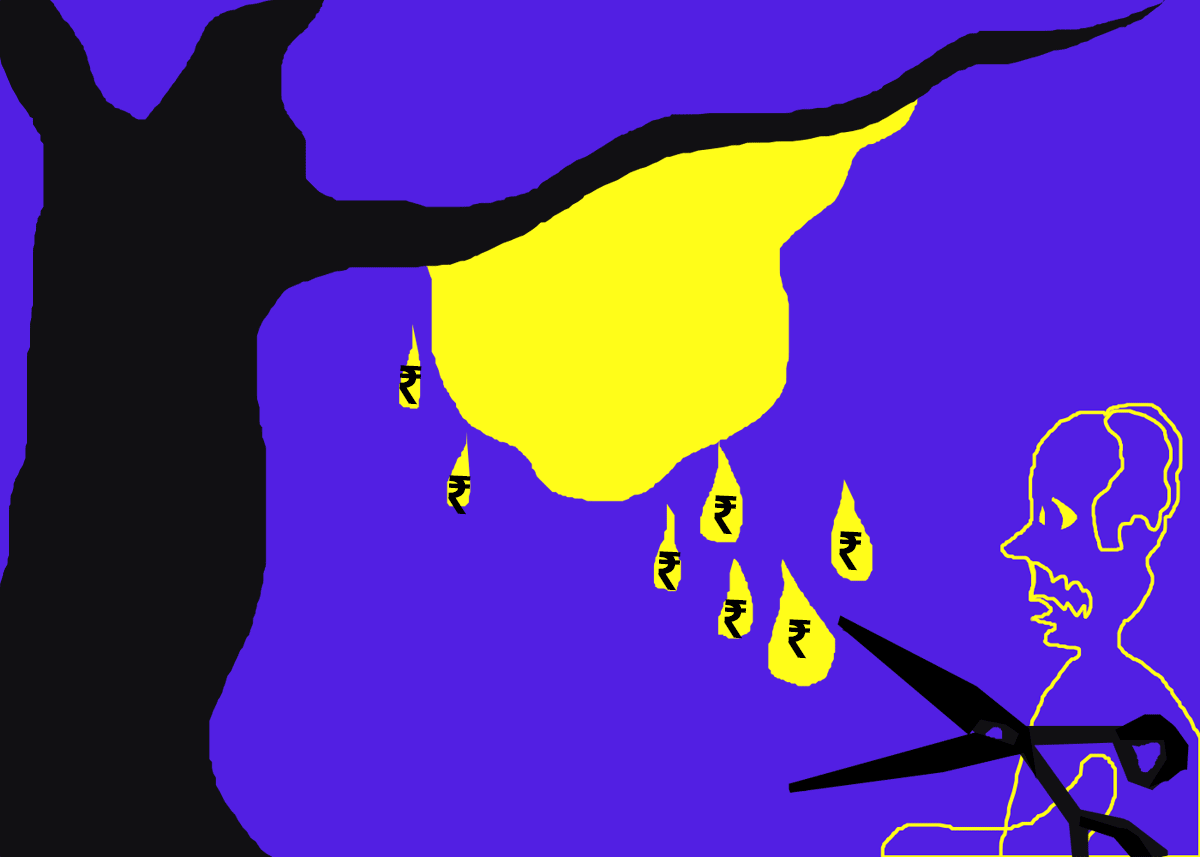
The Indian central government has strategically slashed its total expenditure by approximately ₹60,000 crore in FY26, demonstrating fiscal prudence to successfully meet its ambitious fiscal deficit target of 4.4 per cent of GDP.
Key Points
- The central government cut total expenditure by nearly ₹60,000 crore in FY26 to meet the fiscal deficit target of 4.4 per cent of GDP.
- This reduction included cuts of ₹26,636 crore in revenue expenditure and ₹33,055 crore in capital expenditure.
- The expenditure cut was partly necessitated by a ₹20,368 crore dip in total receipts due to shortfalls in revenue receipts from Personal Income Tax and GST reforms.
- Despite a downward revision in nominal GDP, the fiscal deficit was contained at 4.4 per cent of GDP, aided by the significant expenditure cuts.
- Analysts warn of fiscal risks in FY27 from higher subsidies and potential tax shortfalls, though higher import duties and an Economic Stabilisation Fund may offer some cushion.
The central government has slashed its total expenditure by around Rs 60,000 crore in FY26, below its revised estimate (RE) for the financial year, to meet the fiscal deficit target of 4.4 per cent of gross domestic product (GDP), according to the latest Controller General of Accounts (CGA) data released on Monday.
In FY26, while revenue expenditure was cut by Rs 26,636 crore, capital expenditure was reduced by Rs 33,055 crore, leading to a dip in total expenditure by Rs 59,691 crore to Rs 49 trillion.
Thus, from the Budget estimate level, total expenditure has been reduced from Rs 56.65 trillion by Rs 7.6 trillion to Rs 49 trillion.
Reasons for Expenditure Cuts
The cut in total expenditure was also necessitated by a dip in total receipts by Rs 20,368 crore from its RE level of Rs 34 trillion in FY26, due to a shortfall in revenue receipts driven by extensive Personal Income Tax and Goods and Services Tax (GST) reforms. While the government had budgeted a fiscal deficit of Rs 15.2 trillion in RE, it had to slash it by Rs 39,323 crore to stick to the fiscal deficit target for FY26.
Aditi Nayar, chief economist at Icra said the Government of India's (GoI's) fiscal deficit trailed the RE for FY26 by Rs 0.4 trillion, aided by a Rs 0.6 trillion expenditure cut, which more than offset the marginal miss on the receipts front. "This enabled the fiscal deficit to be contained at 4.4 per cent of GDP in FY2026, in line with the target for the fiscal, notwithstanding the downward revision in the nominal GDP prints.
FY27 Fiscal Outlook and Challenges
Nayar said the inflows on account of savings deposits, certificates and PPF exceeded the RE by about Rs 1.0 trillion, higher than her expectations.
"This led to an increase in the cash balance of the GoI, as against the Rs 457 billion drawdown that was envisaged as per the RE.
"This is expected to provide some cushion to the GoI's fiscal position in FY27, and prevent any fiscal slippage from translating into an equivalent increase in market borrowings," she added.
CGA also released the central government finance data for April that showed that the government exhausted 21.4 per cent of its fiscal deficit target in the first month of FY27, compared to 11.9 per cent during the same month a year ago.
Nayar said the GoI started off FY27 on an expectedly sombre note, with a year-on-year (Y-o-Y) dip in tax and non-tax revenues and sharp expansion in both revenue and capital spending, resulting in a near doubling of the fiscal deficit in April 2026 in Y-o-Y terms.
"While fiscal risks abound in the form of higher than budgeted fertiliser and LPG subsidies, and shortfalls in excise duty, corporate tax and dividend from the OMCs, a portion of the stress would be absorbed by higher import duty on gold and silver and the balance in the Economic Stabilisation Fund.
"While we estimate the slippage in the fiscal deficit at around 0.3 per cent of GDP relative to the FY27 BE, the incremental borrowing requirement would be softened by the higher opening cash balance vis-a-vis the BE, partly benefitting from the overshooting in small savings collections in FY26," she added.
Rajani Sinha, chief economist, CareEdge, said lingering uncertainty over the resolution of the West Asia crisis and its repercussions on the Indian economy challenge the Centre's fiscal consolidation path for FY27.
"The burden of the elevated global crude oil prices is being shared by the Centre and oil marketing companies (OMCs) while passing on some impact to the consumers as well.
"We estimate the net revenue foregone from the announced excise duty reductions to be to the tune of Rs 1.1 trillion for the full year.
"Additionally, there are fiscal pressures stemming from a higher fertiliser subsidy bill and likely lower tax collections.
"Overall, we estimate the fiscal burden from all these factors to be around 0.5 per cent of GDP in FY27," she added.



