

S&P Global Ratings warns that rising crude oil prices and potential government intervention could squeeze the profit margins of Indian oil marketing companies like IOC, BPCL, and HPCL, impacting consumers and the energy sector.
Key Points
- S&P Global Ratings predicts potential margin squeeze for Indian oil marketing companies due to rising crude oil prices.
- Geopolitical tensions and the Strait of Hormuz closure contribute to crude oil price volatility, impacting India's import costs.
- India's strategic petroleum reserves offer limited buffer against supply disruptions, covering only about 10 days of consumption.
- Government intervention and regulated LPG prices may further pressure oil marketing companies' profitability.
- India's reliance on crude oil imports makes it vulnerable to global price fluctuations and supply chain disruptions.
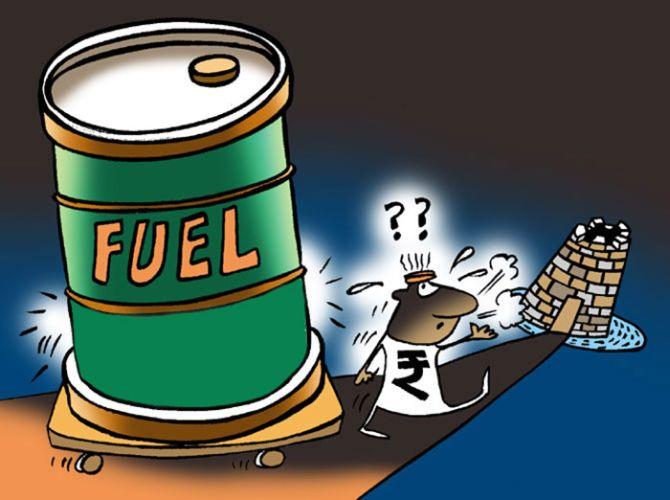
S&P Global Ratings on Wednesday said profit margins of oil marketing companies like IOC, BPCL and HPCL, could suffer as they are likely to keep retail prices of petrol and diesel unchanged to curb inflationary pressures.
Oil prices have risen since the start of the US-Iran war with crude rising to over $100 per barrel earlier this week as the Strait of Hormuz, which handles about a fifth of the global crude oil and liquified natural gas (LNG) flows, remained effectively closed.
Crude prices have fallen to $88 a barrel on Wednesday.
S&P Global Ratings have recently revised its 2026 average price assumption for Brent crude oil prices by $5 to $65.
The US-based rating agency said India will remain dependent on maritime routes to fulfil its crude needs, but there is some scope for diversification as the country has a history of buying oil from outside Asia, such as from Russia and South America.
Purchases from Russia currently stand at 1.1 million bpd, while that from Venezuela has resumed last month at 142,000 bpd, it added.
India imports 88 per cent of its crude oil, making it the third-largest oil importer in the world.
The country consumes 5.8 million bpd, of which 2.5-2.7 million passes through the Strait of Hormuz.
Exposure to the strait amounts to 55 per cent of LPG and 30 per cent of its LNG consumption.
S&P said despite the high exposure, India has limited reserves. Its strategic petroleum reserves support 10 days of consumption while its commercial stocks support roughly 65 days.
LPG and LNG stockpiles are even lower, reportedly around 25-30 days and 10-12 days, respectively.
Impact on Upstream and Downstream Players
It said government directives and rising prices may drive down margins. Risks to upstream players such as ONGC will be reduced by higher sale prices and limited operating exposures to the Middle East.
However, downstream players, such as India's oil marketing companies (OMCs), will face both market and regulatory headwinds.
"In India, LPG prices for consumers are regulated. Amid rising prices, OMCs such as Indian Oil Corp (IOC), Bharat Petroleum Corp Ltd (BPCL) and Hindustan Petroleum Corp Ltd (HPCL) may need to maintain steady retail prices for petrol and diesel to curb inflationary pressures, in our view.
"Their margins could suffer as a result.
"The government may use budgetary allocations and excise duty cuts to ease resulting pressures on the OMCs, as it has done during the Russia-Ukraine conflict, but the likelihood of such measures remains uncertain," S&P said.






 © 2026