

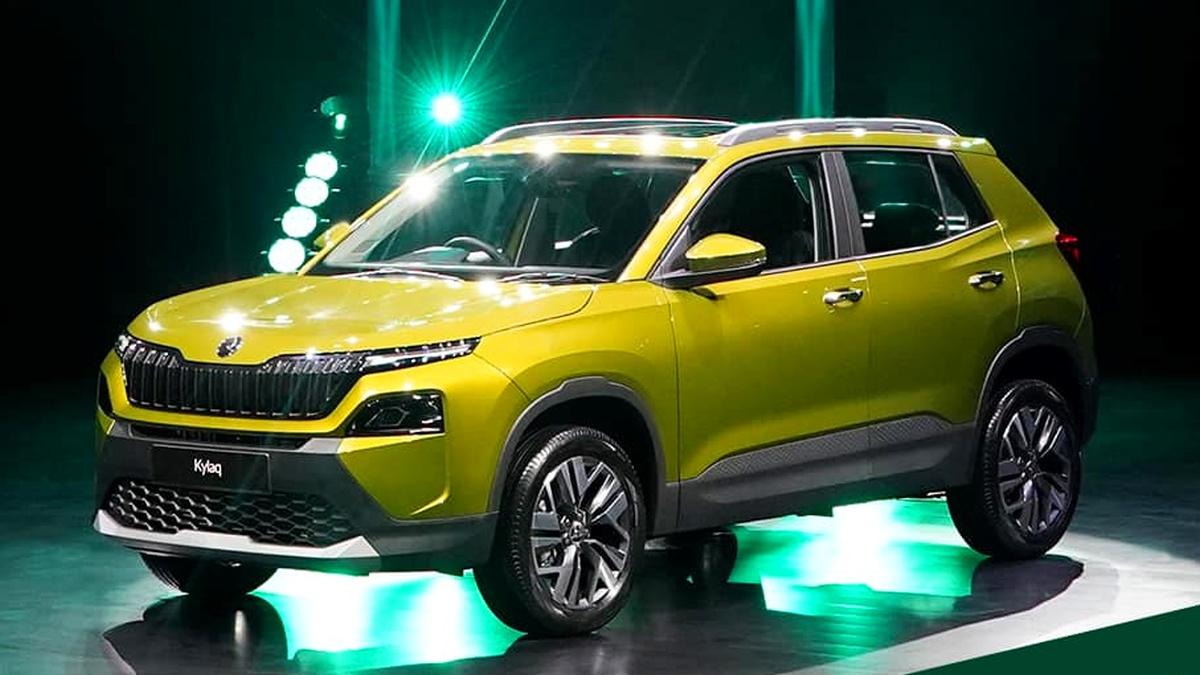
Skoda India is focusing on cleaner fuel options, including CNG and EVs, while compact SUV Kylaq drives volumes, expands first-time buyers and strengthens the brand in India's competitive market.

Key Points
- Skoda evaluating factory-fitted CNG for Kylaq.
- EV confirmed in roadmap, but timelines depend on cost, platform, and regulations.
- Kylaq contributes nearly 60% of Skoda’s India volumes.
- 65% buyers are new to Skoda; nearly half are first-time car owners.
- Over 50,000 Kylaq units sold in its first year.
- CAFE Phase 3 norms increasing pressure to adopt cleaner fuels.
CNG in Focus
Skoda Auto India is sharpening its focus on cleaner fuel technologies, such as compressed natural gas (CNG) and electric vehicles (EV), even as the compact SUV Kylaq emerges as the brand’s primary growth engine in one of India’s most competitive segments.
While electrification remains part of Skoda’s long-term road map, the company is more advanced in its thinking on CNG.
With around 20 per cent of the compact SUV segment already running on CNG, Brand Director Ashish Gupta said Skoda Auto India was actively working on a factory-fitted CNG option for Kylaq.
“This is a clear opportunity,” he said, adding that multiple technical routes are being evaluated, including in-house and group solutions.
He stressed that Skoda is not considering third-party retrofits and that any CNG offering would be factory-engineered. While timelines remain undisclosed, CNG is clearly the near-term execution.
EV Plans Under Review
On EVs, Gupta struck a more cautious note. “If you want to be a serious player in India, you must have an EV,” he said, confirming active discussions around a locally made EV for the domestic market, with potential export optionality.
However, he stopped short of committing to a launch in calendar 2026 or FY27, noting that platform choice, localisation depth, cost viability, and regulatory clarity will determine timelines. Importing small volumes of European EVs, he said, does not make strategic sense.
Push towards cleaner tech
The push towards cleaner technologies comes as the Kylaq has fundamentally altered Skoda’s position in India and as the upcoming Corporate Average Fuel Efficiency (CAFE) Phase 3 norms will sharply tighten fleet-level emission targets, making expansion into CNG and EVs less a choice and more a compliance necessity as volumes rise in mass-market segments.
The compact SUV accounts for over 60 per cent of Skoda’s volumes and nearly 40 per cent of the Skoda Auto Volkswagen India’s total.
“Today, Kylaq contributes close to 60 per cent of our overall volumes,” Gupta said, adding that entry into the segment was critical for visibility, awareness and relevance.
“It made the brand more accessible, helped us enter territories where we were not present earlier, and allowed us to operate at price points where customers are actually buying cars.”
Kylaq Drives Growth
Launched in early 2025, Kylaq sold over 50,000 units in a year.
Gupta said maintaining that run rate would sustain into 2026, supported by segment growth following goods and services tax (GST) changes and the rampup of 77 new touch points added over the past year. “I won’t give a fixed number, but the direction is clearly upward.”
Beyond volumes, Kylaq is expanding Skoda’s buyer funnel. Around 65 per cent of customers are first-time Skoda buyers and nearly half are first-time car owners.
Female buyers registering vehicles in their own names account for 10-12 per cent of Kylaq sales, up sharply from 3-4 per cent earlier, signalling a shift in brand perception beyond Skoda’s traditional urban, premium base.
Operationally, Skoda believes it is well positioned to support growth without aggressive capacity expansion.
The group’s installed capacity in India stands at about 225,000 units annually, including sister brands and exports, with Skoda accounting for roughly 80,000 units.
Production bottlenecks seen at the Kylaq’s launch -- largely due to variant-mix mismatches -- have been resolved, and Gupta said the company has sufficient flexibility to meet higher demand without adding new lines.
Network Expansion Push
Network expansion remains a parallel priority. From about 245 touch points in January 2025, Skoda ended the year with around 325 outlets across 183 cities.
In 2026, it aims to reach 200 cities and about 350 touch points, covering close to 90 per cent of India’s addressable market.
“Beyond that, expansion is not economically viable,” Gupta said, noting that average throughput of about 300 cars per outlet aligns with industry norms.
3% Market Share Target
All of this feeds into Skoda’s longer-term ambition of reaching a 3 per cent share of India’s passenger vehicle market.
Gupta acknowledged this would require a broader product portfolio, not just Kylaq-led growth, pointing to refreshes of Skoda Kushaq and Skoda Slavia, new variants across price points, performance models such as Skoda Kodiaq RSand Skoda Octavia RS, and festive editions.
Exports and free-trade agreements (FTAs) remain a secondary lever.
About 30 per cent of production is exported, mainly to Mexico and South Africa, while Europe remains constrained by regulatory differences.
FTAs are directionally positive, Gupta said, but interoperability of standards will take time before materially changing export economics.
Taken together, Skoda Auto India’s strategy for 2026 rests on consolidating Kylaq-led gains, expanding cleaner fuel options -- starting with CNG -- and laying the groundwork for a local EV.
As Gupta put it, the objective now is not just to sell more cars, but to ensure the brand remains relevant, differentiated and credible as the market evolves.
Feature Presentation: Rajesh Alva/Rediff






 © 2026