
The Indira Gandhi International Airport in the national capital is the country's busiest airport and RWY refers to runway.

Cyclone Shakhti, the first cyclonic storm of the post-monsoon season in the Arabian Sea, has intensified.

The year 2024 was not only the hottest year on record but also the first to breach 1.5C above the 1850-1900 baseline.
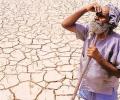
The death toll included over 450 from intense heat wave last summer, according to the World Meteorological Organization.

The global body added that national meteorological and hydrological departments in both countries are working closely with health and disaster management agencies to roll out heat health action plans.

More than twice as much global glacier mass will remain if countries restrict temperature rise to 1.5 degrees Celsius, compared to the warming level of 2.7 degrees Celsius resulting from the current policies, says a new study released.

The year 2024 was the hottest year on record, with the global average temperature exceeding 1.5 degrees Celsius above pre-industrial levels for the first time, according to the European climate agency Copernicus. Every month from January to June was the warmest ever recorded, and from July to December (except August), each month was the second warmest on record. Scientists are warning that the world is entering a new climate reality, with extreme heatwaves, floods, and storms becoming more frequent and severe. The report also highlights the failure of developed nations to meet their climate finance commitments to developing countries, despite the urgency of the situation.

'The intensity and frequency of heatwaves will be much higher than in previous years over Punjab, Haryana, Rajasthan, Gujarat, Madhya Pradesh and Odisha.'

Climate scientists warn that climate change is intensifying heatwaves in India, with the cooling effects of La Nia potentially becoming less effective in a warmer future. The India Meteorological Department (IMD) predicts an early summer with above-normal temperatures and intense heatwave spells, following an unusually dry winter and the warmest February since 1901. Experts emphasize the role of human-caused climate change, along with natural climate drivers like El Nio and La Nia, in shaping weather patterns. While La Nia typically brings cooler temperatures, scientists suggest that under climate change, its ability to mitigate heatwaves may be diminished.

The World Meteorological Organisation (WMO) has officially confirmed that 2023 is the hottest year on record by a huge margin, smashing global temperature records.

The first five months of 2023 have witnessed at least six major events/trends that augur badly for global economic and socio-political prospects, points out Shankar Acharya, former chief economic adviser to the Government of India.

The warmest six years have all been since 2015, with 2016, 2019 and 2020 being the top three. The differences in average global temperatures among the three warmest years are indistinguishably small. The average global temperature in 2020 was about 14.9C, 1.2 ( 0.1) C above the pre-industrial (1850-1900) level.

Several major cyclones have hit various parts of India over the last 10 years. Here is a look at the notable among them.

The World Meteorological Organisation assessment which was released on Monday in Marrakech, Morocco said that 2016's global temperatures are approximately 1.2 C above pre-industrial levels.

No lives were lost after cyclone Biparjoy made landfall. Preparations for Biparjoy were not only extensive, they were also telecast far and wide. Ahead of the cyclone's landfall, Shyam G Menon observes there was considerable publicity on how much the government was geared up to face the storm and its aftermath.

Over the 10 years from 2001 to 2010, global temperatures have averaged 0.46 C (0.82 F) above the 1961-1990 average.

The new records for extreme lightning bursts, or 'megaflashes', during 2019, are more than double the size and duration of the previous record flashes.
The India Meteorological Department (IMD) seems to have taken a cautious stand over the World Meteorological Organisation's (WMO) projection of a 'poor monsoon' due to a probable 'El Nino' impact. The IMD did not agree with WMO's projections, saying, "El Nino and the progress of monsoon are not mutually exclusive events", and remained non-committal over its earlier projection of a "normal monsoon" for the June-September 2009 season.

Asserting that it has been a strong champion of equity, India on Thursday said developed countries should compensate developing nations for the effects their greenhouse gas emissions have had on climate.

A low-pressure area, set to form over east central Bay of Bengal on May 22, is likely to intensify into a cyclonic storm and strike the Odisha-West Bengal coast on May 26, the Met department said on Thursday, sparking fears of another Amphan-like catastrophe.

Swarms of immature pink locusts and adult yellow locusts are currrently active. Not only are fresh locusts swarms expected to arrive in the coming weeks, but even those already present in India have mated and are breeding new offspring.

Paucity of monsoon rainfall alone is not a sufficient determinant of drought, maintains the World Meteorological Organisation.

The same development would benefit the progress of the north-east monsoon, also known as the 'reverse monsoon'.

With rainfall and monsoons becoming highly unpredictable partly due to climate change and partly due to usual changes in weather patterns, it is such innovations by IMD which will help in planning better, reports Sanjeeb Mukherjee.
There is a substantial possibility of the emergence of La Nina, the opposite of El Nino, which invariably has a positive influence on the monsoon.

Weather watchers said it can't be known till May whether El Nio will impact the monsoon or not.
 © 2026 Rediff.com - Advertise with us - Disclaimer - Privacy Policy - Sitemap - Feedback - About us - Terms of use - Grievances