
United States President Barack Obama not just met, but beat India's expectations, feel two veteran career diplomats who between the two of them have over four decades of service in the Indian subcontinent, reports Aziz Haniffa.
The apparent consensus among South Asia watchers and experts in United States is that Secretary of State Hillary Clinton's three-day visit to Mumbai and New Delhi was a slam dunk in effectively quashing the contention of naysayers, both in India and the US, that the Barack Obama administration was less committed to the India-US strategic partnership than its predecessor George W Bush administration.

"The new sarsanghchalak, Mohan Bhagwat, is perhaps the most politically inclined head of the RSS since its founder Keshav Baliran Hedgewar some eight decades ago," says American expert Dr Walter Andersen.
Walter Andersen, associate director of the South Asia Program at Johns Hopkins University's School of Advanced International Studies, told rediff.com, "I am surprised that after several terrorist incidents, the government hasn't moved faster to get something much more effectively in place. You have a totally incompetent home minister, and why he isn't removed is beyond me."

To mark Prime Minister Modi's seventh meeting with Obama and his historic joint address to US Congress -- the sixth Indian PM to do so -- India Abroad, the newspaper published from New York and owned by rediff.com, reached out to diplomats and strategic thinkers in New Delhi and Washington, DC, to assess the current state of the US-India relationship and suggest a road map for the future.

The American efforts to make India a security partner have enhanced India's importance to Chinese decision makers and new recognition of India's importance and achievements are reflected in a much more positive reporting about India in the State-controlled media, says Walter Andersen.

'Building on the potential for closer ties is the changing narrative in each country about the other. The Chinese narrative on India has become significantly more positive over the past few years,' says Walter Andersen and Zhong Zhenming.
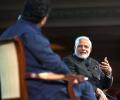
'From the evidently pre-selected questions to the promotional slides on a screen redolent of the official audio-visual department, the choreography was palpably intended to present the prime minister in as good a light as possible in a 'safe' environment insulated from uncomfortable questions,' says Amulya Ganguli.

Friends and colleagues pay rich tributes to the "charming, approachable, and very accessible" Indian Constitution scholar Granville 'Red' Austin.
 © 2026 Rediff.com - Advertise with us - Disclaimer - Privacy Policy - Sitemap - Feedback - About us - Terms of use - Grievances