Prime Minister Narendra Modi-led National Democratic Alliance government has changed the telecom policy after receiving electoral bonds worth Rs 150 crore from a company, All India Majlis-e-Ittehadul Muslimeen chief Asaduddin Owaisi claimed on Thursday.

The tryst with instant fame began on June 28 when Manish, son of farmer Gajendra Bisi, purchased a new Jio SIM from a mobile shop in Deobhog, around 8 kilometres from his village.
The main thrust of the policy is on the multiplier effect and transformational impact of such services on the overall economy.

The Telecom Policy 1999 which revolutionised the telecom sector will be revamped soon with the Department of Telecom likely to retain licensing powers.

The Department of Telecommunications (DoT) will finalise its internal view on the Telecom Regulatory Authority of India (Trai's) recommendations, which was given in May last year, on mergers and acquisitions, spectrum allocation, spectrum sharing and other licencing aspects by the end of this month, a senior official from the department said.

The department is planning a complete overhaul of the archaic Indian Telegraph Act.

Telecom users will be able to avail free roaming and keep their phone numbers even if they switch service providers anywhere in the country, as per the draft New Telecom Policy unveiled by the government said on Monday.
The policy is also pushing for a one-country-one-licence regime, which means removal of roaming charges.

With the import bill of telecom equipment rising, the government on Wednesday said preferential treatment would be given to its indigenous production in the New Telecom Policy, which is under formulation.
The Joint Parliamentary Committee on the 2G spectrum scam on Wednesday began examining the telecom policy pursued during the National Democratic Alliance rule as it sought to know the quantum of losses incurred during that period and decided to summon the then Attorney General Soli Sorabjee in this connection.

Reports that the government is considering seeking a review of that judgment are worrying.

The policy was earlier expected to be unveiled by December this year, but delays in receiving recommendations have pushed the date to next year.
Citing statistics of teledensity which has gone up from seven per cent in March 2004 to 66 per cent in December, 2010, Singh said the policy has paid 'rich dividends'.
The government has approved mergers between telecom companies with a combined market share of 35 per cent and rejected spectrum-sharing among 3G operators while restricting it for 2G operators.
The Department of Telecommunications is planning to give more powers to the telecom regulator, Telecom Regulatory Authority of India, in the new telecom policy, including the power to impose financial penalties on the erring telecom service providers.
"Draft of the policy was circulated in 2011 for consultation with various stakeholders. Views/comments from these stakeholders have been received and the same are under consideration. NTP is likely to be in place by June 2012," the Survey said.
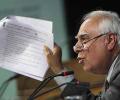
Delinking spectrum from the licences in the aftermath of the 2G scam, Sibal said, "In future, the spectrum will not be bundled with licence. The licence to be issued to telecom operators will be in the nature of 'Unified Licence' and the licence holder will be free to offer any of the multifarious telecom services."
Amidst the controversy over the allocation of spectrum and grant of telecom licences, the government on Monday said all licences are proposed to be renewed after 10 years instead of the 20-year period earlier.
The Joint Parliamentary Committee to probe the 2G spectrum issue will look into the allocation and pricing of telecom licences and spectrum from 1998 to 2009.
Telecom Minister Kapil Sibal has accused the Bharatiya Janata Party-led National Democratic Alliance (NDA) government over the 2G spectrum allocation
Appears before PAC, admits voice in Radia tapes his, but denies influence over Cabinet formation.
As part of the national telecom policy, which is likely to be released next month, various levies and charges including SUC would be reviewed in line with the input tax credit available.
Sibal, who is also looking after the telecom ministry, claimed that change of telecom policy by the then communication minister Pramod Mahajan in 1999 from the auction model to the revenue share model eventually led to the first come first serve controversy of 2001.
Countering industrialist Ratan Tata's statement, the Bharatiya Janata Party on Thursday said he is "no judge" and his views will not be given much importance as he himself was a "beneficiary" of United Progressive Alliance's telecom policy.

Discussing the prospect of more reform earlier this month, telecom minister Ashwini Vaishnaw announced a delay in the 5G spectrum auction. India's telecom sector regulation has to be benchmarked with the global best, he said. It's another matter that many countries have either introduced or are about to roll out 5G services that will enable cutting-edge tech in diverse areas. For India, too, it will mean a lot for healthcare, robotics and unleashing a new chapter in Digital India perhaps.

Modelled loosely around the National Highway System of the US, he in 2001 launched the Golden Quadrilateral and the North-South & East-West Corridor projects to build 4/6 lane highways between four top metropolitan cities of Delhi, Mumbai, Chennai and Kolkata as well as from Srinagar to Kanyakumari and Porbandar to Silchar.
NTP 2012, approved in May, aims to abolish roaming charges and allow mobile phone subscribers to use same number across country without having to pay extra charges for services once they are outside their telecom circle.
NTP 2012, approved in May, aims to abolish roaming charges and allow mobile phone subscribers to use same number across country without having to pay extra charges for services once they are outside their telecom circle.
India has become the world's fourth largest market for optic-fibre cable after Japan, the US, and China following adoption of new telecom policy, a new study has said.
Far from benefitting consumers, the new rules on roaming charges have opened another front in the battle between large and small operators.

High court orders Swan Telecom's promoter Shahid Balwa, the director of Kusegaon Fruits and Vegetables, Rajeev Agarwal, and three firms, namely Dynamic Realty, DB Realty, and Nihar Constructions to plant 3,000 trees each in the Delhi's South Ridge forest area.

In a setback to telecom service providers, the Supreme Court on Thursday allowed the Centre's plea to recover adjusted gross revenue (AGR) of about Rs 92,000 crore from them.
it will allow users to retain their numbers even if they move from one state to another.
Rajasthan, Assam, Himachal Pradesh and Tripura among states that will set up an institute each.

Malaysia's leading telecom operator, Axiata, has backed out of its negotiations to pick up a substantial stake in broadband wireless access operator Tikona Digital.
 © 2026 Rediff.com - Advertise with us - Disclaimer - Privacy Policy - Sitemap - Feedback - About us - Terms of use - Grievances