
'Indian markets may underperform global peers for the next two quarters.' 'But beyond that, India should catch up and resume its long-term growth path.'

Mutual funds (MFs) have significantly increased their ownership across market segments, but the midcap space stands out with comparatively higher growth. Data reveals that the number of midcap companies with over a fifth of MF ownership has doubled from nine in March 2022 to 18 by March 2025. In contrast, largecap stocks saw only a marginal rise, from three to four such companies during the same period.

Over half, or 269 NSE 500 stocks, have given over 10-fold (10x) returns in the last two decades, finds a recent report by Goldman Sachs that analysed 10 major markets across emerging and developed markets (EM/DM) that covered 6,700 stocks. The report examined '10-baggers' - stocks that have generated at least 10x total returns within a rolling 5-year period over the past two decades. Some of the prominent ones that comprise these 269 stocks in the Indian context stocks that delivered over 10x total returns over a 5-year rolling period since 2000 as per Goldman Sachs includes Westlife Foodworld, Bharti Airtel, Adani Total Gas, Patanjali Foods, Larsen & Toubro, BEML, Blue Star, Shree Cement, Lupin, Godrej Industries, Astral, Adani Enterprises, Hindustan Petroleum and Deepak Fertilisers.

More than 90 per cent stocks in the NSE 500 universe are currently trading above their 200-day moving average (DMA). Experts say this is a sign that the market has become overheated and can lead to a correction or sideways movement for a long period. The 200-DMA is a key technical indicator used by traders to get a sense of market direction. A level, which is roughly a 40-week average, often acts as key support or resistance.

Retail investors have been the hardest hit in the recent market downturn, with stocks where they hold over 20% falling 45% from their 52-week highs.

'Regardless of whether you invest Rs 100 or Rs 1 crore per month, risk is inevitable.' 'Positive returns at the end of the year can never be guaranteed.' 'This is a fundamental truth every SIP investor must grasp.'

The rumour verification process would now be triggered by changes in price or 'material price movements', as the paper defines it. What this means is that companies would need to verify rumours only if the share price moves significantly.

The Indian markets have seen a good run in the last three months with the S&P BSE Sensex rising around 7 per cent and the Nifty50 moving up 7.5 per cent. The next leg of the market rally from here on, analysts suggest, will be driven by a growth in corporate earnings over the next few quarters. That said, they do not expect material / sharp downgrades to India Inc's earnings estimates despite headwinds for the economy.

With the Nifty50 just about 3 per cent away from its all-time closing high of 18,812 points, analysts at BofA Securities suggest investors book profit. Their reasons for the advice include risks like the possibility of a cut in corporate earnings growth forecasts, high valuation (one-year forward P/E of 19.5x), interest rates staying elevated for longer-than-expected and credit tightening. Going ahead, they expect the Nifty50 index to drop to 16,000 levels - down nearly 12 per cent from the current level of 18,255 points, which they believe would be a good time to buy.

Investors may increase exposure to mid and small-cap stocks as their risk-reward profile is more attractive currently, suggest Nitin Singh and Vinay Joseph.

IT, FMCG and manufacturing sectors are less attractive to foreign portfolio investors

Bubbles can inflate indefinitely and also burst, with deep corrections, warns Devangshu Datta.
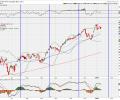
It is too early to say if we have seen the "final" bottom to these stocks in August 2013 or if another attempt to test them will be made before or just after elections, says Sonali Ranade.
 © 2026 Rediff.com - Advertise with us - Disclaimer - Privacy Policy - Sitemap - Feedback - About us - Terms of use - Grievances