
A US federal government commission has raised concerns about the state of religious freedom in India, recommending its designation as a 'Country of Particular Concern' and suggesting targeted sanctions.

India has strongly condemned Pakistan's airstrikes on Afghanistan, calling them a flagrant violation of international law and hypocritical given the civilian casualties during Ramzan.
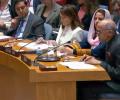
India told the UN Security Council that it calls for a pragmatic engagement with the Taliban, underlining that a focus on only punitive measures will ensure a 'business as usual' approach.
'Another demonstration of strong India-USA counter-terrorism cooperation. Appreciate the Department of State for listing The Resistance Front (TRF) as a designated Foreign Terrorist Organization and Specially Designated Global Terrorist.'

Trump also repeated his claim that seven fighter jets or more were shot down during the hostilities.

A UN Security Council report states that The Resistance Front (TRF) claimed responsibility for the Pahalgam terror attack and published a photograph of the attack site. The report also cites assertions that the attack could not have happened without the support of Pakistan-based Lashkar-e-Tayyiba (LeT).
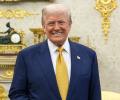
Trump, who has repeatedly said that he stopped the conflict between India and Pakistan through trade, last Friday said for the first time that "five jets were shot down" during the fighting.
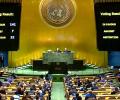
India abstained from a UN General Assembly vote on a resolution regarding Afghanistan, citing the need for a balanced approach that combines incentives and disincentives, and calling for new initiatives to address the humanitarian crisis.
The United States has approved the extradition of Tahawwur Rana, accused of involvement in the 2008 Mumbai terror attacks, to India. The decision was announced by President Donald Trump during a joint press conference with Prime Minister Narendra Modi in the White House. India is currently working on the logistics of Rana's surrender and extradition, with several final steps to be completed before he is sent back to India. The joint statement issued by India and the US during Prime Minister Modi's visit reaffirmed their commitment to fighting terrorism and eliminating terrorist safe havens. The leaders also called on Pakistan to bring to justice the perpetrators of the 26/11 Mumbai and Pathankot attacks. Rana, a Canadian national of Pakistani origin, is currently lodged at a metropolitan detention center in Los Angeles. He is associated with Pakistani-American terrorist David Coleman Headley, one of the main conspirators of the 26/11 attacks.

The Delhi police are expected to question Hurriyat Chairman Syed Ali Shah Geelani over alleged links with Lashkar-e-Tayyiba.

The Quad also vowed to work towards a free, open and prosperous Indo-Pacific, a region that has seen increasing Chinese military muscle-flexing in the last few years.
Rauf Azhar, born in 1974 in Pakistan, had been sanctioned by the United States in December 2010.
Asked about the $ 10 million bounty announced for Saeed by the United States, he said a policy statement on the issue had been issued by the foreign office and he had expressed his views in parliament on Friday.
Pakistan Prime Minister Yousuf Raza Gilani has said the matter of Lashkar-e-Tayyiba founder Hafiz Saeed is an "internal issue" and if there is any concrete proof against the outlawed Jamaat-ud-Dawah chief then it should be provided to them.
Underlining that it cannot take action against Lashkar-e-Tayyiba founder Hafeez Saeed in the absence of concrete proof, Pakistan on Thursday said that even the United States does not possess any evidence linking the Jamaat-ud-Dawah chief to terrorism.
Backed by a court order, India is expected seek extradition of Lashkar-e-Tayyiba operative David Coleman Headley and his accomplice Tawwahur Rana. But this is going to be an uphill task for investigators, reports Vicky Nanjappa.
The $ 10 million bounty announced by the United States for Lashkar-e-Tayyiba founder Hafiz Mohammad Saeed is a "blatant pressure tactic" and has boosted his image as the leader of resistance against the Americans, the Pakistani media said on Friday.
Terming Pakistan President Asif Ali Zardari's scheduled visit to India as "very constructive", the United States has said it does not want any new strains in Indo-Pak ties over the $ 10 million bounty offered by it for Lashkar-e-Tayyiba founder Hafiz Saeed.
India on Tuesday welcomed the United States announcement of a bounty of $ 10 million on Pakistan-based Jamaat-ud-Dawa chief Hafiz Saeed, the mastermind of the 26/11 Mumbai attacks, saying it sends a strong signal to Lashker-e-Tayyiba and its patrons.
External Affairs Minister S M Krishna on Friday said that it was unfortunate that Pakistan had not felt the need to thoroughly investigate the role of Lashkar-e-Tayyiba founder Hafiz Saeed in the 26/11 attacks.
The Obama administration on Thursday said it announced a bounty of $ 10 million on Hafiz Saeed to bring him to justice as it was convinced that the Lashkar-e-Tayyiba founder had played a key role in the 2008 Mumbai terror attacks.
The United States underlined that $ 10 million bounty for Lashkar-e-Tayyiba founder Hafiz Seed is not about finding his location, but to seek information that can convict the alleged mastermind of the 2008 Mumbai terror attacks in a court of law.
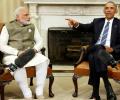
The American side also committed itself to treat Pathankot attack at par with 26/11 terror strike in terms of ensuring punishment to perpetrators based in Pakistan.

An advisory issued by the American Embassy warned its citizens of an increased threat in places frequented by Westerners in the country.
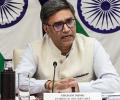
In a strongly-worded reaction on the issue, Spokesperson in the Ministry of External Affairs Anurag Srivastava said India has repeatedly called on Pakistan to give up its 'obfuscation and dilatory tactics' in discharging its international obligations in the trial of Mumbai terror attacks.

China has blocked a proposal by the US and India at the United Nations to blacklist Abdul Rauf Azhar, the brother of Jaish-e Mohammed (JeM) chief Masood Azhar and the deputy chief of the Pakistan-based terror group, in the second such move by Beijing in less than two months.
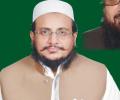
Hafiz Talha Saeed is a senior leader of the LeT and is the head of the cleric wing of the terrorist organisation.
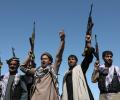
The 13th report of the Analytical Support and Sanctions Monitoring Team cites a UN Member State as saying that Jaish-e-Mohammed (JeM), a Deobandi group ideologically closer to the Taliban "maintains eight training camps in Nangarhar, three of which are directly under Taliban control."

Pakistan on Monday termed as "irrational" India's strong reaction to a court's ruling ordering release of 2008 Mumbai terror attack mastermind Zaki-ur-Rehman Lakhvi, but hoped that the issue will not affect the proposed bilateral talks.

"China's ideology seems to be eliminating terrorism from its country but letting terrorist activities flourish in India," the Sena said.

'Drone warfare has come to stay.' 'India should exploit the expected Reaper acquisition from the US to build an effective counter terror campaign,' argues Group Captain Murli Menon (retd).

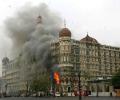
The Trump administration announced this major reward on the 10th anniversary of the terror attack in which 10 Pakistan-based Lashkar-e-Tayiba terrorists went on a shooting rampage in India's financial hub killing 166 people, including six Americans.
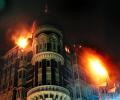
Pakistan on Saturday detained Zaki-ur Rehman Lakhvi, the 2008 Mumbai attack mastermind, for 30 more days under a public security order before he could be released from jail following a court directive to set him free which evoked a strong protest from India.
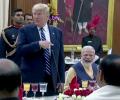
'Many said his visit was very risky. But mercifully, Air Force One has taken off from Delhi without Mr Trump stepping on anybody's toes,' notes Ambassador T P Sreenivasan.

Lieutenant General Syed Ata Hasnain (retd), former general officer in commanding, 15 Corps, explains what may have happened during the Indian Army's anti-terrorist operation in Kashmir in which four soldiers and one policemen, including the commanding officer 21 Rashtriya Rifles, made the supreme sacrifice for the Motherland.

'It is crucial today to realise where we have reached in this 15 year-period in order to fully and properly assess the profundity of what General Rawat has said,' points out Ambassador M K Bhadrakumar.

Here is the full text of the joint statement issued by India and the US.
 © 2026 Rediff.com - Advertise with us - Disclaimer - Privacy Policy - Sitemap - Feedback - About us - Terms of use - Grievances