
The flight took off from Sriharikota in the Bay of Bengal on schedule.
The indigenous rocket will carry the second technology experiment satellite GSAT-2.
India's ambitious attempt to flight-test its indigenous cryogenic engine on Thursday received a setback as the homegrown rocket Geosynchronous Satellite Launch Vehicle (GSLV-D3) deviated from path within seconds of lift-off.
Indian Space Research Organisation is preparing to launch a geosynchronous satellite launch vehicle (GSLV-D3), powered for the first time by a home-made cryogenic engine, from Sriharikota spaceport this month, its chief K Radhakrishnan said on Friday.
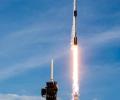
'The solution is to replace, clean up, retest and proceed.' 'There is nothing to worry about if corrected.'
The launch is slated for 1658 IST from the space port at Sriharikota in Andhra Pradesh.
Indian Space Research Organisation is all set for the launch of the first flight-testing of indigenous cryogenic engine on homespun rocket, Geosynchronous Satellite Launch Vehicle (GSLV-D3), from the Satish Dhawan Space Centre at Sriharikota at 4.27 pm on Thursday.
ISRO has put out stunning photos of the launch of GSLV-D5. The vehicle smoothly lifted off to space from Sriharikota on Sunday afternoon and put India into the elite 'cryogenic club'.
India's top space scientists will be meeting in Thiruvananthapuram on Saturday to analyse the data and find the cause for failure of GSLV-D3 rocket, which was launched for the first time on Thursday using an indigenously made cryogenic engine.

The Indian Space Research Organisation successfully put India's heavy rocket Geosynchronous Satellite Launch Vehicle-Development 5 (GSLV-D5) into orbit from the spaceport at Sriharikota, Andhra Pradesh at 4.18 pm on Sunday.
India on Sunday successfully launched its heavy-duty rocket with indigenous cryogenic engine that placed a communication satellite into the orbit, with Indian Space Research Organisation scientists finally taming the 'naughty boy' GSLV and propelling the country into an elite club of countries.

The feat is the second one for the Indian Space Research Organisation scientists in using the indigenously made cryogenic stage after the January 5, 2014 launch of GSLV-D5.
ISRO officials said that the Rs 330 crore mission failed minutes after the rocket lifted off at 4.27 pm. Although they would go ahead with the same mission next year, it is still considered to be a setback since ISRO had planned on using the GSLV rocket for its second moon mission.
It is scheduled for lift-off at 1658 IST on Thursday from the space port at Satish Dhawan Space Centre at Sriharikota, about 100 km from Chennai.
The apogee [farthest point] is 36,000km and the inclination of the orbit with respect to the equatorial plane has been reduced from 7.37 degrees to the present 0.32 degrees,

GSAT-6, the country's latest communication satellite has been successfully positioned in its orbital slot, Indian Space Research Organisation said on Sunday.
"First orbit raising operation of GSAT-6 was successfully completed by firing the Apogee Motor for 3385 seconds at 8:35 pm IST on August 28," the ISRO said.

It is important for India to develop multiple launch sites and become capable of undertaking more launches in a year's time, says Ajey Lele.
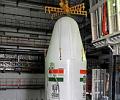
The launch of a Geosynchronous Satellite Launch Vehicle was called off by the Indian Space Reasearch Organisation at the eleventh hour on Monday due to a fuel leak in its second stage -- in a setback to the mission to test its homegrown cryogenic engine -- after its failure three years ago.

The rocket is almost 49 meters high -- as much as a 17-floor building. It weighs 415 tons -- as much as the combined weight of 80 full grown elephants.
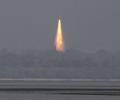
Enthused over its successful launch of GSLV D5 with GSAT-14 communication satellite from Satish Dhawan Space Centre in Sriharikota on Sunday, the Indian Space Research Organisation is planning a series of GSLV launches and an experimental launch of the advanced version GSLV Mark III soon from the spaceport.

It has already tasted success with the moon mission and Mangalyaan. Is man in space the next frontier for ISRO?

The year 2014 has been an eventful one for India. The country got a new government and a new state, broke new frontiers in various fields and of course its share of controversies.
 © 2026 Rediff.com - Advertise with us - Disclaimer - Privacy Policy - Sitemap - Feedback - About us - Terms of use - Grievances