
The Indian Navy's Republic Day tableau will showcase indigenous platforms like INS Vikrant and a stitched ship from the 5th century CE, highlighting the theme of a 'Strong Navy for a Strong Nation'.

These upcoming launches carry added significance in light of setbacks suffered in recent years.

The heaviest communication satellite to be launched from the Indian soil onboard a new generation, homegrown 'Bahubali' rocket was successfully placed into the intended orbit on Sunday, the Indian Space Research Organisation said.

ISRO Chairman V Narayanan announced the development of a massive rocket capable of placing 75,000 kg payloads in low earth orbit, highlighting India's growing space capabilities and future satellite launches.

India's advanced multi-band communication satellite GSAT-7, launched from French Guiana by European space consortium Arianespace's Ariane 5 rocket on August 30, has been successfully placed in the geosynchronous orbit with an altitude of about 36,000 km above earth's surface.

India's first exclusive defence satellite GSAT-7 was successfully launched by European space consortium Arianespace's Ariane 5 rocket from Kourou spaceport in French Guiana on Friday, giving a major push to the country's maritime security.

The approved proposals included "procurement of night sight (image intensifier), light vehicles GS 4X4, air defence fire control radar (light) and GSAT-7B satellite," it mentioned.

The earth observation satellite would provide real-time images of the country and also be able to quickly monitor natural disasters.

The Mars Orbiter Mission (MOM) is among the most-tracked satellites in the world, according to N2YO, which provides a web-based real-time satellite mapping website.

The mission life of the 2,250kg GSAT-7A, built by ISRO, is eight years. It will provide communication capability to users in Ku-band over the Indian region.

Out of its 47 operational satellites, India currently has six to eight satellites which are used entirely for military purposes.

Indian Space Research Organisation's second mission of the year to place an earth observation satellite by a GSLV rocket faced a setback as the mission could not be accomplished fully due to performance anomaly in the cryogenic stage of the rocket, the space agency said on Thursday.
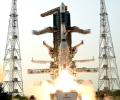
Over 32 missions -- satellites and rockets -- have been planned for the year.

The primary goal of HysIS, whose mission life is five years, is to study the earth's surface in visible near infrared and shortwave infrared regions of the electromagnetic spectrum.
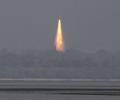
Enthused over its successful launch of GSLV D5 with GSAT-14 communication satellite from Satish Dhawan Space Centre in Sriharikota on Sunday, the Indian Space Research Organisation is planning a series of GSLV launches and an experimental launch of the advanced version GSLV Mark III soon from the spaceport.
 © 2026 Rediff.com - Advertise with us - Disclaimer - Privacy Policy - Sitemap - Feedback - About us - Terms of use - Grievances