
Dr Abdullah Abdullah, erstwhile foreign minister of Afghanistan and a candidate in the 2009 Presidential election, has lauded India's role in Afghanistan in terms of infrastructure development and institutional capacity building as significant and dismissed Pakistan's paranoia and deep suspicions about New Delhi's involvement in his country as totally misplaced.

Echoing India's concerns over Afghanistan President Hamid Karzai's move toward reconciliation and reintegration of segments of the Taliban into the Afghan government -- which has been endorsed by the Obama administration -- Dr Abdullah Abdullah, erstwhile Afghan foreign minister and Karzai's nemesis, who was a candidate in the controversial 2009 presidential elections, said pursuing such a policy would be a futile exercise.
The White House informed media persons that during a telephone conversation with Karzai, Obama underscored that this decision was in the best interests of the Afghan people.

The future can only get better if we continue to break silos and work as integrated teams focussed on promoting national interests, recommends Sanjeev Nayyar.

'We have been bold and innovative on recognition in the past and we do not need to rush,' advises Ambassador T P Sreenivasan.
'We don't want to see our relations with one country undermining our relations with another, says Afghanistan Foreign Minister Dr Abdullah Abdullah.

'It was always anticipated that the return of the Taliban would embolden armed Islamists including anti-India groups like the Lashkar and Jaish.'
Deputy Secretary of State John J Sullivan, who recently returned from a visit to Afghanistan, said the US also expects Pakistan to contribute to a lasting and enduring peace in the region.
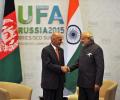
Prime Minister Narendra Modi on Friday met Afghan President Ashraf Ghani in Ufa and the two leaders are understood to have discussed Afghanistan's security situation and India's assistance in reconstruction efforts in the war-torn country.

'India has to ensure its borders are properly sealed and there is no infiltration from PoK.

New Delhi should resist any temptation to act as spoiler and instead should cooperate with its SCO partners in reaching a regional consensus behind the formation of an interim government in Kabul, argues Ambassador M K Bhadrakumar.

'India could help in Afghanistan, but if it does too much, it will stoke Pakistan's paranoia and risk making the situation worse,' Michael O'Hanlon, one of America's leading experts on international security, tells Rediff.com's Vicky Nanjappa.
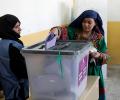
The election seem to have been conducted without any major security lapses. However, in the coming weeks, the military situation in Kandahar could tilt in the Taliban's favour, notes Aveek Sen.

It is in Prime Minister Narendra Modi Modi, officials in Washington believe, US President Barack Obama has found an Indian leader who is willing to walk the talk to realise the common goals of the two countries. Lalit K Jha reports

'Some Pakistani generals are saying -- a little more so now than before -- that the biggest threat to Pakistan is not external -- not India -- but internal.' 'The proof of that will be their change of policies and that is going to be the challenge,' Rakesh Sood, one of India's most distinguished diplomats, tells Aziz Haniffa/Rediff.com in Washington, DC.
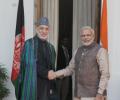
Security will be a consideration, as would protocol, but given Modi's penchant for the unconventional, it should not come as a surprise if he indeed decides to attend the ceremony in Kabul, says Ramesh Ramachandran.

'Perhaps the biggest indication was its striking decision in November to delink LeT from its aid certification process.' 'The administration decided that the US, in order to send military aid to Pakistan, would not need to certify that Pakistan is cracking down on LeT.' 'Perhaps the administration was trying to offer a carrot -- in effect, we're backing off on LeT, but in return we expect you (Pakistan) to go after the Haqqanis.' 'Either way, the optics were dreadful for the US given that Hafiz Saeed was released from house arrest a few days after the US move.' 'The US reacted angrily, but eventually it moved on, and refocused on its core concern: The Afghan-focused terror groups.'

'Obama's decision to end the US military involvement in the Afghan civil war needs to be welcomed as a positive development for regional security and stability. India, too, has a great opportunity opening up here if it plays its cards in sync with the spirit of the times rather than continuing to view the Afghan problem in zero-sum terms,' says Ambassador M K Bhadrakumar.
 © 2026 Rediff.com - Investor Information - Advertise with us - Disclaimer - Privacy Policy - Sitemap - Feedback - About us - Terms of use - Grievances