
By the time the enemy aircraft is 50 km away, the Akash-NG's computers have calculated the launch trajectory and impact point and launched the missile.
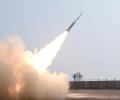
The Integrated Test Range of Defence Research and Development Organisation (DRDO) has taken various measures to protect its facilities at Chandipur and Abdul Kalam Island in Odisha, which are likely to be affected by cyclone 'Yaas', an official said.

Defence Research and Development Organisation Director General Vijay Kumar Saraswat on Friday said the Agni-V missile, which took 30 years to be developed, was the best such thing in the 21st century. Agni-V is an intercontinental ballistic missile developed by the DRDO. It is part of the Agni series of missiles, one of the missile systems under the original Integrated Guided Missile Development Programme.
India's long-criticised Akash anti-aircraft missile is now blazing towards success. After years of rejection from the military, the Akash is being accepted as a world-class missile.
Two medium-range surface-to-air missiles 'Akash' were successfully test-fired from the Integrated Test Range (ITR) at Chandipur-on-sea, about 15 km from Balasore.
'There is nothing like the President does not desire a second term and wants to return to academia. That is not the point. The point is what the nation desires,' says Professor Arun Tiwari, the President's friend and biographer.

The surface-to-surface missile, a naval variant of the indigenously-developed 'Prithvi' missile, was test-fired from the ship positioned near Paradip in the Bay of Bengal at around 10.52 am, the officials said.

Prithvi-2 is capable of carrying 500-1,000 kg of warheads and is powered by liquid propulsion twin engines, the sources said.
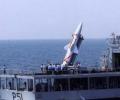
India on Thursday successfully test-fired its nuclear-capable Dhanush ballistic missile with a strike range of 350 km

The missile is capable of carrying 500/100 kg of warheads and is powered by liquid propulsion twin engines.
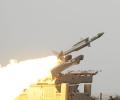
The missile targeted a floating object supported by the pilot-less target aircraft 'Lakshya', defence officials said.
The missiles were randomly chosen from the production stock and the entire launch activities were carried out by the specially formed strategic force command and monitored by the scientists of Defence Research and Development Organisation as part of training exercise, a defence scientist said.

The Prithvi-II missile is capable of carrying 500 kg to 1,000 kg of warheads and is thrusted by liquid propulsion twin engines.

India on Monday successfully test-fired its indigenously developed nuclear capable Prithvi-II missile, which has a strike range of 350 km, as part of a user trial for the defence forces.
Prithvi-II is capable of carrying 500-1,000 kilogram of warheads and is thrusted by liquid propulsion twin engines.
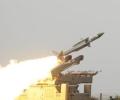
India today successfully test fired indigenously-developed surface-to-air Akash missile with a strike range of 25 km and capability to carry warhead of 60 kg from the Integrated Test Range at Chandipur as part of a user-trial.

I suggest we build a Vigyan Mandir (Temple of Science) with the ambience of a place of worship, so that it becomes a destination for pilgrims. We should embed on its walls bronze plaques describing each scientist mentioned here along with about a dozen of our ancient mathematicians, recommends Professor Kalyan Singhal, historian of science and technology.

In fresh trials, India has test-fired its indigenously developed Nag anti-tank guided missile, which can hit a target up to seven km, from a helicopter at a firing range in Jaisalmer in Rajasthan.

India on Saturday successfully conducted two rounds of trials of its indigenously developed surface-to-air Akash missile as part of a user trial by the Indian Air Force from the Integrated Test Range at Chandipur near Balasore in Odisha.
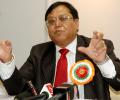
Saraswat played a key role in developing a series of missiles at a time when India faced tight international technology sanctions.
Inducted into India's SFC in 2003, Prithvi II, the first missile to be developed by DRDO under India's prestigious Integrated Guided Missile Development Programme is now a proven technology

Describing the launch of the sophisticated missile as a complete success, ITR Director M V K V Prasad said all the mission parameters were met during the trial. "The missile was randomly chosen from the production stock and the launch activities were carried out by the specially formed Strategic Force Command and monitored by scientists of Defence Research and Development Organisation as part of training exercise," sources said.
India on Monday successfully test-fired indigenously developed nuclear-capable Prithvi-II missile -- with a strike range of 350 km -- from a test range at Chandipur near Balasore in Odisha.

India on Friday successfully test-fired its indigenously-developed nuclear-capable Prithvi-II and Dhanush ballistic missiles in separate trials, boosting the armed forces' operational readiness.

Powering the Agni-1P will be the cutting-edge technologies developed for the Agni-4 and Agni-5 missiles.

DRDO chief G Satheesh Reddy Reddy is the first Indian to be appointed Fellow of the Royal Institute of Navigation and of the Royal Aeronautical Society.

Parliament on Tuesday hailed A P J Abdul Kalam as the "real gem" of India, saying the death of the former President has taken away its "true son" who became the driving force behind the country's space and missile programme.

The Akash weapon system, which will be deployed facing the western borders, employs command to line of sight guidance and relies on sophisticated radars and control systems to guide the missile to its targets.

Ordering more Akash systems is essential for the Indian defence industry.
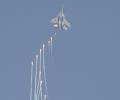
The IAF faces a 'fighter gap' of 13 squadrons. The IAF would be caught seriously short in a two-front war -- the worst-case planning contingency in which China and Pakistan attack India simultaneously, points out Ajai Shukla.

An industrial house bred in old-school manufacturing values, Godrej & Boyce has displayed unusual agility to become a trusted builder of advanced weaponry, discovers Ajai Shukla.

'His simple lifestyle, his optimism, his hard work and his genuine humility made him an authentic role model to millions of children, many of them growing up in challenging circumstances.'
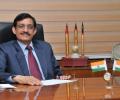
By removing Avinash Chander last week, the government has chosen to sacrifice the organisation's most potent symbol of success
 © 2026 Rediff.com - Investor Information - Advertise with us - Disclaimer - Privacy Policy - Sitemap - Feedback - About us - Terms of use - Grievances