We present some of the most unusual and bizarre treatments people undergo to rid themselves of sickness.
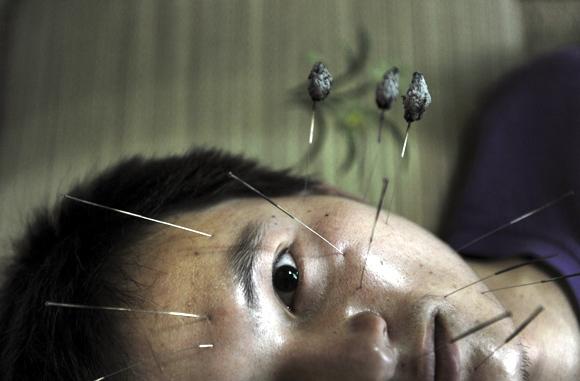
A patient suffering from facial paralysis undergoes acupuncture treatment at a traditional Chinese medical hospital in Jiaxing, China.
Click NEXT to see more PHOTOS...
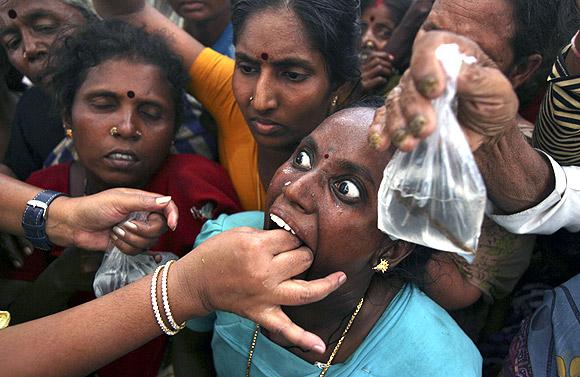
A woman prepares to swallow a live fish that has been dipped in homemade medicine during a camp in Hyderabad.
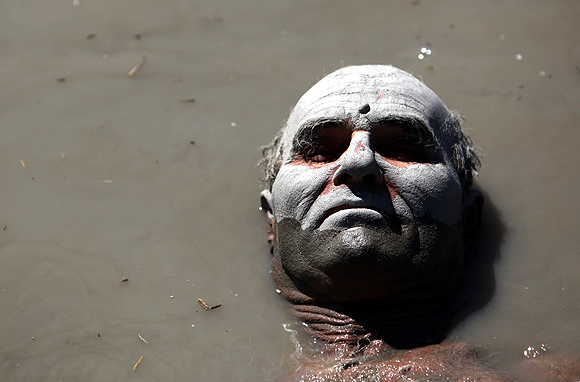
A man bathes in mud in the village of Ovca near Belgrade.
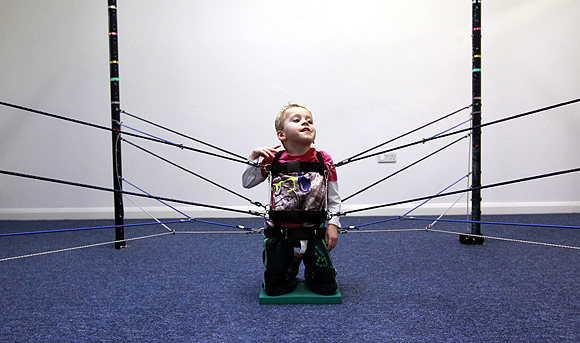
Owen Kew, 5, of Reading uses The Spider during therapy with his physiotherapist Fiona Savory at the Footsteps Centre, which provides an intensive physiotherapy program for children and young adults with neurological disorders, in Dorchester-on-Thames, southern England .
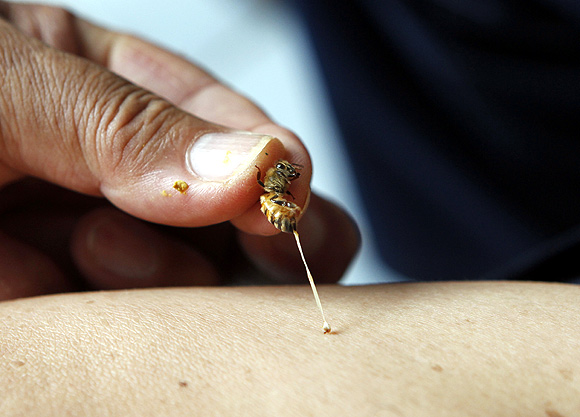
A bee sting therapist holds a bee to sting the arm of a patient in a bee farm in Silang, Manila. Farm owner Joel Magsaysay uses bee sting to treat patients with ailments such as hypothyroidism, paralysis and cancer. Magsaysay said the bee's venom contains a potent cocktail of proteins that boost auto-immune system that let the body activate the nerves and heal itself.
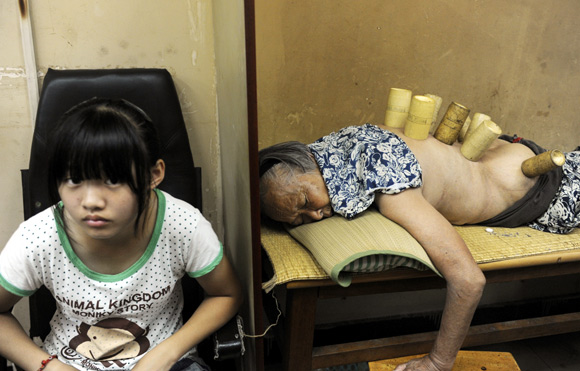
A woman undergoes cupping treatment as another patient waits for her turn at a traditional Chinese medical hospital in Jiaxing, China.

Residents in Rawa Buaya, Indonesia believe that the electrical energy from the tracks will cure them of various illnesses.
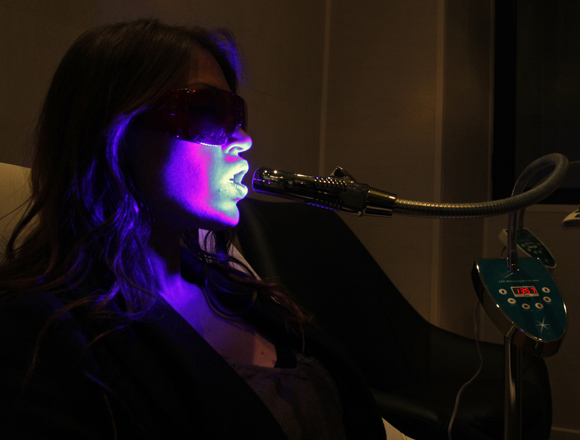
A customer undergoes a teeth whitening treatment in a smile shop in Nice. Clients bite on a gel-filled mouthpiece which reacts to the ultraviolet light in a 'bar a sourire' shop.

A patient is treated for cervical spondylosis at a hospital in Jiaxing, China
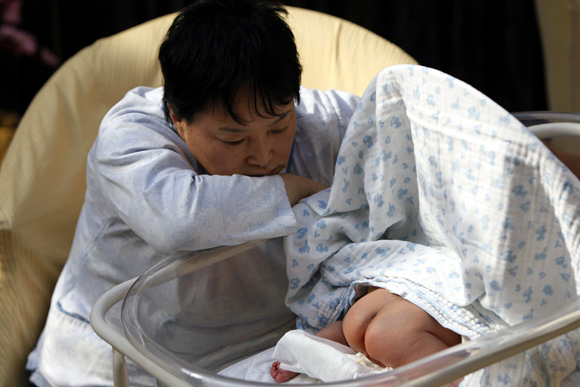
An employee watches as she exposes a baby to the sun to prevent jaundice at the CareBay maternity care centre in Shanghai. CareBay is a high-end maternity care centre in providing private services for "Zuo Yue Zi," or confinement period in Mandarin, a Chinese practice for mothers who have just given birth to stay indoors, undergo a restrictive diet and set of activities for a month.
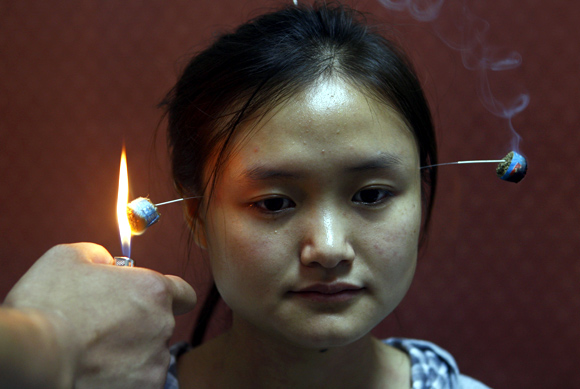
A doctor ignites dried moxa during a traditional Chinese acupuncture treatment to cure headache and insomnia at a hospital in Suining, China.

A villager pours water over the carcass of a dead calf, which villagers believe to be a "magic cow" born with crocodile skin, during its funeral at Trang Per village in Pusat, Cambodia.
The villagers believe that drinking water poured over the calf can cure rheumatism and other bodily ailments. Belief in the supernatural healing powers of animals such as cows, snakes and turtles is a relatively common phenomenon in Cambodia, where over a third of the population lives on under $1 a day and few can afford modern medicines.

Garra rufa obtusas, also known as "doctor fish", swim around the face of a man as he relaxes in a hot spa pool in Kangal, Turkey.
The treatment is believed to heal Psoriasis, a chronic skin disease which affects the joints and skins. Garra rufa obtusa, also known as "doctor fish" which live in mineral-rich hot spa pools, is used in the treatment as they nibble away the diseased skin.
The mineral-rich water is then believed to aid in the healing process of the lesions. People suffering from psoriasis travel to Kangal to stay at the spa for 21 days and visit the fish pools twice daily for four-hour treatment sessions.

Dead scorpions and ginger flakes are placed on a patient's face during a traditional Chinese medical treatment for curing facial paralysis, at a hospital in Jinan, China.
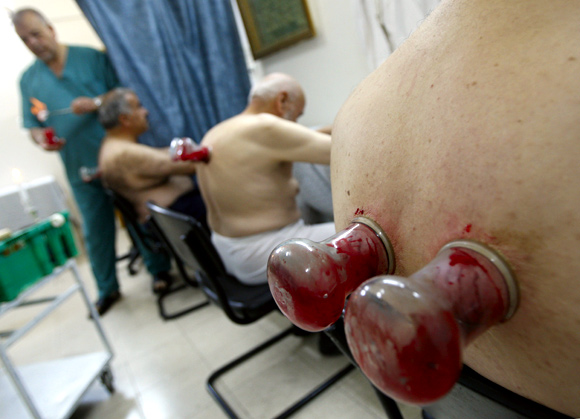
Assem al-Tamimi, a Palestinian doctor and Hijama specialist, treats patients at his clinic in the West Bank city of Hebron.
Hijama is a traditional Islamic treatment method that involves creating a vacuum on the skin by placing inverted cups on parts of the body and drawing blood from an incision on the skin.
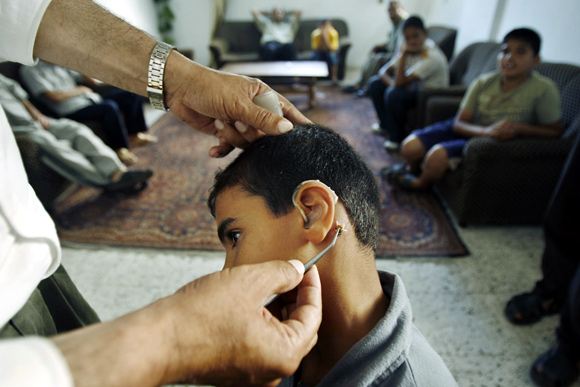
A hearing impaired Palestinian boy receives treatment with bee venom at a clinic in Gaza City.
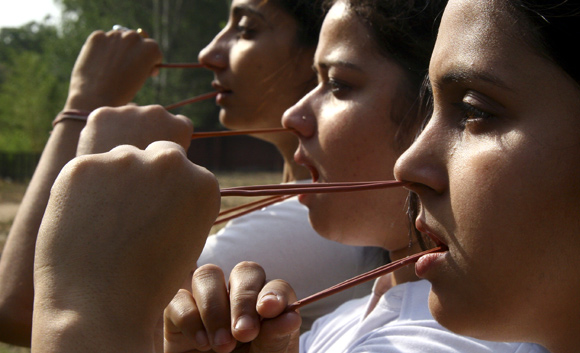
Students perform Rubber Neti, an ancient yogic technique, in the northern Indian city of Chandigarh. Many Indians believe that Rubber Neti controls the common cold, cough and asthma and keeps the nasal passages clean.
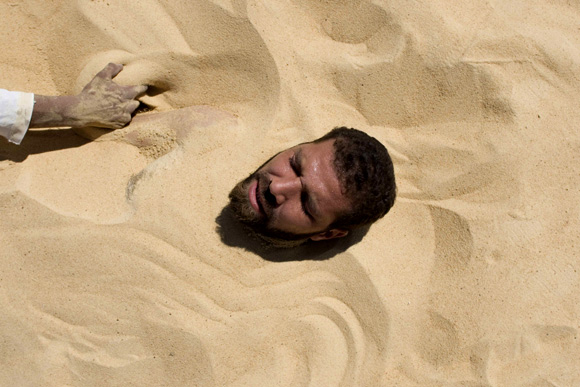
Mohmmed Emad, 41, lies buried neck-deep in the sand in the El Dakrror mountain area at Siwa Oasis, northwest of Cairo. The people in Siwa believe that being buried in the sand during the hottest time of the day is a therapeutic treatment which can cure rheumatism, joint pain and sexual impotency.

A walnut is placed on a patient's eye and ignited dry moxa leaves in his ears during a traditional Chinese medical treatment for curing facial paralysis, at a hospital in Jinan, China.

A resident receives horn cupping treatment on his back on a street in Nanning, Guangxi Zhuang Autonomous Region. Cupping is an alternative form of pain therapy that has been part of Chinese medicine for over 2,500 years.
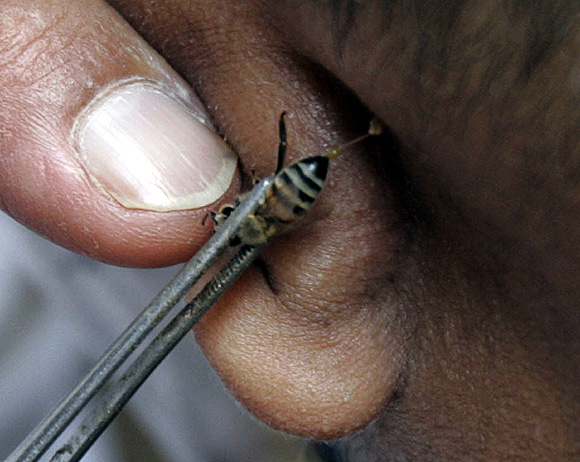
Haj Mohamed el-Minyawi allows one of his bees to sting a patient suffering from ear problems in Cairo. Minyawi believes that the bee stings have special properties, that when used on different parts of the body can cure ailments like kidney problems, appendicitis and even cancer. Minyami has opened his home to public and treats people from all over Cairo.
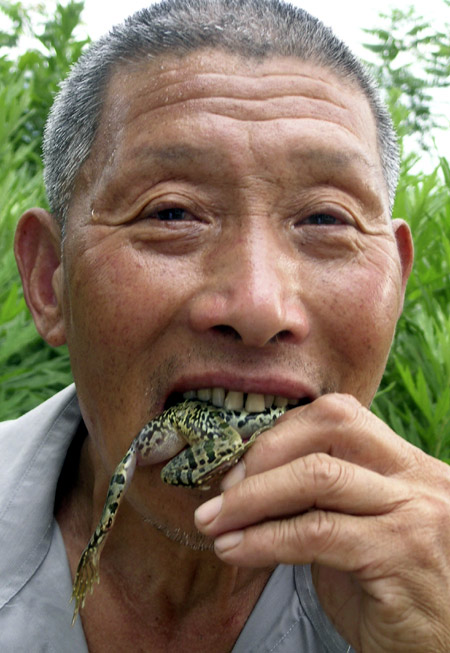
Jiang Musheng, a 66-year-old resident, eats a live tree frog at a village in Shangrao, in eastern China's Jiangxi province. Jiang suffered from frequent abdominal pains and coughing 20 years ago, until an old man called Yang Dingcai suggested tree frogs as a remedy.
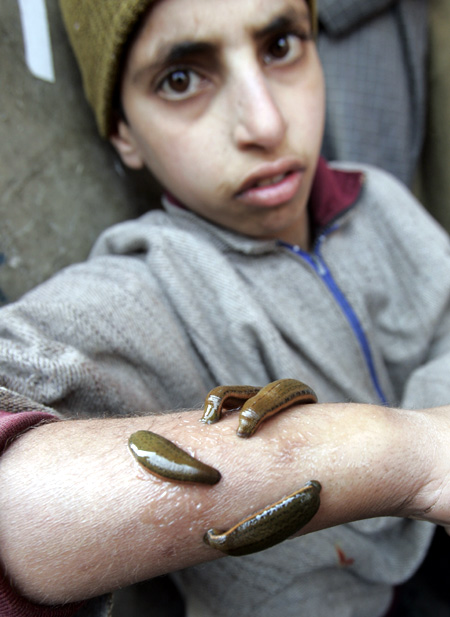
A Kashmiri child shows his arm as he undergoes leech therapy in Hazratbal, on the outskirts of Srinagar. Leeches have been used for thousands of years for various medical treatment purposes.

Consumers enjoy mud therapy at a nursing home in Anshan, east China's Liaoning province. The mineral mud is believed to be able to alleviate pain from rheumatoid arthritis, sequela of traumatisms and peripheral nervous system diseases.
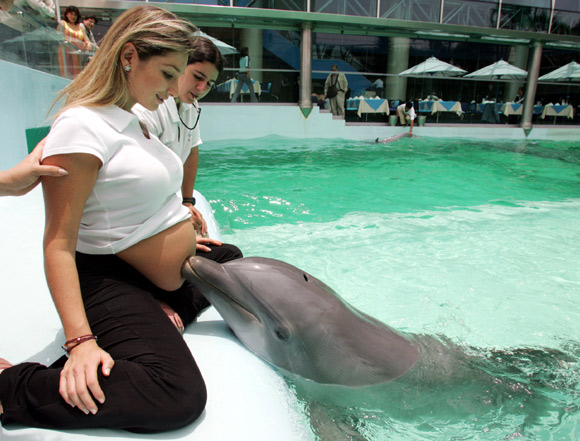
Peruvian Ety Napadenschi (L), who is eight month pregnant, is touched by a dolphin named Wayra during a therapy session for pregnant women at a hotel in Lima. The therapy is supposed to stimulate the brains of the baby inside the belly, with the dolphins high-frequency sounds, to develop neuron abilities.
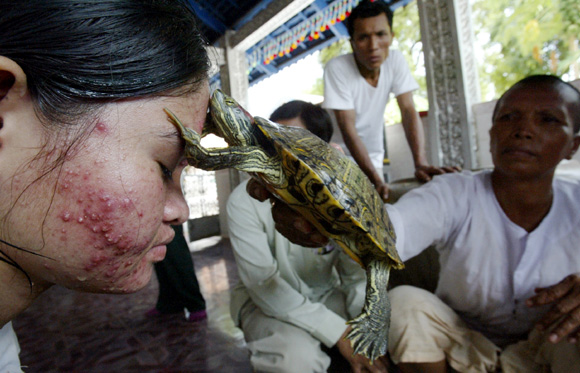
A man holds a terrapin, whose touch believed to cure rheumatism and other bodily ailments, as he prepares to treat the face of a villager in Kandal province, west of Phnom Penh. Belief in the supernatural healing powers of animals such as turtles, cows and snakes is a relatively common phenomenon in Cambodia.
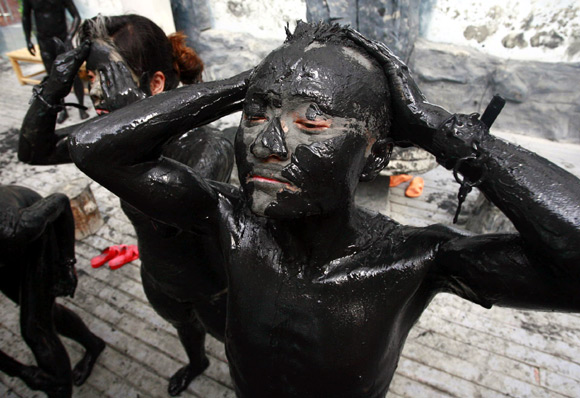
Visitors cover their bodies with black mud at a tourist resort in Daying County of Suning, south-western China's Sichuan province. The mineral-rich black mud is believed to be good for the skin, local media reported.

Cambodia villagers collect the urine of a cow believed to have healing powers in Kompot province, south of the Cambodian capital Phnom Penh. Belief in the supernatural healing powers of animals such as cows, snakes and turtles is relatively common in Cambodia, where more than third of the population lives on less than $1 a day and few can afford modern medicines.
...
 © 2025 Rediff.com - Investor Information - Advertise with us - Disclaimer - Privacy Policy - Feedback - About us - Terms of use - Grievances