We present some of the best photographs from across the globe in the week gone by.
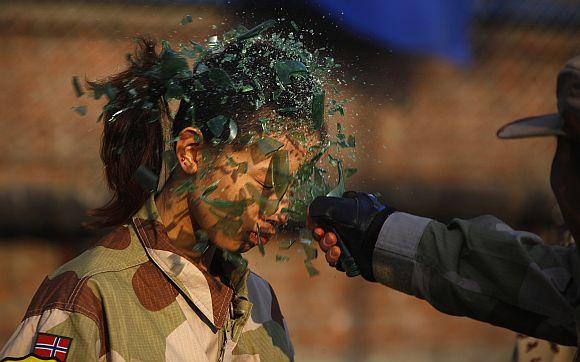
In this photograph, an instructor from the Tianjiao Special Guard/Security Consultant Ltd. Co, smashes a bottle over a female recruit's head during a training session for China's first female bodyguards in Beijing, on January 13.
According to the company, the training session consists of 20 women, mostly college graduates, who will undergo 8-10 months of training to develop sufficient skills to become security guards.
The company will then offer the best trainee a chance to attend the International Security Academy in Israel.
Click here for more Realtime News on Best Images
Click here for more Rediff Realtime News
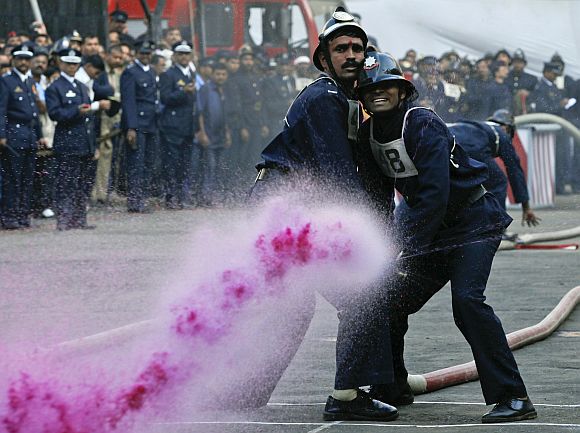
Firefighters aim coloured water at a target during the annual fire drill competition in Mumbai on January 9.
Firefighters in Mumbai took part in the annual competition to enhance their emergency response during fire incidents.
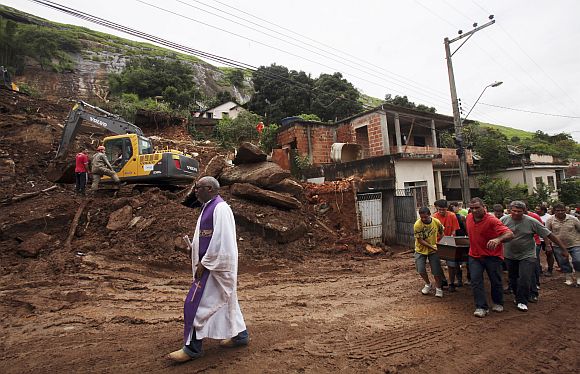
Relatives and friends of a two-year-old child and her grandmother who died in a landslide carry their coffins to a cemetery past houses destroyed by heavy rains, in the town of Sapucaia, 104 km northeast of Rio de Janeiro, on January 10.
Thirteen bodies were found and another nine people still missing due to heavy rains since the New Year, according to the Civil Defense, as Brazil's President Dilma Rousseff created a national task force to work towards preventing floods and landslides.
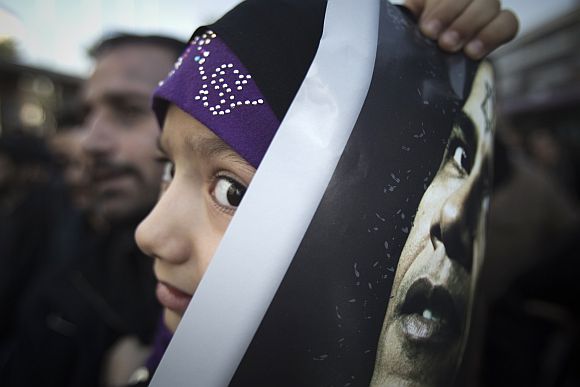
An Iranian girl carries an anti-US placard bearing an image of US President Barack Obama during a funeral for Iranian nuclear scientist Mostafa Ahmadi-Roshan, who was killed in a bomb blast in Tehran on January 11.

Actress Angelina Jolie is seen in the Oval Office during a meeting with US President Barack Obama (not pictured) before he departs for a day trip to Chicago, from the South Lawn of the White House in Washington, on January 11.
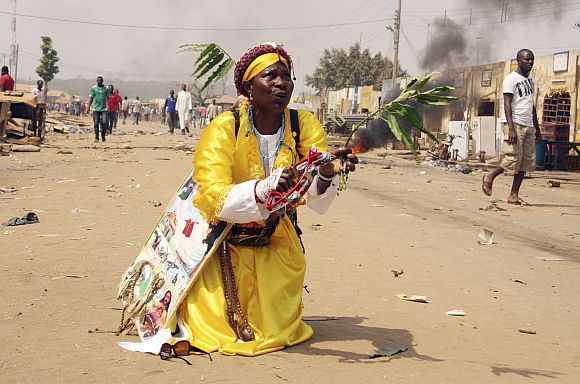
A woman prays during a protest against the elimination of a popular fuel subsidy that has doubled the price of petrol in Nigeria's capital Abuja, on January 10.
Nigerians took to the streets on Tuesday in growing numbers on the second day of protests against a sharp increase in petrol prices, piling pressure on President Goodluck Jonathan to reverse his removal of fuel subsidies.
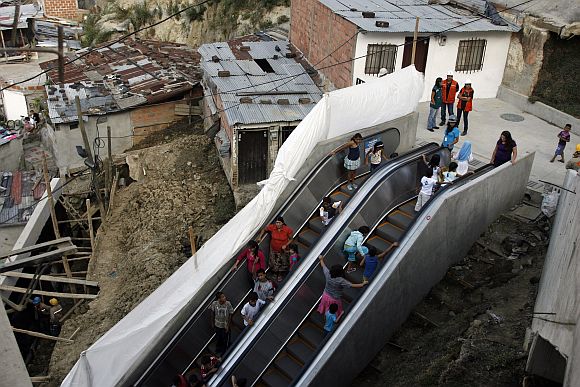
People travel on an outdoor public escalator at Commune 13 at Medellin in Columbia on January 12, 2012.
A huge 384 metres (1,260 ft) long outdoor escalator, divided into six sections, has been erected in one of the poorest districts of Colombia's second largest city to help the 12,000 residents there get around.
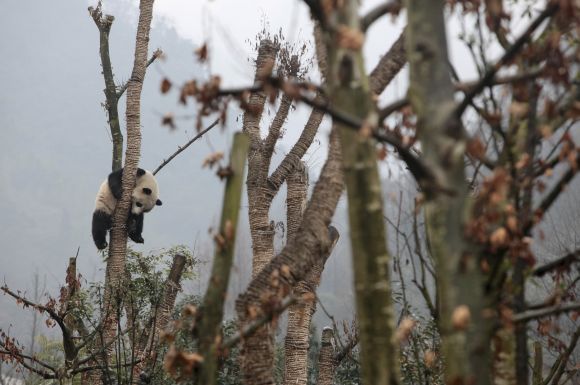
A giant panda sits in a tree at a panda breeding center in Dujiangyan, Sichuan province of China, on January 11.
The giant panda is among six young giant pandas which were bred in captivity and were released as a group of "pioneers" into an enclosed forest in Sichuan province.
The release is the first step of a project aiming to help the endangered species to adapt to the wild environment and eventually survive in the wild, Xinhua News Agency reported.
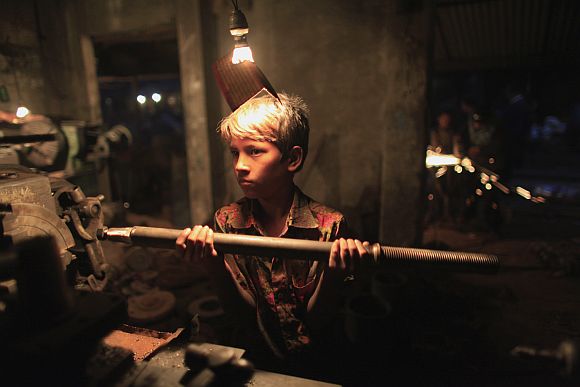
Shuvo, 7, works at a metal workshop which makes propellers for ships at a shipbuilding yard next to Buriganga River at Dhaka in Bangladesh, on January 10.
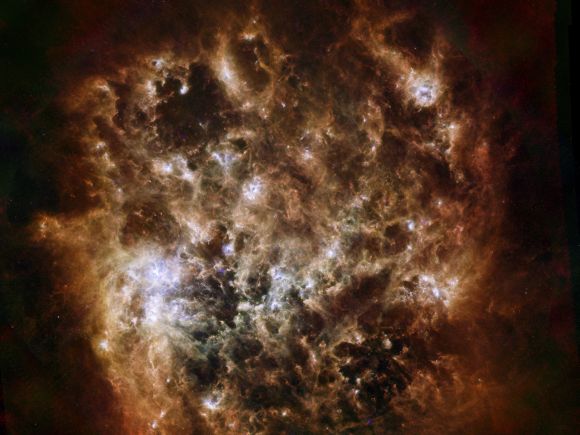
This new image, released by NASA on January 10, shows the Large Magellanic Cloud galaxy in infrared light as seen by the Herschel Space Observatory, a European Space Agency-led mission with NASA contributions, and NASA's Spitzer Space Telescope.
In the instruments' combined data, this nearby dwarf galaxy looks like a fiery, circular explosion. Rather than fire, however, those ribbons are actually giant ripples of dust spanning tens or hundreds of light-years.
Significant fields of star formation are noticeable in the centre, just left of centre and at right. The brightest center-left region is called 30 Doradus, or the Tarantula Nebula, for its appearance in visible light.
The colours in this image indicate temperatures in the dust that permeates the Cloud. Colder regions show where star formation is at its earliest stages or is shut off, while warm expanses point to new stars heating surrounding dust.
The coolest areas and objects appear in red, corresponding to infrared light taken up by Herschel's Spectral and Photometric Imaging Receiver at 250 microns, or millionths of a meter.
 © 2025 Rediff.com - Investor Information - Advertise with us - Disclaimer - Privacy Policy - Feedback - About us - Terms of use - Grievances