
Nitin Gadkari said AI will be used to detect landslides, waterlogging and accident-prone spots on highways, while highlighting logistics cost cuts and road safety initiatives.
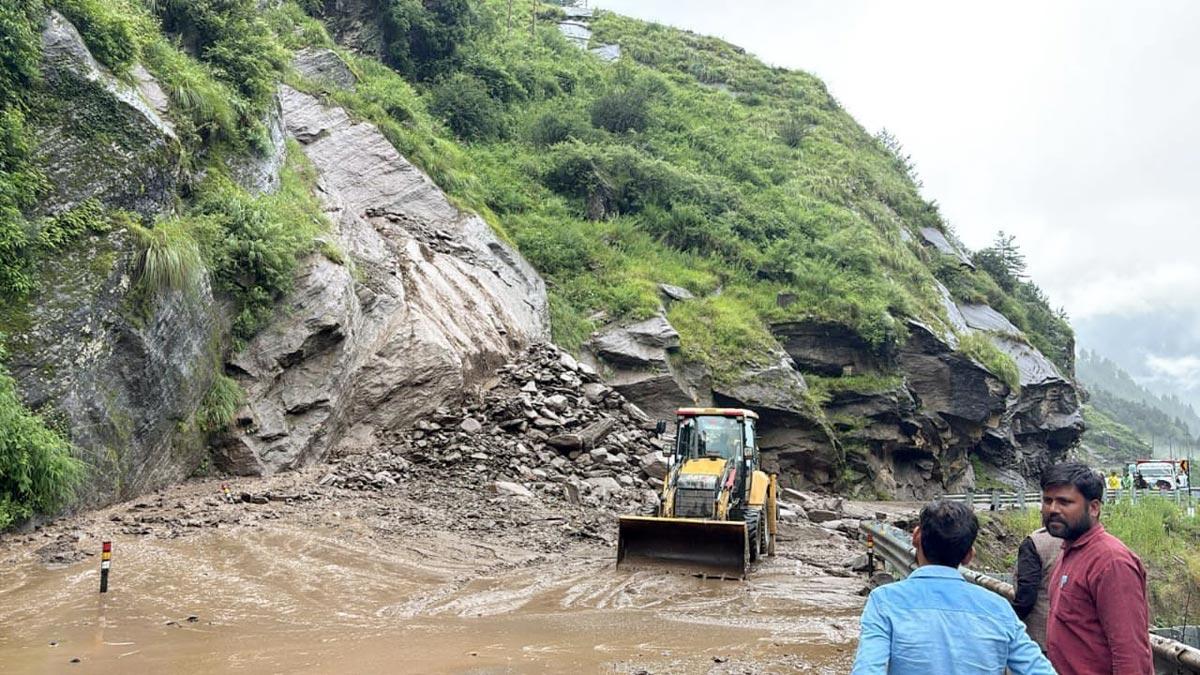
In a bid to strengthen road safety and ensure quality of national highways, the government is slated to use artificial intelligence technology to detect landslides, waterlogging and accident-prone spots along the national highways, Road Transport and Highways Minister Nitin Gadkari said on Thursday.
'We are trying to use AI and (other emerging technologies) in detecting landslide-prone stretches, accident-prone spots, waterlogging, and black spots along the national highways.
'We have already issued the circular. We want to improve it... especially in states like Uttarakhand and Himachal Pradesh. Wherever there is flooding, we are also trying to use other technologies to check the strength of the bridges and (other structures),' Gadkari said.
The minister made these remarks during a fireside chat themed 'India's vision on Infrastructure' at the Business Standard Infrastructure Summit 2025.
He was responding to a query about the quality of roads, and the efforts by the government to improve road safety.
Gadkari further added that he is 'very much' conscious about the quality of roads and won't make any compromise on that.
'I am very much conscious about it. I am taking strict action against the (erring) contractor. I am blacklisting them, charging fines and even pursuing criminal charges as well. I am not going to tolerate anything regarding quality. Though sometimes there are genuine problems as well,' he added.
Further, the minister talked about the 'Rah-Veer' scheme, also known as the Good Samaritan scheme, aimed at recognising and rewarding individuals who assist road accident victims by providing immediate medical attention and transportation to a hospital or trauma centre during the crucial 'golden hour'.
'If any common man is taking a victim to the hospital, we are rewarding him with ₹25,000. We want to save lives,' he said.
On logistics cost
Besides, the minister also remarked that by the end of December this year, he is confident that logistics cost in India will come down to single digit from 16 per cent at present, which will boost competitiveness of the country's exports in the global market.
'Recently, a study was submitted, which showed that logistics cost in India is reduced by 6 per cent. I am confident that by the end of December, logistics cost would be reduced to single digit. By reducing this cost, we are going to increase our exports. To achieve the $5 trillion economy goal, it is important to have good infrastructure,' he added.
This will be in line with the logistics cost for other developed economies such as China (8 per cent), US (12 per cent), and Europe (12 per cent), the minister remarked.
On assessing infra sector development
Gadkari said that infrastructure development is very important for the development of the country as without having good water, power, transport, and communication infrastructure, we can't bring industry and capital investment, which, in turn, will result in poor employment opportunities, thus limiting our fight against poverty.
'Everywhere we are constructing roads, hence industrial clusters, logistics parks, and real estate are getting developed. For example, the newly inaugurated Dwarka Expressway has resulted in a real estate development of around ₹8 to ₹10 trillion,' he said.
Along with creating world-class infrastructure and roads, the minister also highlighted his vision of providing an 'international standard' public transportation, with lower pollution emissions.
'I have received proposals for ropeway cable cars, hyperloop, and sky bus. Also, we are working on alternative and biofuels. Saving people from pollution, and especially air pollution, is the biggest challenge for me. My mission is also to make India free from fossil fuel imports and generate biofuels,' he added.
On challenges to attract private investment
On resources, Gadkari said his main challenge is expenditure of the resources and not raising the money itself.
He cited the example of the Infrastructure Investment Trust (InVIT) bond, which, according to him, was able to raise the required money within hours, and was oversubscribed.
'Every project of mine is viable. The only challenge lies in pushing the projects through the system. The (usual) challenges of land acquisition, clearances are there, but we are constantly pursuing them and holding meetings with stakeholders,' he said.
On his biggest achievement
Gadkari termed freeing millions of rickshaw pullers and handcart pullers from the clutches of human exploitation by providing them with the option of mechanised rickshaws as his biggest achievement, apart from the numerous highways and expressways worth trillions of rupees that he may have commissioned as the road transport minister.
'In my city and other parts of the country, there were rickshaw pullers. It was a form of human exploitation, and it was majorly the people from marginalised sections of society. When I became the minister, I held meetings with all stakeholders and decided to make mechanised rickshaws available to them.
'As of today, nearly 15 million people across the country are availing them (mechanised rickshaws), thus freeing themselves from this human exploitation. Even women are also able to earn a livelihood because of these mechanised rickshaws. This has to be my biggest achievement,' the minister recounted.
Feature Presentation: Rajesh Alva/Rediff








 © 2025