
'JP opened up about all the betrayals, the betrayal of the Jan Sangh and the RSS, how they ganged up with Sanjay Gandhi and pulled down the Morarji Desai government, how they destroyed the Janata Party.'

M G Devasahayam, a retired IAS officer from the 1968 batch is one of the senior-most retired civil servants in the country.
Before joining the IAS, Mr Devasahayam was commissioned in the Indian Army in 1964 and participated in the 1965 War and counter-insurgency operations in Nagaland in 1967-1968.
As the collector-cum-district magistrate of Chandigarh during the Emergency, Mr Devasahayam was in charge of then 'Enemy Number 1' of the State: Prisoner Jayaprakash Narayan.
"JP is one of the tallest leaders India has ever produced. I would put JP a step ahead of Mahatma Gandhi," Mr Devasahayam -- whose new book, Emergency and Neo-Emergency: Who Will Defend Democracy? has just been published -- tells Rediff's Shobha Warrier in the concluding segment of a multi-part interview.
- Part 1: Indira Gandhi's Enemy No. 1 During The Emergency
- Part 2: 'Sanjay Gandhi Was On The Verge Of Throwing Out Indira'
Do you feel the country also betrayed JP? If you ask anyone from the new generation, they may not even know the name, Jayaprakash Narayan....
Yes, he was betrayed by the intellectuals also.
The Vajpayee government did nothing to commemorate JP.
Who is talking about JP now?
These people who have been there for 11 years, want to completely finish off JP's name.
You were talking about the new generation in India not knowing JP. Even Biharis do not know who JP is.
The other day, when I went to a hospital in Bangalore, I met a young helper from Jharkhand (it was earlier part of Bihar). I asked him, 'Have you heard of a person called Jayaprakash Narayan?' He had no idea. He sheepishly said, 'Sir, I have not heard of that name. I am from Dhoni's place!'
After the interactions I had with JP I can say he is one of the tallest leaders India has ever produced. I would put him a step ahead of Mahatma Gandhi.
Why?
Mahatma Gandhi fought alien rule. He had the whole country with him and it was a movement.
But JP fought the entrenched Indian establishment of the Congress party headed by Nehru's daughter.
He didn't have the entire country's backing behind him.
For him, everything was about democracy.
Almost single handed, he gave democracy back to India.
I go back to your first question. While Jawaharlal Nehru brought in democracy on one midnight in 1947, his daughter executed democracy on a midnight in 1975.
That was why JP was very angry with her.

Were you in touch with JP later?
Of course. I was constantly in touch with him and meeting him regularly.
I used to go to Bombay when he was admitted in hospital. I used to go to Patna also.
Even two weeks before his death, I met him, and we had some interesting conversation.
That was when he completely opened up about all the betrayals, the betrayal of the Jan Sangh and the RSS, how they ganged up with Sanjay Gandhi and pulled down the Morarji Desai government, how they destroyed the Janata Party one by one.
The RSS wanted to destroy the Janata Party so that the Jan Sangh prospered. Soon, the Jan Sangh became the BJP. Everything was a well-planned strategy.
Was he a very disappointed man?
He was extremely disappointed.
He died of pure anguish.
He had a feeling of complete betrayal not just by the Left but by the Janata Party, particularly by the Jan Sangh and the RSS.
And also by the country.
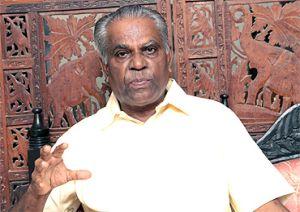 IMAGE: M G Devasahayam
Your new book is Emergency and Neo-Emergency. Who Will Defend Democracy? Who will?
Only the people can defend democracy.
Democracy is for the people, so, they have to defend it. There is no other way.
The Emergency was described as the darkest period in India's history...
It was the darkest period. What you have now is a deep, dark period.
Feature Presentation: Aslam Hunani/Rediff







 © 2025