
'Professor Kitagawa is an exceptional researcher, a good teacher and above all a great person.'

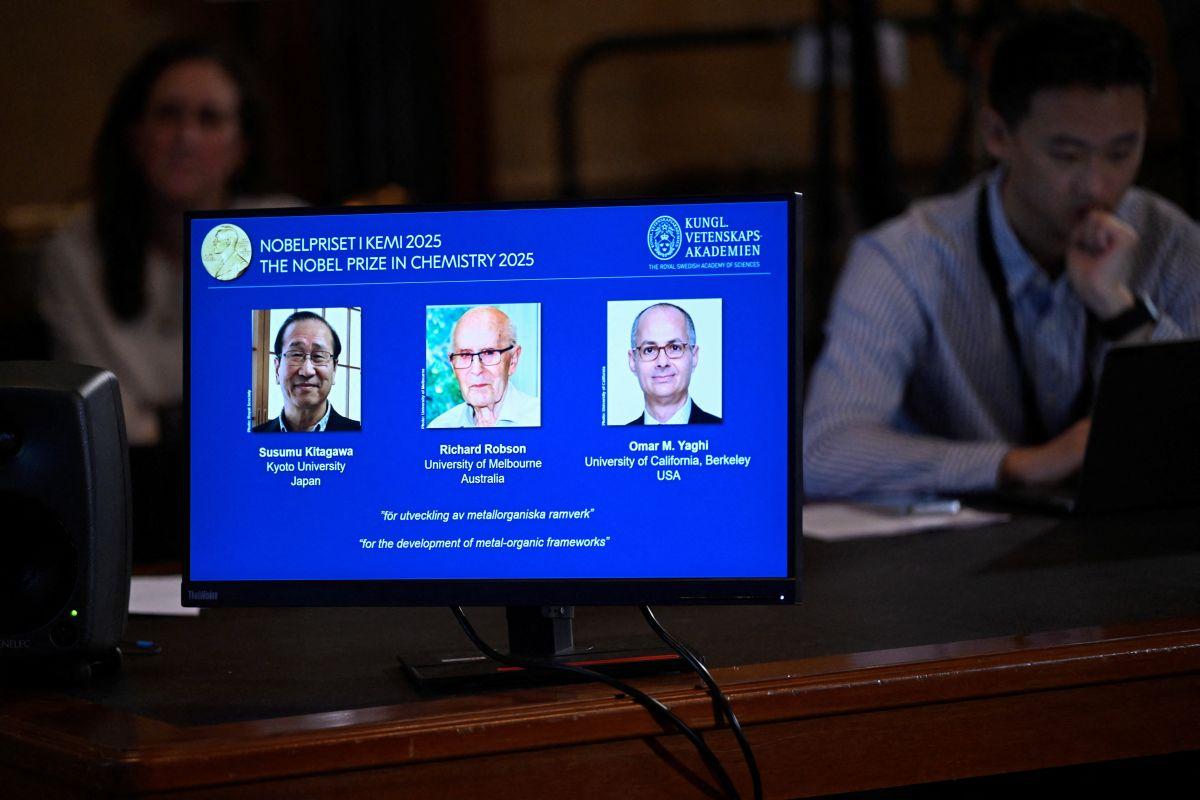
The 2025 Nobel Prize in Chemistry is shared by Professor Susumu Kitagawa of Kyoto University in Japan, Professor Richard Robson from the University of Melbourne in Australia and Professor Omar Yaghi from the University of California, Berkeley, in the United States.
The Nobel Prize was awarded for creating molecular constructions, called metal-organic frameworks (MOF).
The astonishing ability of this substance is that it 'allows chemists to change the size of the holes as desired at the molecular level, making it possible to capture and store specific gases and separate out only targeted substances'.
This makes it possible to recover toxic gases emitted from factories and automobiles, and allow the safe storage of hydrogen.
Tamas Kumar Panda, Assistant Professor at the Vellore Institute of Technology, was mentored by Professor Kitagawa for his post-doctoral studies at Kyoto University.
Incidentally, his PhD supervisor Professor Rahul Banerjee's post-doc mentor was Professor Omar Yaghi, the joint winner of the Nobel Prize.
"Professor Kitagawa! I don't think I have met such a humble person in my life," Professor Panda tells Rediff's Shobha Warrier.
Applying to Kyoto University to work on metal-organic frameworks
I did my PhD at the National Chemical Laboratory in Pune under Professor Rahul Banerjee.
While doing my PhD, I came to know about the Japan Society for Promotion of Science (external link) which gives 25 to 30 two year post-doc fellowships every year. It is indeed a very prestigious fellowship.
Based on the work I was doing, I wrote a proposal and applied for a post-doc fellowship in 2014.
And even before I completed my PhD, I got the post-doctoral fellowship. So, I had to finish my PhD in a hurry so that I could avail the fellowship.
After I applied, I had a Skype call with Professor Kitagawa as he wanted to know the kind of research I was planning to do. After our conversation, he told me what I should write in the proposal.
I used to send my proposal drafts to him, and he would check and make corrections and sent them back to me.
Then he assigned an assistant professor -- Professor Satoshi Horike -- to follow up my proposal.
Joining the Kitagawa group as a researcher
Professor Kitagawa was a very big name in Japan, a very powerful scientist of great standing.
He was the director of the Institute for Integrated Cell-Material Sciences (iCeMS) at Kyoto University.
Under the Kitagawa Group at Kyoto University, there were 50-55 people working -- associate professors, assistant professors, research scholars.
Though all of us worked under Professor Kitagawa, because he was so busy, he would assign an associate professor and assistant professor to all those who did post doc under him at the university.
Meeting Professor Kitagawa
I met him at the university as soon as I reached Japan.
The first thing that struck me was how humble and simple he was. In India, a person of his stature would have security all around him!
The moment I presented myself, in the typical Japanese way, he bowed to greet me.
I was shocked. You don't expect a person of his stature to bow to you.
But that is how Japanese people are. Very soon, I also learnt their culture of greeting others in that way.
And Professor Kitagawa! I don't think I have met such a humble person in my life.
After the greeting, he told me, 'You must be very tired after all the travel. You take rest and come back when you feel fine.'
He then instructed one of his secretaries to help me find an apartment. In fact, his secretary took care of everything, from house hunting to signing papers to taking insurance... I didn't have to worry about the nitty gritty associated with a new place.

Monthly scientific meetings with Professor Kitagawa
Once I started my research, we used to have monthly meetings where we have to present the progress we made.
At those meetings, Professor Kitagawa and the other professors would listen to the presentations of all the research scholars.
After the presentation, they would critically analyse what we did, and then give us their feedback.
When Professor Kitagawa gave his suggestions, we would never feel that it was the director or a scientist of his stature talking to us. He made us feel calm and comfortable.
One thing he used to tell us was, do research not thinking about publishing a scientific paper, publication is only a by-product of your research.
That is how he looks at research, with a lot of passion.
This changed my view towards science and research, and helped me in what I do today.

MOF, a wonder material
Now that the Nobel Prize has been given to the work done in this field, we see a lot of possibilities happening all over the world.
MOF is such a wonder material that it not only absorbs gas but releases it also unlike other material. The beauty of this material is that because of this reversible phenomenon, you can reuse MOF a thousand times.
The great thing about Japan is that they appreciate and encourage pathbreaking research done by its scientists unlike in India.
Here, the researchers tend to work on well-established subjects and not something new. If you choose a new field, you face a lot of challenges and uncertainties.
A Nobel Prize winner who travels by train and bus
Professor Kitagawa is a man of great stature in Japan but he doesn't have a car or a driver.
Every day, he came from Osaka to Kyoto by train, a train journey of 45 minutes to 1 hour.
As he worked in the Katsura campus of the university, he has to get down at the Katsura railway station and travel by bus to the campus.
And from the bus stop, he walked to iCeMS.
That was how this great man came to the university every day, by train, by bus and then walked.
A physically fit good dancer!
Most people will be surprised to hear that Professor Kitagawa is a great dancer.
We used to have this Sakura party -- traditional Japanese hanami, a picnic under cherry blossom trees -- every year when the cherry blossoms bloom.
Professor Kitagawa loved taking us to Arashiyama where all the cherry trees would be full of flowers.
At the party, he would serve drinks and food to everyone. He was like one of our best friends at the party!
He must have been in his 60s when I was there but he used to dance like a young person, and he loved dancing at the parties.
He was such a fit person that he gave us young people a complex.
He was so fit that his energy level was always so high.
So also his ability to hold alcohol. No 30 year old could beat him in that.
Our lab was on the 5th floor but I never saw him take the lift. Whenever he came to our lab, he chose the stairs.
His physical fitness is one of the reasons why he is so mentally fit and successful as a scientist.

The Kitagawa personal touch
He was very particular that he addressed everyone by their first name, and he remembered the names of each and every one of us.
Whenever he met me, he would say, "How are you, Tamas?"
I met him in Singapore last year at International MOF 2024 where both of us were speakers. He was so happy to see me and said, "Tamas, you are here as a speaker? I am so proud of you! Very good!"
Then he said cheekily, "You look the same except that you lost hair!"
 IMAGE: Professor Tamas Panda
Replies to e-mails immediately
Professor Kitagawa is an exceptional researcher, a good teacher and above all a great person.
Though he is such a busy person, he would reply to mails immediately; the maximum time taken is an hour.
Whenever I did something interesting or something new, I used to mail it to him. In fact, I dedicated one of my publications to him. And I would get a reply from him immediately appreciating what I did.
I sent him a congratulatory message after the Nobel Prize was announced, and this is the first time that a reply has not come yet. It is understandable as he must be flooded with messages right now!
Having known him, I am hundred percent sure he will reply when he gets time.
In his address, he said, 'I thank all the people associated with the research including the post-doc students, even those from abroad for doing such excellent work. The work done by every single person is behind the Nobel Prize.'
Who will remember the researchers at such a hour?
That's why I said, you will not see a great person like him.

Nobel Prize, not a surprise!
It is not a surprise to anyone who knows the Kitagawa group that he won the Nobel Prize.
When I was there, every year, the Nobel Chemistry Prize announcement was keenly awaited by his group.
Everybody knew that if the Nobel Committee considered MOF as the field for the Prize, he would definitely get the Nobel as what he has created is path-breaking in the field of science.
He is a pioneer in the field, and no wonder he is called the Father of MOF.
The most beautiful thing about him is that despite being such an extremely talented scientist, he remains so simple and humble.
I would say Professor Kitagawa is the most deserving scientist to have won a Nobel Prize.
Feature Presentation: Aslam Hunani/Rediff









 © 2025