
'What we need to watch is how Saudi Arabia's financial assistance will be used by Pakistan. If the funds go to build their military hardware and operations, it should worry us.'
India must use its relationship with Saudi Arabia to diplomatically deal with the new geopolitical architecture to be prepared for any eventuality, explains Ramesh Menon.
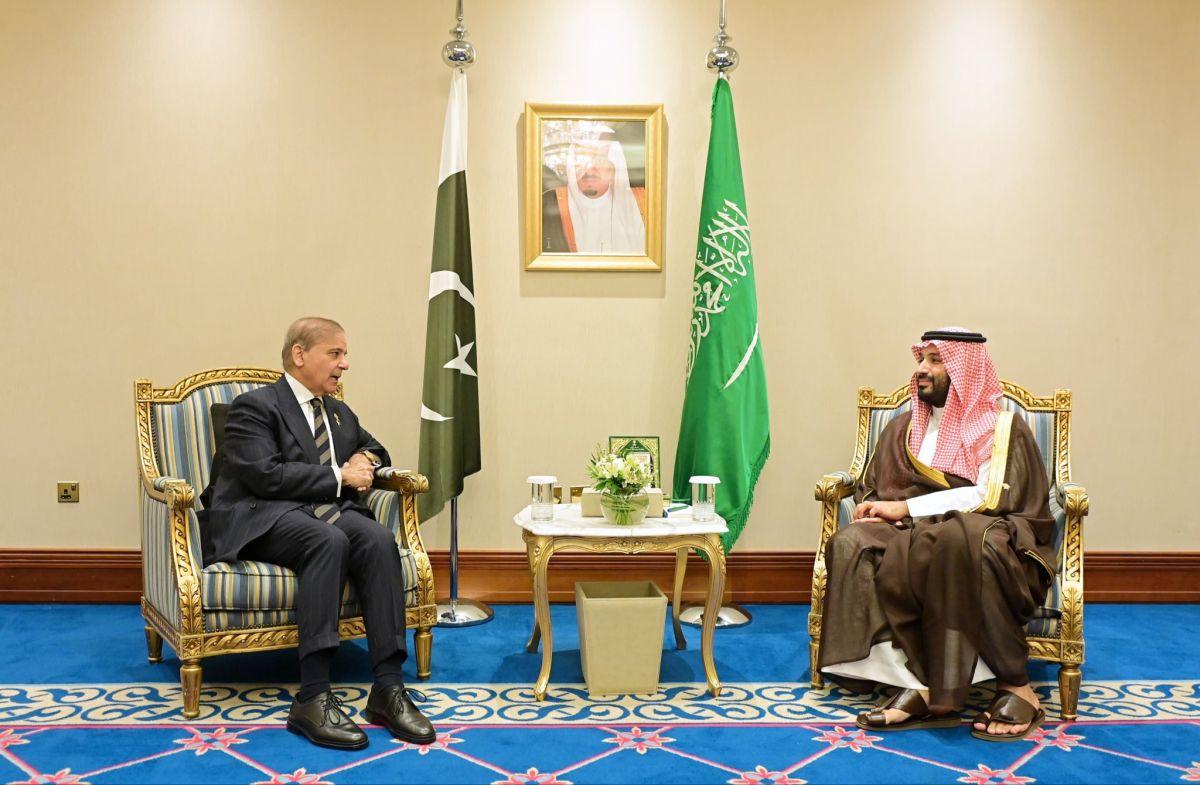
If alarm bells rang in India's political establishment and bureaucratic circles when Saudi Arabia signed a Strategic Mutual Defence Agreement with Pakistan, it was with good reason: Pakistan, the Islamic world's only nuclear-armed country, was engaging with Saudi Arabia, the Arab world's most prosperous State and a leader in the Islamic world.
The pact stated that aggression against one party would be considered an act against both.
It is not good news for India, considering the rocky relations it has suffered with its neighbour, Pakistan, long plagued by unstable governments.
Pakistan possibly hastened the pact after Operation Sindoor to create ground support among an otherwise disenchanted public at home.
When a nuclear State's defence minister proclaims that its capabilities are now available for Saudi Arabia, we know what he is referring to.
Theoretically, Pakistan can extend its nuclear umbrella to Saudi Arabia after this pact.
It is unlikely, however, that Pakistan would use its nuclear arsenal if Saudi Arabia were attacked. The pact is mainly symbolic and is more likely to serve as a deterrent.
Saudi Arabia realised it could no longer rely on the United States for protection as the attack on Doha in Qatar could not have happened without American knowledge.
The pact signals the start of a grand military alliance in the Gulf. Pakistan has said that other countries can also join.
After the Israeli attacks on Doha, countries like Saudi Arabia, Pakistan, Turkey, Iran and Iraq have been talking to each other to chart the way forward to protect themselves.
Israel is no longer seen as just a rival, but as a military threat.
It is doubtful that Pakistan could have signed this pact without an okay from China, its key ally and primary arms supplier.
China may have sniffed a lucrative business opportunity as Pakistan could use Saudi funds to shop for more sophisticated arms.
Nearly 70 per cent of Pakistani arms and ammunition are bought from China.
China is also Pakistan's largest trading partner and its second-biggest lender, with around $4.37 billion in loans, another $4 billion in central bank support, and $37 million in additional economic assistance.
Since the 1960s, Pakistan has had close links with Saudi Arabia, training its soldiers and pilots, guarding Mecca and Medina, protecting its royalty, and even stationing an entire division in the country.
In times of economic crisis, Pakistan has been grateful for Saudi aid.
Both countries have also conducted joint naval and land forces exercises.
Saudi Arabia may become Pakistan's largest source of external funding, which could go up to nearly $6.46 billion, helping Islamabad wade through its current financial crisis.
Remittances from Saudi Arabia to Pakistan amount to about $7.4 billion, making it critical for the Pakistani economy.

The pact has unsettled India, as it had carefully cultivated relations with Saudi Arabia for over a decade.
India has invested over $3 billion in the kingdom, and it is unlikely to want to jeopardise that relationship. In recent years, Indian firms like L&T, Tata, and Wipro have expanded their presence in technology, construction, management, and consultancy to help Saudi Arabia diversify its economy away from oil.
India's imports from Saudi Arabia are valued at $30.12 billion, while exports stand at around $11.75 billion. India exports rice, aircraft, chemicals and petroleum products.
More than 18 per cent of India's crude oil imports are sourced from Saudi Arabia.
In April this year, Saudi Arabia also announced plans to invest $100 billion in India in sectors like energy, petrochemicals, infrastructure, technology, fintech, telecommunications, pharmaceuticals, manufacturing, and health.
As Saudi Arabia is India's fourth-largest trading partner, it is unlikely to encourage conflict against India. Riyadh would not want to jeopardise a flourishing economic partnership that serves its own diversification goals.
India needs to remind Saudi Arabia that its future lies not in being tethered to Pakistan's insecurities but in partnering with India's stability and growth. And, even its own.
Sharat Sabharwal, India's former high commissioner to Pakistan, told me, "Saudi Arabia has great equity in India. It is diversifying, and there are more opportunities for it in India than in Pakistan. What we need to watch is how Saudi Arabia's financial assistance will be used by Pakistan. If the funds go to build their military hardware and operations, it should worry us.
"Pakistan is coming out of its geopolitical tight spot that it was in because of its internal problems and how its nationals were linked to terrorism, but with its new relationship with the US, it might get more adventurous towards India. We have to see how this pact pans out.
"The security architecture in this region will undergo a flux. If Pakistan gets a bigger role, it will not be in India's interest."

It would be prudent for New Delhi to use its best diplomatic options with Riyadh. India must clarify what Saudi Arabia means by 'aggression' in the pact and obtain assurances that it will not apply in any Pakistan-India clash.
India should also leverage its economic ties and strengthen them further to give Saudi Arabia a secure market and ensure that its investments in India flourish.
When economics do the talking, there cannot be friction.
As India deepens ties with the United Arab Emirates, it could also help bring Saudi Arabia closer.
Handled deftly, India can shape how the pact is interpreted and applied.
At the same time, India must prepare strategically, as the situation is fluid and external players can complicate a bilateral crisis.
India must deepen defence cooperation with new partners like France and friendly Gulf States, while strengthening intelligence and maritime security in the Indian Ocean and Arabian Sea.
India could also reassert its role in non-proliferation forums, positioning itself as a responsible actor and urging Saudi Arabia and Pakistan to ensure nuclear restraint.
This pact may be India's opportunity to reinvent. Ausaf Sayeed, India's former ambassador to Saudi Arabia, puts it succinctly: 'India's most strategic response is to leverage its unique and formidable strengths in technology, trade, and human capital, becoming an indispensable partner in the Gulf's economic transformation. Its most significant asset will be its ability to emerge as the region's most valuable partner for the future.'
Ramesh Menon is an author, award-winning journalist, educator, documentary filmmaker, and corporate trainer. He authored Modi Demystified: The Making of a Prime Minister.
Feature Presentation: Aslam Hunani/Rediff








 © 2025