
Going by political tradition, another formation will likely come to power in Karnataka in the next assembly election, due 2028.
And if that happens, D K Shivakumar will have to sit it out till 2033, points out Aditi Phadnis.
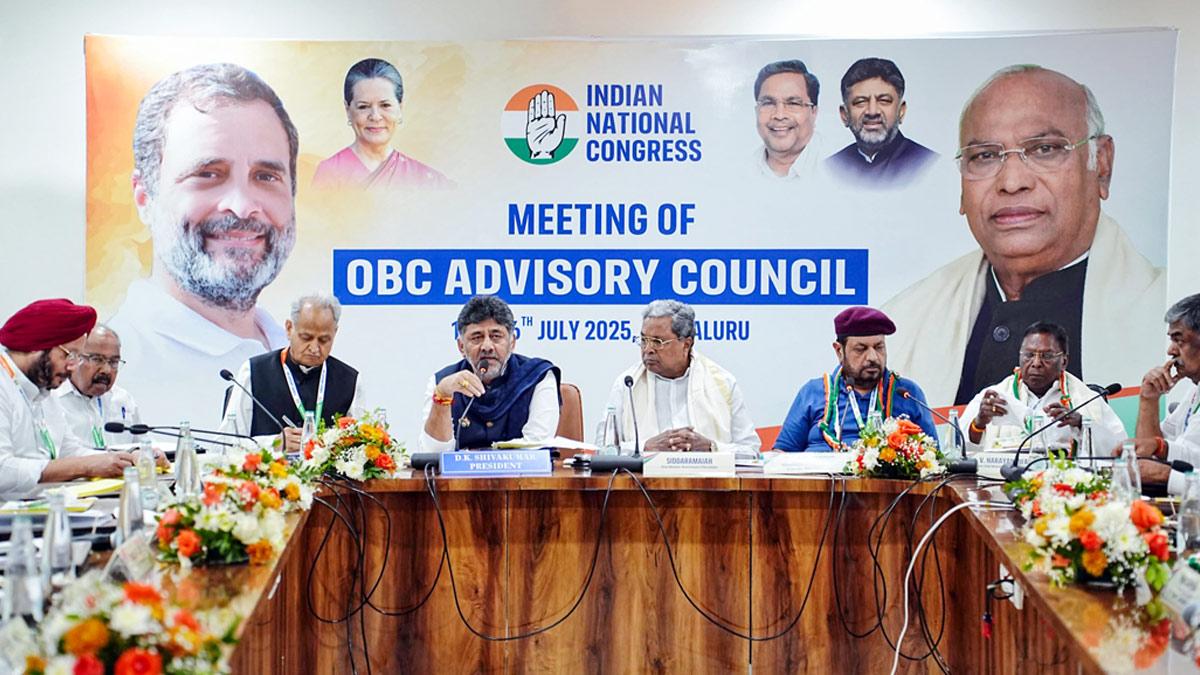
Is it always a good idea to announce your retirement in advance? Maybe in chalking out corporate succession plans. But in politics maybe not.
It is possible that Karnataka Chief Minister Siddaramaiah's gambit to snag the chief ministership of Karnataka in 2023 -- 'this is the last election I will be fighting' -- paid off at the time.
But looking at the state of the government in Karnataka today, despite winning 135 seats in the 224-member assembly (137 now after by-election victories), which is a kind of a landmark for the ruling Congress after 1989, you wouldn't think so.
It is hard to recall an instance in India's political history when a deputy chief minister has publicly told his supporters that he has no option but to let the chief minister continue, as D K Shivakumar did last fortnight.
Not governance initiatives, not infrastructure creation but succession to Mr Siddaramaiah seems to be the primary concern of the government and party.
There are so many elements in the mix, including cross-party linkages. The relationship between former chief minister B S Yediyurappa and Mr Siddaramaiah is a complex, many-layered one.
Publicly, the two fight, which is to be expected. But at Mr Yediyurappa's 78th birthday celebrations, recalling his role in bringing the Bharatiya Janata Party to power in the state, Mr Siddaramaiah said: 'Very few leaders know the pulse of the state and Yediyurappa is one among them.'
There have been many instances when the two have helped each other out against rivals in their own parties.
Currently, Mr Siddaramaiah's biggest challenger is not Mr Yediyurappa (who is facing problems of his own in the BJP) but Mr Shivakumar or DKShi, as he is called in local parlance.
Unlike Mr Siddaramaiah who came to the Congress from socialist stock, Mr Shivakumar has always been in the Congress -- since he joined the Youth Congress when he was in college.
He was Youth Congress general secretary in the state between 1983 and 1985.
His first electoral victory was to become a member of the zilla panchayat in 1987.
He is from the powerful Vokkaliga caste and his first assembly contest was against caste titan H D Deve Gowda in Sathanur in 1985. He was in his 20s.
Not unexpectedly, he lost, though by a narrow margin. That, in itself, was not a small feat because Mr Deve Gowda was then a senior minister in the Ramakrishna Hegde government.
But Mr Deve Gowda, who had contested from two constituencies, quit Sathanur, which Mr Shivakumar contested and won in the by-election.
Then began a battle with the Deve Gowda family, which has changed its look and shape but remained, in essence, exactly what it was: A battle.
Mr Shivakumar contested the 1989 Lok Sabha election from Kanakapura against Mr Deve Gowda and, not unexpectedly, again lost.
Those were the years when Mr Deve Gowda was at the height of his power.
However, he contested the assembly elections too and won. (In the 1989 elections to the Lok Sabha and assembly were held together in the state.)
But despite his defeats Mr Shivakumar began building his influence in the rural areas adjoining Bengaluru.
At around this time, land prices began rising. He also invested in mining and allied businesses.
He became the youngest minister in the state just two years later at 31, where he served as minister of state under Chief Minister S Bangarappa from 1991 to 1992.
By now he had formidable resources at his command -- money (records reveal his assets amounted to Rs 1,400 crore [Rs 14 billion] in 2023), and patronage.
Both grew as time went by. Mr Shivakumar has used personal wealth to earn political capital. These stories are well known.
The 2002 episode, when the Maharashtra chief minister and Congress leader, the late Vilasrao Deshmukh, had all but lost the government in a no-confidence motion, it was Mr Shivakumar, urban development minister in Karnataka at the time, who corralled MLAs and lodged them at a resort, and led them to Mumbai on the day of the vote.
The late Ahmad Patel won his Rajya Sabha seat from Gujarat (2017) and publicly acknowledged his debt to Mr Shivakumar, who kept 44 MLAs from Gujarat 'safe'.

But while money can buy a lot of things, it doesn't always buy leadership. Observers of Karnataka politics say that while Mr Shivakumar has political influence, Mr Siddaramaiah wields power among the MLAs.
This caused hectic lobbying and extended delays in government formation in 2023, testifying to the tug of war between the two leaders from the get-go.
Going by political tradition, another formation will likely come to power in Karnataka in the next assembly election, due 2028.
And if that happens, Mr Shivakumar will have to sit it out till 2033.
Hence all these shenanigans midway through the term of the Congress government. Expect more restlessness.
Feature Presentation: Aslam Hunani/Rediff







 © 2025