
'On February 1, 2026, everyone in India, please light a diya. Because the Grammy is coming home.'
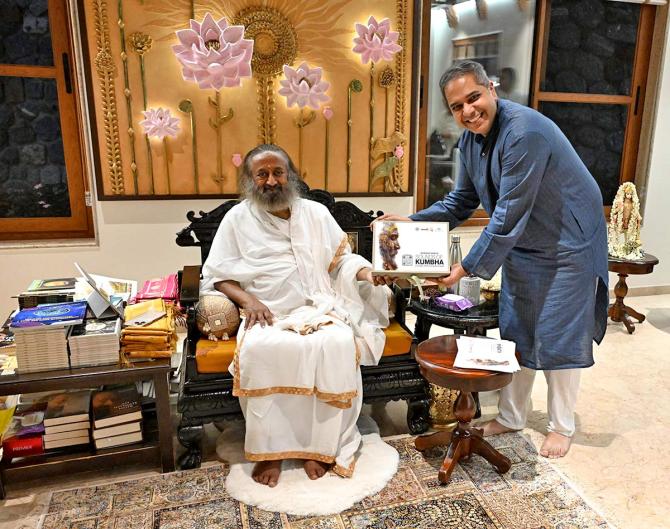
It's not the first time an Indian artiste has won a Grammy nomination.
But it IS the first time, an album of this magnitude -- that brings together 50 global artistes, and was conceived and executed within record time -- has been shortlisted to win a Grammy.
Delhi-born composer Siddhant Bhatia's album Sounds of Kumbha has been nominated in the Best Global Music Album category, alongside sitarist-composer Anoushka Shankar (a 14 time nominee) and Shankar Mahadevan-led Shakti Band.
Inspired by the devotion, the chants and timeless rhythms of the Maha Kumbh 2025, the album is a collaboration between Network18, HistoryTV18 and Universal Music India commissioned by the Uttar Pradesh government.
In this exclusive interview with Divya Nair/Rediff, Siddhant tells us how the universe conspired to bring together 50 artists from around the world, including Sri Sri Ravi Shankar, Grammy winner Jim 'Kimo' West, Grammy-nominated Indian-American rapper Raja Kumari, V Selvaganesh, Madi Das, Ron Korb, Charu Suri, Kala Ramnath, Bhanumathi Narasimha, Kanika Kapoor, Pravin Godkhindito, and many more to create this historic moment for India.
Watch: Siddhant discusses the biggest challenge of making a project of this magnitude
Manifestation Or Divine Intervention?
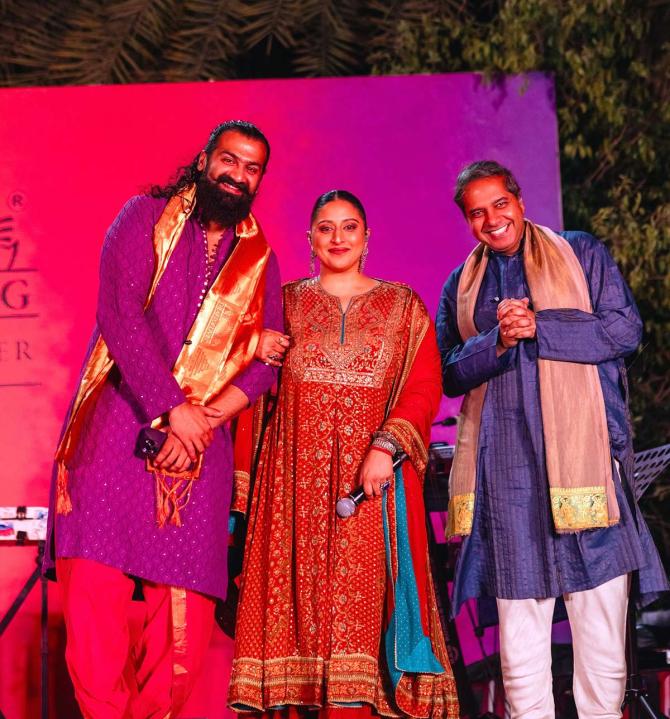
For singer-performer Raja Kumari, winning the Grammy nomination a second time for Sounds of Kumbha is more than just a personal dream.
"God's timing is always divine," says the America-born artiste who was working on her album Kashi to Kailash when the opportunity came knocking.
"I remember I asked God. I told Mahadeva, 'I'm making this album for you and want it to reach the people who are meant to hear it. Please send me someone who can help me. And Siddhant literally called that same day," she confesses.
The 39 year old, who has sung the track Durga Trance alongside Siddhant, Kanika Kapoor and Siroyi, still gets goosebumps when she talks about her deep, personal connection with the track and the album.
Don't miss Raja Kumari's proud excitement when she exclaims, 'Watch out! The Grammy's coming home to India'.
Recording Live Sounds At The MahaKumbh Mela
What makes the album interesting is that Sounds of Kumbha has used various sounds recorded live from the festival into the songs.
Raghav Mehta, who has composed and produced the tracks, explains how he took up the challenge: "When you're trying to record a single sound -- whether it's a temple bell, the fire from a havankund, or the oar striking the water from a boat on the Ganga -- you end up capturing a lot of other noises too. There's so much happening around you, so much energy, that isolating one clean sound becomes difficult."
"When I listened back, I realised we needed cleaner options -- something that sounded like fire without people talking in the background. But once things started falling into place, I discovered different textures and layers, and it stopped feeling like a gimmick. We weren't using sounds just for the sake of it; they became instruments in themselves," explains Raghav.
"What began as a challenge eventually added a sense of novelty to the tracks. If you listen to a track like Durga, it has recorded the havankund flame. Sangam carries the sound of the boatman on the Ganga.
"All these elements, which were difficult to capture at first, ended up creating an amazing experience in the final music."
Slumdog Millionaire To Sounds of Kumbha
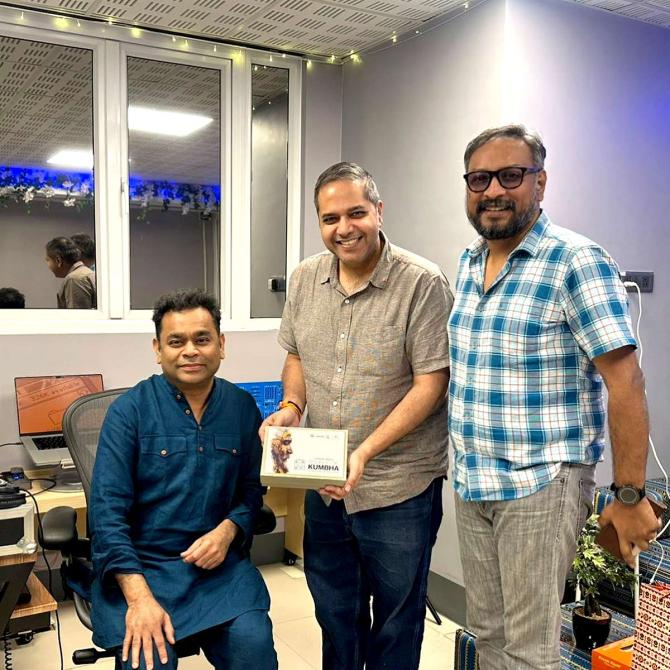
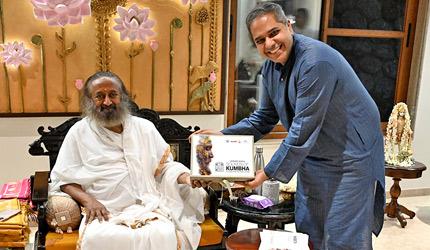
Deepak reveals the story behind the picture: 'I was working with Rahman sir on a lot of projects, and joked with him that every year has now become an 'e-mail year' -- Sir, we got a nomination... Sir, we got another nomination.
<'Last year I was nominated for Ricky's album, and this year it's this album. So sir laughed and said, 'Oh, you're on a roll, bro!'
'I was working on an upcoming project then, and I told him Siddhant was nearby and would love to meet him, he's a big fan. Rahman Sir said, 'Yeah, no problem, ask him to come.'
'So Siddhant and I went in and presented him with a small box -- not exactly a gift box, but more like a token of love from the Sounds of Kumbha team.' Photograph: Kind courtesy PA Deepak/Instagram
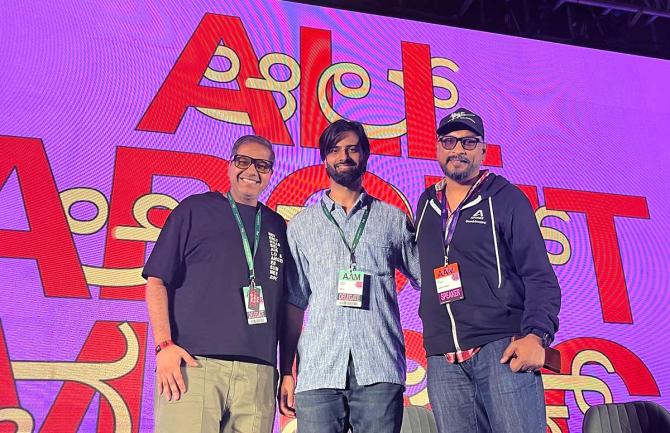
Grammy-winning mixing engineer and record producer PA Deepak was delivering a speech at BITS Pilani when the Grammy nomination was announced.
"It was insane," he recalls, about sharing the historic news with 3,000 plus students.
For Deepak, who has also worked with A R Rahman and won a Grammy certificate of honour for Slumdog Millionaire, every album and nomination is special.
"We never make music with the goal of getting nominated," he clarifies. "So when we were nominated -- whether it was Slumdog Millionaire, Ricky Kej, or any of our albums -- it always came as a surprise. Each album is created step by step, like nurturing a baby.
"Working with Rahman sir for so many years has taught us to listen to everything as musically as possible."
"For example, as Raghav mentioned about the temple bell -- musically, it must match the pitch of the song. We can't use anything that's off-pitch. That attention to detail, listening to every element with musical precision, is my forte.
"Personally, I enjoy rhythm-heavy songs, but I also love something like Balakrishna, which has its highs and lows. Music shouldn't feel like one continuous flow of the same emotion. It needs variation -- rises, dips, and contrasting textures. That's why this album shifts from the trance energy of Durga to the gentleness of Balakrishna, and then to Kanika's Legend of Kumbha.
"We call it Sounds of Kumbha, but the Mahakumbh is far too vast to capture with just a few instruments or artists," Deepak shares, while adding how the album is one of its kind.
"We're grateful that so many musicians from around the world contributed to it with their whole heart."
The story of Kumbh
For Raghav, the most exciting part was to compose for the track Colors of Kumbh in which he got to sing and compose.
"I was wearing different hats -- not just a music producer, but also a songwriter. For me, that was really fulfilling," he says.
"Playing instruments alongside such amazing artists was another highlight," he adds while explaining how it transported him back to college.
"When you get to share studio time with someone like Jim Kimo West -- he's on the guitar and you're on the bass -- it feels incredible. It took me back to my university days when I used to play in bands. Jamming with great musicians brought that same energy back.
"In my usual work -- be it films, studio sessions or advertising -- everything has become quite disjointed. But this album was completely different. It felt organic. We jammed a lot, exchanged ideas constantly, and the whole process was like a conversation between artists. Honestly, it was the most fun I've had in a long time while making music.
"It was not just about creating tracks; it was also about storytelling, like why do we celebrate the Kumbh in India -- the history," Raghav says.
What Worked For Sounds of Kumbha
According to Deepak, who has closely followed the Grammy awards, the album had all the ingredients required to make it a global phenomenon.
"When you look at songs like Jai Ho or RRR's Naatu Naatu, their chances of winning came from diversity and the fresh musicality they brought. Hollywood produces so many scores every year, yet Jai Ho stood out because it ticked all the right boxes.
"I've been a Grammy voting member for about 18 to 19 years now, and from my experience, I can say that there is much more diversity today. In our own album, for example, you have a devotional track like Balmukunda and then something completely different like the Durga Trance, which is incredibly powerful. Raja Kumari performed brilliantly on that track, showcasing Durga's energy in a modern trance form.
"This album carries so many different energies and moods, and that variety gives it real strength. Just like when I mixed Rockstar, it wasn't only rock; it had many layers. Similarly, this album has a wide spectrum. People who don't enjoy fast music may connect with the slower tracks, and vice versa."
Photographs curated by Satish Bodas/Rediff










 © 2025